Art galleries
Open storage is showing visitors that care belongs in the gallery too.
By dismantling the walls between the public gallery and the private archive, institutions are inviting visitors to witness the patient, essential labor of conservation. Open storage transforms the museum from a static display into a living laboratory.
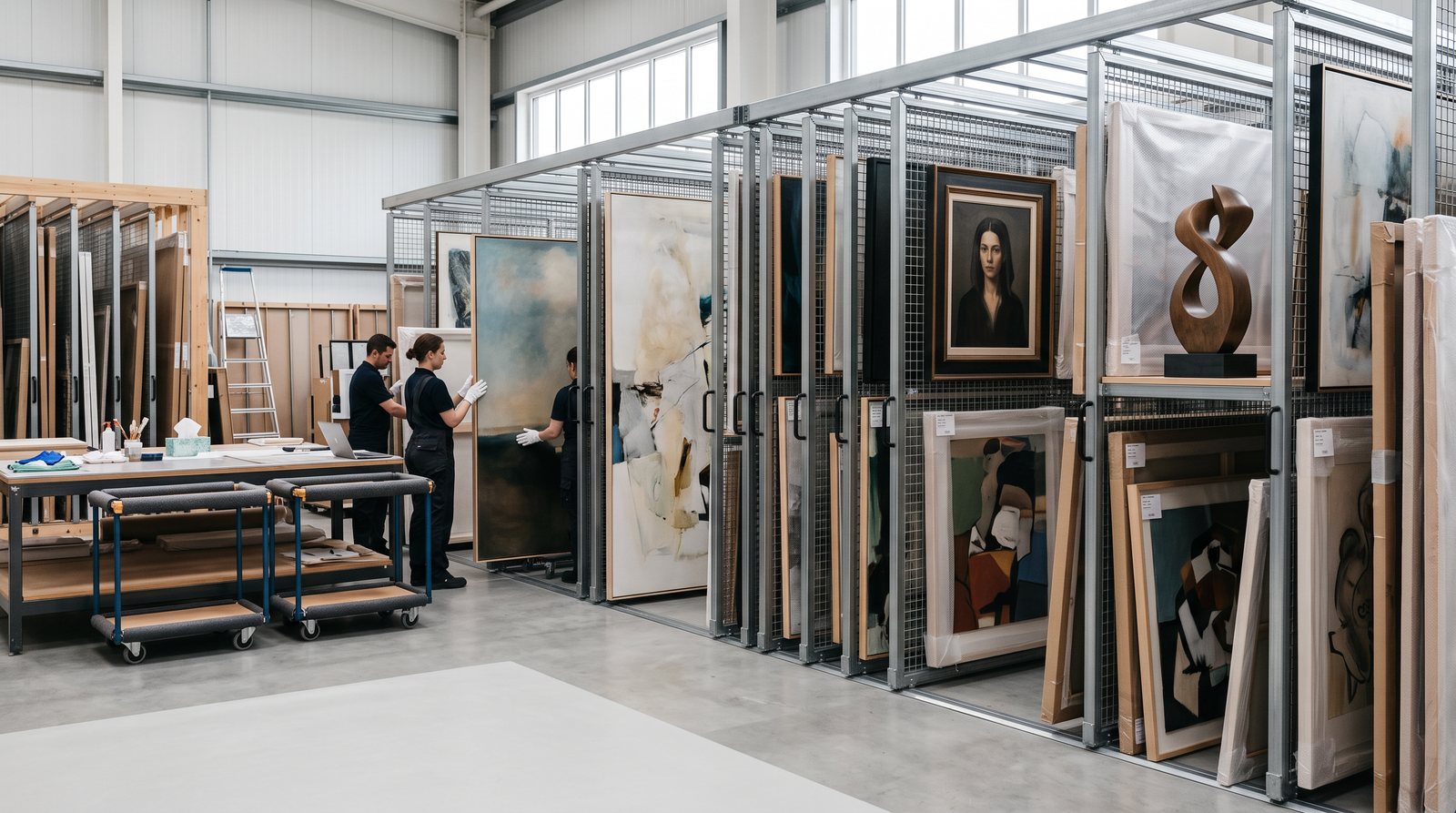
Most visitors to a major art gallery see only a fraction of the institution’s holdings. The "permanent collection" is, in reality, a rotating selection, a curated sliver of a much larger whole that exists in the shadows of basement vaults and off-site warehouses. For decades, the professional standard was one of strict separation: the gallery was for the public, and the storage was for the objects and their caretakers. This arrangement maintained a certain mystique, presenting art as a series of finished, untouchable masterpieces. However, this separation also obscured the fundamental reality of the museum—that it is not just a place of display, but a massive, ongoing project of preservation. The racks and crates were treated as a backstage necessity, something to be hidden away to maintain the illusion of a seamless aesthetic experience. But as the role of the museum evolves, the walls of the vault are beginning to turn into glass.
The shift toward open storage represents a profound change in the philosophy of cultural stewardship. It is a move away from the museum as a "treasury"—a locked box containing rare jewels—and toward the museum as a "laboratory" or a "study center." By opening the archive, institutions are acknowledging that the value of a collection lies not just in the objects themselves, but in the knowledge and care that surround them. This transparency demystifies the curatorial process, showing that every object on display is the result of a deliberate choice, and every object in storage is a potential future story. It replaces the static authority of the gallery with a more dynamic, inquiry-based model of engagement. Visitors are no longer just passive observers of a finished narrative; they are invited to witness the raw material of history and the active work required to keep it from fading.
Visually, open storage offers a different kind of pleasure than the traditional white-cube gallery. In a gallery, space is a luxury used to isolate and elevate individual works. In storage, the aesthetic is one of density and rhythm. There is a quiet, industrial beauty in the sight of hundreds of frames aligned on sliding metal racks, or the repetitive geometry of acid-free boxes stacked on high-density shelving. The colors and textures of different eras and styles sit side-by-side, creating unexpected juxtapositions that would never occur in a chronologically organized exhibition. A 17th-century landscape might lean next to a 20th-century abstract, linked only by their size or the requirements of their storage medium. This density suggests the true scale of human creativity and the immense responsibility of the institution to hold it all in trust. It is a visual manifestation of a "working" collection.
Perhaps the most significant aspect of this trend is the way it makes the labor of care visible. In a traditional setting, the work of registrars, conservators, and art handlers happens behind closed doors. In an open-storage facility, this labor becomes part of the public experience. Visitors might see a conservator cleaning a surface under a microscope, or a team of handlers carefully transferring a sculpture into a custom-built crate. This visibility transforms care from a technical background task into a core value of the institution. It teaches the public that art is fragile and that the survival of these objects depends on a continuous, multi-generational effort. When visitors see the patience and precision required to maintain a single painting, their relationship to the entire collection changes; the objects become more than just images—they become physical entities that require protection and respect.
Open storage also serves as a powerful tool for democratizing the museum. In a curated exhibition, the visitor’s attention is directed toward a few "highlights" selected by experts. While this guidance is valuable, it necessarily leaves out thousands of other perspectives. By providing access to the broader collection, open storage allows visitors to follow their own curiosity. A researcher interested in a specific, obscure technique, or a student looking for a minor work by a major artist, can find what they need without waiting for a thematic show. It allows for a more personal, idiosyncratic form of discovery. Someone might be drawn to a work simply because of its frame, or the way the light hits a particular corner of the rack. This freedom to look beyond the "masterpiece" encourages a more active, participatory form of spectatorship, where the visitor takes on the role of a researcher.
The physical realization of open storage requires a new kind of museum architecture. It is not enough to simply open the doors to a basement; the environment must be carefully engineered to balance public access with the strict requirements of preservation. This means designing climate-controlled zones that can handle the heat and humidity brought in by crowds, and lighting systems that provide visibility without damaging sensitive materials. Glass becomes a primary material—not just for windows, but for the walls of the vaults themselves. The architecture must communicate a sense of openness while maintaining the security and stability of a high-tech warehouse. This technical challenge often leads to innovative design solutions, where the infrastructure of the building is celebrated rather than hidden. The building itself becomes an instrument of transparency, a machine for both showing and saving, making the institution’s long memory visible.
Ultimately, open storage reminds us that a museum collection is a living organism, not a graveyard of dead objects. By making the "backstage" the "main stage," institutions are inviting the public into the heart of their mission. This transparency builds trust and fosters a deeper sense of collective ownership. When we see how an institution cares for the things we have entrusted to it, we are more likely to value the institution itself. The museum becomes a shared space of memory, where the past is not just preserved, but actively engaged with in the present. The racks, the crates, and the labels are not just tools of the trade; they are the physical evidence of our commitment to remember, and in an open gallery, they are a testament to the fact that care is the most important thing we can exhibit.