Art galleries
After dark, the gallery becomes a more generous kind of public room.
After-hours openings are less about extending retail hours than creating a different social rhythm for looking, talking, and lingering with art. By turning the interior into a lantern for the street, the gallery becomes a generous, accessible civic room.
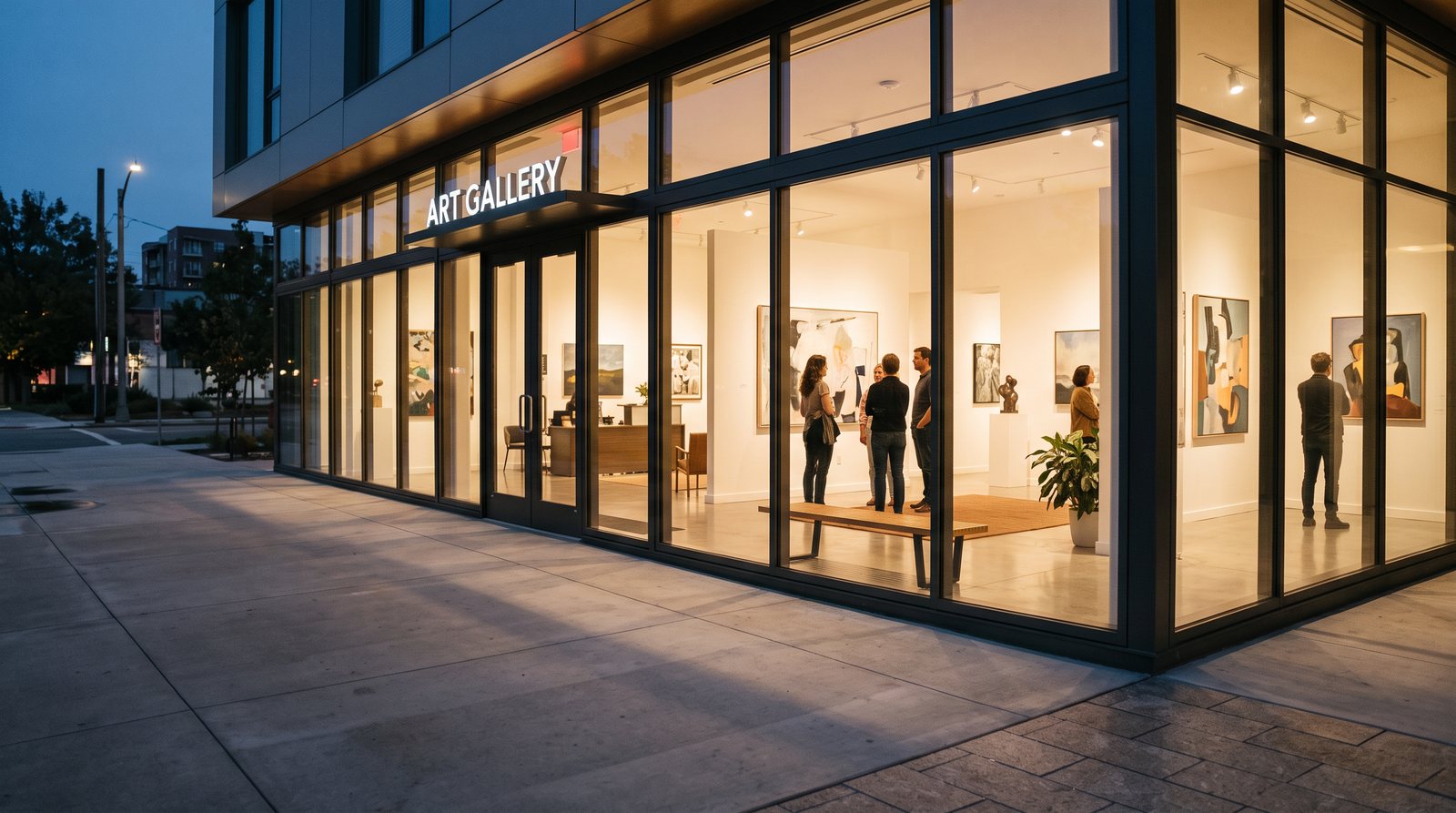
The transition of an art gallery from its daytime operations to an after-hours program marks a profound shift in the architectural and social identity of the space. During the day, the gallery functions within a retail-adjacent framework, where natural light and the hum of city business define the pace. However, as evening settles, the glass facade begins to behave with different optical properties. It ceases to be a transparent membrane and starts to gather reflections from the street, turning the interior into a temporary lantern. This luminescence serves as a beacon, making the internal contents visible to a demographic of passersby who might never enter during standard business hours. The gallery becomes a glowing vessel that projects the quietude of art into the darkness of the urban environment, bridging the gap between the private act of looking and the public life of the neighborhood.
This shift is less about extending commercial hours and more about creating a fundamentally different social rhythm for engaging with art. The daytime gallery visit is often framed by the constraints of a schedule—a lunch break or a weekend errand. In contrast, the evening opening invites a sense of lingering that is difficult to replicate under the glare of the midday sun. The social dynamics change as the pressure of the workday recedes, allowing for conversation that is both focused and relaxed. It is a time when the exhibition space becomes a "third place," a communal territory where the primary activity is the shared observation of creative labor. By altering the time of access, the institution signals a willingness to accommodate the varied lives of its local community, acknowledging that profound encounters with art often require a pace that the standard working day cannot provide.
The strongest after-hours programs maintain their intimate scale despite increased social activity. There is a delicate balance to be struck between community engagement and the necessity of preserving a space for the individual to stand with a work of art. In a well-designed evening opening, conversation collects at the edges of the room rather than swallowing the exhibition whole. This spatial arrangement ensures that the art remains the central focus. The room becomes a site of collective attention, where the presence of others validates the importance of the work rather than distracting from it. This controlled scale produces a unique atmosphere where the intensity of the viewing experience is heightened by the proximity of a like-minded public, creating a shared experience that is both silent and deeply social.
At the heart of this nocturnal transformation is the creation of an unusual kind of civic room. It is a space that is free, local, and intentionally open to curiosity without demanding specialist knowledge from those who walk in. The evening hours often lower the psychological barrier to entry, as the formal atmosphere of the daytime gallery is replaced by the more casual, invitational glow of the "lantern" effect. For many, stepping into a gallery during the day can feel like an intrusion into a specialized domain, but the evening program offers a different kind of hospitality. It suggests that the art is there for anyone passing by, turning the sidewalk into a front row seat for the neighborhood’s cultural life. This accessibility is about how the room communicates its purpose to the street, offering a moment of visual reflection to anyone willing to stop and look.
The phenomenology of looking at art changes significantly under artificial lighting and the surrounding darkness. In the evening, the external world is largely obscured, focusing the viewer’s attention entirely on the lit surfaces within the gallery. This narrowing of the visual field creates a sense of intimacy and focus rarely achieved in the broad light of the day. The textures of a painting, the shadows of a sculpture, and the precise edges of a photograph are rendered with new clarity. The glass of the gallery, now a dark mirror, occasionally catches the movement of a passing car or the silhouette of a pedestrian, reminding the viewer of the city’s presence without disrupting the stillness of the room. This interplay between interior light and exterior shadow reinforces the gallery’s role as a sanctuary, a place where time slows down even as the city continues its relentless pace outside.
A well-timed after-hours program does not make art more exclusive; rather, it provides the neighborhood with a new way to meet it. By turning the gallery into a public room lit from within, the institution asserts its place as a durable part of the city’s infrastructure. It becomes a landmark not just for its contents, but for the way it contributes to the safety and vibrancy of the street at night. A lit gallery provides a sense of passive surveillance and communal warmth, making the surrounding area feel more inhabited and cared for. This civic contribution is a vital part of how a gallery earns its place in a local ecosystem. The "lantern" is not just for looking at art; it is a sign of life, a signal that the culture of the neighborhood is active and welcoming even after the shops have closed and the offices have emptied.
Ultimately, the success of these programs lies in their ability to treat the gallery as a living part of the urban fabric. The transition to a nocturnal "lantern" is a deliberate act of design that considers the emotional and social needs of the audience as much as the physical requirements of the art. It allows for a different kind of expertise to emerge—one based on lived experience rather than academic training—as people bring their own perspectives to the work without the pressure to "understand" it in a formal sense. By embracing the different social rhythm of the night, the gallery ensures that its long memory is not just a collection of objects in storage, but a vibrant, active presence in the lives of the people who walk past its windows every day. The gallery becomes a place where a local culture learns what it can become, one evening at a time.