Fiction
The Key We Kept
A brass key, an old friendship, and one rainy harbour city force Mira Vale to decide whether a life can be chosen without first being fully understood.
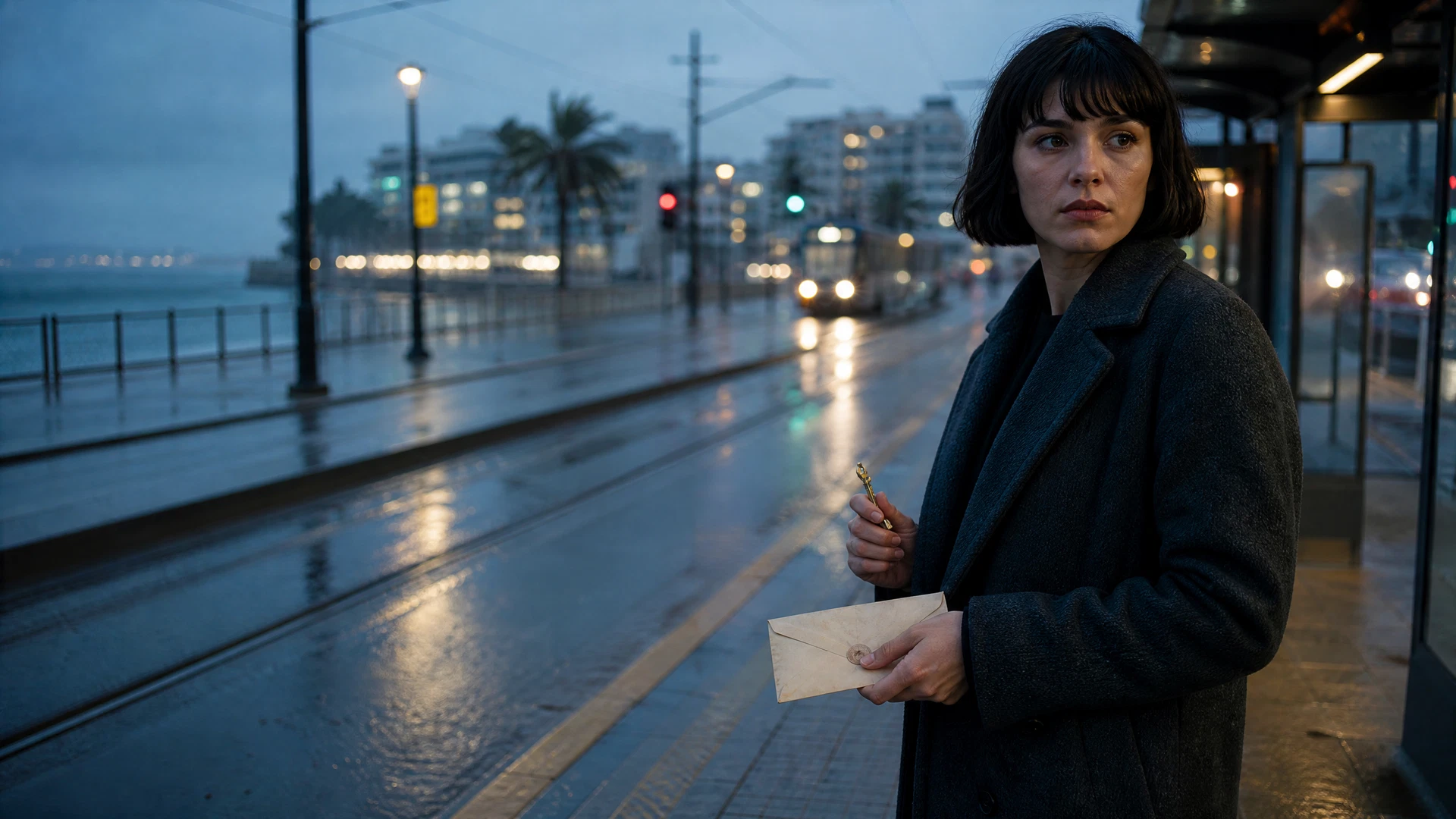
The silence of the studio was a physical weight, smelling of damp earth and isopropyl alcohol. Mira Vale sat hunched over her workbench, the soft glow of a magnifying lamp illuminating a fracture in a Qing Dynasty tea bowl. To anyone else, the crack was a tragedy, a jagged lightning bolt through celadon glaze. To Mira, it was a puzzle. She worked with a surgical needle, clearing away the ghost of a previous, failed repair. Her hands did not shake. They couldn't afford to. At twenty-eight, she had built a life out of the stillness required to mend what others had discarded as broken.
Outside, the harbor city was beginning its evening shift. The low moan of a ferry horn drifted through the cracked window, followed by the rhythmic clatter of the light rail. Mira didn’t look up. She was focused on the tension of her own breathing. Conservation was less about the clay and more about the ego; you had to disappear so the object could become whole again. It was a philosophy that served her well in her professional life, even if it was beginning to erode the edges of her personal one.
A week ago, she had officially declined a permanent position at a gallery in Melbourne. It was the kind of security most freelance conservators would kill for, yet she had let it slip through her fingers. Her mentor called her cautious; her mother simply sighed, the sound of disappointment crackling through the phone. Mira told them both the same lie: that her current backlog was too significant to abandon. The truth was harder to articulate. She couldn't tell the difference between wanting a new life and simply wanting to escape the gravity of a conversation she hadn't had the courage to start.
Theo had been gone for three months. The apartment they had shared for four years—a drafty, high-ceilinged space above a bakery—now felt like a museum of his absence. They hadn't fought. There was no climactic shattering of plates, no dramatic accusations. Instead, there had been a slow, cooling period, like a kiln losing its heat. The jokes became shorter; the shared meals turned into separate snacks eaten over laptops. Then, a brief email: *I’m taking the job in Berlin. Leaving Tuesday.*
He had moved out while she was at a weekend workshop in the valley. When she returned, his bike was gone from the hallway, and the communal bookshelf looked like a mouth missing half its teeth. He hadn't left a note then. Just a vacuum where a person used to be.
The bell above the studio door gave a sharp, metallic ring, startling her. Mira flinched, her needle slipping a fraction of a millimeter. She cursed softly, setting the tool down and rubbing her eyes.
"Delivery for Vale," a voice called out.
A courier stood at the counter, silhouetted against the streetlights. He held a small, padded envelope that looked entirely too light to contain anything of substance. Mira signed the digital pad with a distracted scrawl.
"Late night?" the courier asked, glancing at the shelves.
"The clay doesn't wait," Mira said, a rehearsed line she used to end small talk.
Once he was gone, she stood in the center of the room, the envelope heavy in her hand despite its size. She walked back to her desk, pushing aside a stack of invoices and her leather-bound booking diary. She tore the paper tab.
Inside was a heavy brass key, its bow ornate and worn smooth by years of friction. It fell onto the desk with a dull thud. Beside it was a standard white envelope. Mira opened it, her heart thumping an irregular rhythm. There was no letter. No explanation. Only a small, hand-drawn map on the back of a receipt from a cafe in Berlin, and a single sentence written in Theo’s cramped, architect’s hand: *Return this to the blue doorway.*
There was an address listed—a street in the old docklands district, three miles from where she sat. It was a place she didn't recognize, a part of the city that had been largely abandoned before the recent wave of gentrification.
Mira picked up the key. It was cold, carrying the chill of the evening air. She turned it over in her palm. It was an old-fashioned bit-and-barrel key, the kind that belonged to a heavy wooden door, not the sleek, electronic fobs of the modern city. Why had he kept it? And why, after three months of silence, was he asking her to give it back to a ghost?
She looked at the shelves lining the walls. Rows of unfinished cups, their surfaces matte and grey, waited for the fire. Everything in the room was in a state of becoming or a state of repair. She felt a sharp pang of resentment. Theo had always been the one to move, to build, to leave. She was the one who stayed behind to glue the pieces back together.
She set the key down on the booking diary. The brass glowed under the lamp, looking ancient and out of place against the modern grid of her schedule. She thought about the job she had turned down, the clean slate she had feared. The studio felt smaller now, the shadows stretching toward her. The disciplined life she had constructed—the early starts, the precise movements—suddenly felt like a cage. She reached for the tea bowl, but her hand hesitated. The fracture didn't look like a puzzle to be solved anymore. It looked like a warning.
Mira switched off the magnifying lamp. The room plunged into a soft, blue-grey twilight, the only light coming from the streetlamp outside. She stood there for a long time, listening to the city breathe, her gaze fixed on the small, heavy object on her desk. The key was a bridge he had thrown across the ocean, and despite herself, she felt her fingers twitching with the urge to reach out and cross it.
She wouldn't go tonight. She was a woman of routine, of schedules and safety. But as she locked the studio door and stepped out into the cool harbor air, the weight of the key seemed to follow her, a phantom presence in her pocket, demanding a conversation she was no longer sure she could avoid.
The silence in the apartment had a texture now, something thick and granular that settled over the furniture like fine kiln dust. Mira stood in the entryway, listening to the hum of the refrigerator. For three years, that hum had been the baseline to a soundtrack of Theo’s existence: the rhythmic thud of his running shoes, the sharp click of the kettle, the steady murmur of his voice on work calls. Now, the refrigerator hummed alone, a solitary performer in a theatre that had gone dark. She didn’t turn on the light. The city outside provided a bruised purple glow, casting long shadows across the hardwood.
She walked toward the kitchen, her steps deliberate. As a ceramics conservator, she understood the physics of fragility. She knew exactly how much pressure a hairline fracture could withstand before it became a clean break. Yet, standing in the center of their shared living room, she felt clumsy. Theo’s room was a dark rectangle at the end of the hall, the door left slightly ajar. She knew she would find it scrubbed clean, the mattress bare, the air smelling of lemon-scented floor wax.
On the dining table sat the envelope. It was a heavy, cream-colored stock, the kind Theo used for the rare occasions he sent physical mail. Beside it lay the brass key, its teeth jagged and unfamiliar. Mira sat down, the wood of the chair cool against her thighs. She picked up the key. It was heavier than it looked, the metal cold enough to sting. She turned it over in her palm, tracing the circular bow and the long, slender shank. No markings, no brand name, no room number. Just the dull weight of brass.
She picked up the envelope again. She had already spent the previous evening holding it up to the light, hoping for a watermark or a faint impression of a pen’s tip. There was nothing. The paper was stubbornly, aggressively blank. Theo was a man of few words, but this was a new economy. To move to London without a goodbye, to leave a key to a "blue doorway" at an address he hadn't bothered to write down—it was a riddle that felt less like a game and more like a sentence.
"Why the blue door, Theo?" she whispered. The sound of her own voice was too small for the room.
She thought about the job offer she had turned down in Seattle. The recruiters had offered a senior position at a prestigious museum, a relocation package to a city where the rain didn't feel like a personal affront. She had told them she had "unfinished projects" here. It wasn't a lie. A Tang dynasty horse on her workbench required another month of stabilization. But the real project was the silence that had grown between her and Theo. It had started as a series of small, missed connections—a dinner cancelled, a joke that didn't land. They had become like two pieces of pottery fired at different temperatures; they looked the same on the shelf, but their internal structures were no longer compatible.
She moved to the kitchen counter. The rain had started, a soft drumming against the windowpane that blurred the lights of the harbour into shimmering smears of amber and red. She reached into the cupboard and pulled out two mugs. It was a reflex, a muscle memory she hadn't yet unlearned. One was a stoneware prototype she had thrown, glazed in celadon. The other was a bright blue mug Theo had bought at a garage sale because the handle fit his thumb.
She set them both on the counter. She filled the kettle, the rush of water loud in the quiet. As it boiled, she stared at the empty chair at the breakfast nook. That was where Theo usually sat, his long legs tucked awkwardly under the table. They used to talk about everything—museum board politics, the best ramen in the city, the terrifying prospect of their thirties. Then, the topics had narrowed. They talked about the weather. They talked about the rent. The cost of their silence wasn't a sudden explosion; it was a slow erosion, a gradual thinning of the air until they were both gasping for something they couldn't define.
Mira poured the hot water into her stoneware mug. She left the blue mug empty, but she didn't put it back in the cupboard. She carried her tea to the window. She had spent the afternoon at the library, looking at old maps of the harbour district, searching for "blue doorways." The city was full of them—grand navy arches, narrow cerulean service doors, weathered wooden gates faded to periwinkle. Without the address, the key was just scrap metal.
She wondered if this was Theo’s way of forcing her to look closer at the city, or if it was a final, cruel test of how well she knew him. Had he ever mentioned a blue door? She replayed their conversations in her mind, sorting through them with the same care she used to catalog shards from an archaeological dig. She looked for a hint, a fragment of a memory, a stray comment about a specific street. Nothing came to the surface.
The tea was bitter, but she welcomed the heat. She thought about the difficult conversation she hadn't had—the one where she asked him why he was pulling away, or the one where she admitted that the thought of him leaving made the city feel like a hollowed-out shell. Instead, she had remained professional, polite, and devastatingly quiet. She had mended ancient vases while her own life developed cracks she refused to acknowledge.
She looked back at the table, at the key and the blank envelope. The rain intensified, the droplets racing down the glass. The empty chair seemed to grow larger, a physical manifestation of the space Theo had occupied. She realized then that she wasn't just looking for a door. She was looking for a way to undo the silence. She reached out and touched the cool glass, her reflection ghost-like against the dark city. The key was in her pocket now, a small, hard lump against her hip. She didn't know where the blue doorway was, but she knew she couldn't stay in this apartment, surrounded by the ghosts of conversations they never had. The cost of their silence was this: a key with no lock, a message with no words, and a kitchen where two mugs sat on the counter, but only one was warm.
The ferry engine hummed a low, rhythmic thrum that Mira felt in the soles of her boots. She stood on the open upper deck, the wind whipping her hair, smelling of salt and the cooling late-afternoon air. Behind her, the city’s skyline was a jagged silhouette in the orange flare of the sun. Ahead lay the northern harbor, where villas gave way to industrial docks.
In the pocket of her wool coat, her fingers traced the cold ridges of the brass key. It felt like a fossil, something pulled from a different era. Theo had left it on the kitchen island inside a plain white envelope with only a scribbled note: 14 Lower Reach. Please.
Mira had spent three years in a laboratory, using surgical scalpels to piece together shattered Ming porcelain. She understood the physics of a break—how tension built until a material could no longer hold. But Theo’s departure hadn't been a clean break. It had been a slow, silent delamination, a gradual peeling away of layers until one morning his space in their apartment was simply empty.
The ferry slowed, water churning as it approached the pier at Lower Reach. This wasn't a place Mira had ever visited with Theo. Their lives had been mapped in the university and the city center. This area was grit and shadow, where the tide left behind rusted chains and slick green moss.
As she stepped onto the wooden planks, the silence of the suburb hit her. It was a different quiet than the one Theo had cultivated. His silence had been heavy, a presence at the table. This was merely the stillness of a place the city had forgotten to modernize.
Lower Reach was a steep tangle of streets. Mira climbed past warehouses and a boatyard. The smell of resin reminded her of the conservation lab—the place where she felt most at home. Turning down the job in Melbourne had felt like a failure of nerve. But standing here, she wondered if she had stayed because she wasn't finished with the ghost Theo had left behind.
Number 14 was a narrow terrace house held upright by its neighbors. Its facade was a faded grey, the paint peeling in long strips. But the door was a deep, vibrant blue, the color of a mid-summer ocean. It stood out against the grime, a deliberate anomaly.
Mira hesitated, the key feeling heavy. She looked at the envelope again. There was no name on the bell, just a small brass plate with worn numbers. Before she could knock, the door swung inward.
A man stood there, perhaps in his late sixties, wearing a navy sweater and spectacles. He looked at Mira, the key, and her face with recognition.
"You're Mira," he said.
Mira felt a jolt. "How do you know my name?"
The man stepped back, gesturing for her to enter. The hallway smelled of linseed oil. "Theo described you. The hands of a surgeon and the eyes of a hawk. I’m Elias."
Mira stayed on the threshold. "I didn't know Theo knew anyone here."
"Theo spent a lot of time here lately," Elias said. "He was helping me catalog marine instruments—sextants and chronometers."
He led her into a cluttered room at the back. Tables were piled with brass instruments reflecting a desk lamp. Mira saw a 19th-century compass with a stuck needle.
"He told me he was leaving," Elias continued, buffing a brass telescope. "He said he couldn't stay in the apartment anymore. Not because of you, Mira. Because he felt like he was becoming part of the furniture. He was afraid you’d try to fix him, too."
The words stung, a needle-prick to her chest. Mira looked at her hands. She had spent years perfecting the art of making the broken seem whole. She had thought her silence was respect, a way of giving him space. She hadn't realized he saw it as clinical observation.
"Why the key?" Mira asked.
"This house belonged to his grandfather," Elias explained. "Theo inherited it last year. He didn't tell you?"
Mira shook her head. The fractures were deepening.
"He wanted to sell it but felt it was a betrayal—a secret life he wasn't ready to share. He asked me to keep an eye on it until he decided what to do. Then, two weeks ago, he came by and said he was going to London. He gave me his set, but he said there was one more. The one from his nightstand. He wanted you to bring it back here."
Elias paused. "He wanted you to see the door. He painted it himself the week before he left."
Mira thought back. Theo had returned with blue stains she assumed were ink. She hadn't asked. She had been too busy restoring a cracked celadon bowl, focusing on the past while the present was being repainted in front of her.
"He didn't want to escape a conversation," Mira said, the realization settling like a cold weight. "He wanted to give me the ending I wouldn't let him have."
"Maybe," Elias said. "Or maybe he just wanted you to know that some things are worth keeping, even if you can't live in them anymore."
He held out his hand. Mira looked at the key—brass worn smooth by Theo’s touch. She placed it in Elias’s palm. The transaction felt final, a physical shedding of a burden.
She left the house and walked back toward the pier. The sun had dipped, leaving the sky a bruised purple. The ferry was waiting, its lights reflecting in the water.
As the boat pulled away, Mira stood at the stern, watching the blue door vanish into the shadows. She thought about the job in Melbourne and the silence she had mistaken for peace. The city lights twinkled in the dark. She wasn't fixed, and neither was the story of Theo. But as the salt spray hit her face, she felt the first stirrings of a different movement—not an escape, but a departure.
The train to North Head smelled of damp wool and old coffee. Mira watched the city’s glass spine dissolve into the low-slung, weather-boarded sprawl of the coastal suburbs. Outside, the sky was a bruised purple, the heavy light of a coming storm hanging over the harbour.
Mira’s thumb traced the brass key, a puzzle she had treated like a hairline fracture in a Ming vase. Theo was not a man of grand gestures, but of quiet retreats. When they lived together, his presence was a series of soft footfalls and the hum of a kettle. His departure had been the same: a slow fading of light until the room was simply dark.
The address Theo had left was in a coastal pocket not yet scrubbed clean by gentrification. Mira stepped off the platform and felt the wind immediately—a raw thing smelling of rotting kelp and diesel. She walked past a closed-up bait shop and bungalows with overgrown lawns. Finally, she turned onto a cul-de-sac that ended at a cliff edge. And there it was.
Number 42 was a narrow cottage tucked behind wind-bent tea trees. The doorway was the exact shade of a deep-sea bruise—a weathered, peeling blue that looked forgotten. Beside the stone steps, a massive rosemary bush had gone wild, its woody branches spilling over the path. As Mira approached, her hem brushed the needles, releasing a sharp, medicinal scent that cut through the salt.
She stood before the door for a long minute, her heart a frantic bird. She thought about the job in the city she’d turned down. She had told herself she stayed because the museum needed her, but standing here, she realized she had stayed because she was waiting for the conversation Theo hadn't given her.
The brass key slid into the lock with a smoothness that surprised her. With a soft click, the mechanism yielded.
The air inside was still and smelled of sawdust and linseed oil. It wasn't a home, but a single workshop. Mira stepped in, her boots echoing on the plywood floor. The space was mostly empty, save for a long workbench under a salt-crusted window. Arranged with a precision that mirrored Mira’s own workspace were rows of small, misshapen objects.
They were ceramics, but not the kind she spent her days preserving. These were crude, hand-pinched bowls and lopsided cylinders, scorched and uneven. They were failures. Dozens of them. In the center of the bench sat a small, portable cassette player and a single tape. A yellow sticky note was pressed to the plastic: *For the conservator.*
Mira sat on the stool. Her hands shook as she pressed play. The machine whirred, and then there was the sound of a throat being cleared. Theo’s voice was thinner than she remembered.
"I knew you'd find the door, Mira," he said. There was a long pause, the sound of a match striking. "You’re too good at finding the cracks to miss this one."
Mira closed her eyes. The sound of him was so sudden it felt like he was standing in the room.
"I didn't leave because I was bored," the voice continued. "I left because I spent three years watching you fix things that were broken long before we were born. You’d spend ten hours with a magnifying glass, putting a bowl back together, and I’d sit in the kitchen wondering if you were looking at me the same way. Like I was a project. Like I was something that needed to be stabilized."
Mira flinched. The accusation was quiet, but it landed with the weight of a hammer.
"I tried to make these," Theo said, and she could hear the faint clink of him touching a lopsided bowl. "I wanted to understand the pull of it. The clay, the firing. I wanted to see if I could make something that didn't need to be saved. But everything I touched just... warped. I realized I couldn't be the person who stays in the lab, Mira. I’m the person who breaks things. And I couldn't bear the thought of you spending the next forty years trying to glue me back together."
The tape hissed with silence. Mira looked at the row of scorched bowls. They weren't just failures; they were attempts at a language he didn't know how to speak. The estrangement hadn't been a lack of love; it had been a lack of breath. He had felt suffocated by her competence, by her need to mend every jagged edge.
"The key is for the landlord," Theo’s voice returned, softer. "The lease is up on Friday. I just... I wanted you to see the mess I made. I wanted you to know that it’s okay for some things to stay broken. You don't have to fix this, Mira. You just have to leave the key."
The tape clicked off. Mira reached out and picked up the smallest bowl. It was heavy, the glaze a muddy brown, and there was a thumbprint pressed deep into the rim. Theo’s thumbprint.
She didn't cry. Instead, she felt a cooling sensation in her chest, like a fever breaking. She had spent so long wondering what she had done wrong. She hadn't realized that her very nature—her meticulous, careful love—had been the thing he was running from.
She spent an hour in the room, not fixing anything. She just sat with the failures. When the light began to fail, she stood up and walked to the door. She didn't take a bowl. She didn't take the tape.
She stepped out onto the porch, the scent of rosemary rising in the damp evening air. The storm was finally breaking, a fine mist of rain beginning to fall. Mira reached out and pulled the blue door shut. She felt the weight of the brass key in her hand one last time before she tucked it into the rusted mailbox bolted to the siding.
It wasn't a reunion. It wasn't a tidy ending. But as she walked back toward the station, Mira realized she wasn't thinking about the job she’d turned down anymore. She was thinking about the difference between a fracture and a seam. And for the first time in months, she didn't feel the need to reach for the glue.
The light in the harbor city arrived in layers, a slow graduation from grey to pearl. Mira Vale stood at her workbench in the ceramics studio, the air holding the cool, clay-damp scent of the night. It was five-thirty in the morning, an hour where the city felt like a collection of quiet intentions. On the drying shelf sat a stoneware bowl, arrived three weeks ago in fourteen jagged pieces. Now, it was whole. The lines where the adhesive had cured were nearly invisible, a testament to her meticulous patience.
She reached out, her fingers hovering just above the rim. For years, she had thought of conservation as a way to undo time, to pretend that the breakage had never happened. But standing there in the first wash of dawn, she realized she had been wrong. The bowl wasn’t the same as it was before the fall. It was heavier now, weighted by the history of its collapse. It was a repaired thing, and in the specialized world of ceramics, that carried its own kind of permanence. To fix something was not to erase its trauma, but to give it a new way to exist.
Turning down the permanent job in the city to the north had felt like a failure of nerve. She had told herself she was staying because the studio needed her, but the truth was simpler. She had been afraid that if she moved, she would simply take her silence with her. She had spent a year avoiding a conversation with Theo, and for a long time, she had confused that avoidance with a desire for a new life. She had thought that by changing her coordinates, she could change her character.
Theo was in London now, or perhaps Berlin; his last postcard had been postmarked from a station she couldn't pronounce. The brass key he had left her—the one she had finally returned to the blue doorway in the old quarter—had been a request for a different kind of conservation. The doorway hadn't led to a secret room. It had been the entrance to a communal garden they used to visit when they were nineteen, a place they had both forgotten. Returning the key hadn't been an act of closure; it had been an act of acknowledgement. He had wanted her to see that the places they had inhabited together still existed, even if they no longer lived in them. Shared history was a landscape, not a prison.
Mira picked up a fine-bristled brush and began the final dusting of the bowl. Her hands were steady. The tremor from Theo’s departure had vanished, replaced by a groundedness she hadn't expected to find. She had spent so much time worrying about being ‘known’—about the weight of someone else’s expectations—that she had forgotten the quiet thrill of being present in her own skin. She was no longer looking for herself in the reflection of others.
The studio began to wake up. The kiln hummed, a vibration she felt in her feet. The harbor’s sounds—the groan of a ferry, the cry of a gull—drifted through the walls. She thought about the permanent job offer again. The recruiters had promised a ‘fresh start,’ a clean break from the messy parts of herself. But Mira didn't want a fresh start. She wanted the cracks. She wanted the history of the breakage to be part of the design.
She walked over to the large industrial window that looked out toward the water. The old glass distorted the marina’s masts into long curves. She gripped the latch. The stiff metal yielded with a sharp click. She pushed the window outward, and the city rushed in.
Cold air, sharp with diesel and brine, filled the studio, stirring the dust motes and cooling her skin. Mira leaned against the frame, looking out at the harbor. The sun was finally breaking through the clouds, hitting the water in a blinding sheet of silver. She wasn't waiting for a message anymore. She wasn't waiting for Theo to explain the silence. The silence wasn't a void; it was a space she was finally comfortable occupying.
She looked back at the workbench. The bowl sat there, humble and complete. She would pack it in tissue paper later today, send it back to a client who would likely put it behind glass and never touch it again. But for now, it was hers. She was here, in this city, in this light, and for the first time in a long time, the permanence of her life didn't feel like a cage. It felt like a choice. She had decided to stay, even when leaving was easier.
Mira picked up a small piece of sandpaper and began to smooth a tiny imperfection on the base of the bowl. The sound was a soft, rhythmic rasp, a counterpoint to the distant clatter of the city. She felt a sharp affection for the harbor’s refusal to be anything else. She had been so busy looking for a way out that she had forgotten to look at what was right in front of her. The beauty of the city wasn't in its perfection, but in its persistence.
As the clock on the wall ticked toward nine, Mira stood up and stretched. Her back ached slightly, a familiar reminder of the physical toll of her work. She looked at the bowl one last time, then at the open window. The harbor was now a hive of activity, the water churned into white wakes by the passing tugboats. The world was messy and beautiful, and she was in it.
She didn't reach for her phone to check for a message. She didn't wonder where Theo was or what he was thinking. Instead, she picked up the next piece on her list—a terracotta figurine with a broken wing—and began to look for the place where the pieces fit. The light in the studio was bright now, clear and unforgiving, and Mira Vale didn't look away. She just kept working. The wing would be difficult to align, the fracture jagged and old, but she had all the time in the world. She reached for her tweezers, her movements fluid and unhurried. Outside, the harbor sparkled, a vast, shifting map of possibilities, and Mira simply began.