Figure skating
Training makes the invisible parts of a jump visible.
In figure skating, a jump is often reduced to its final rotation, yet its success is determined by the invisible mechanics of the edge. Alina West explores how years of disciplined training transform raw force into the precise, silent language of the ice.
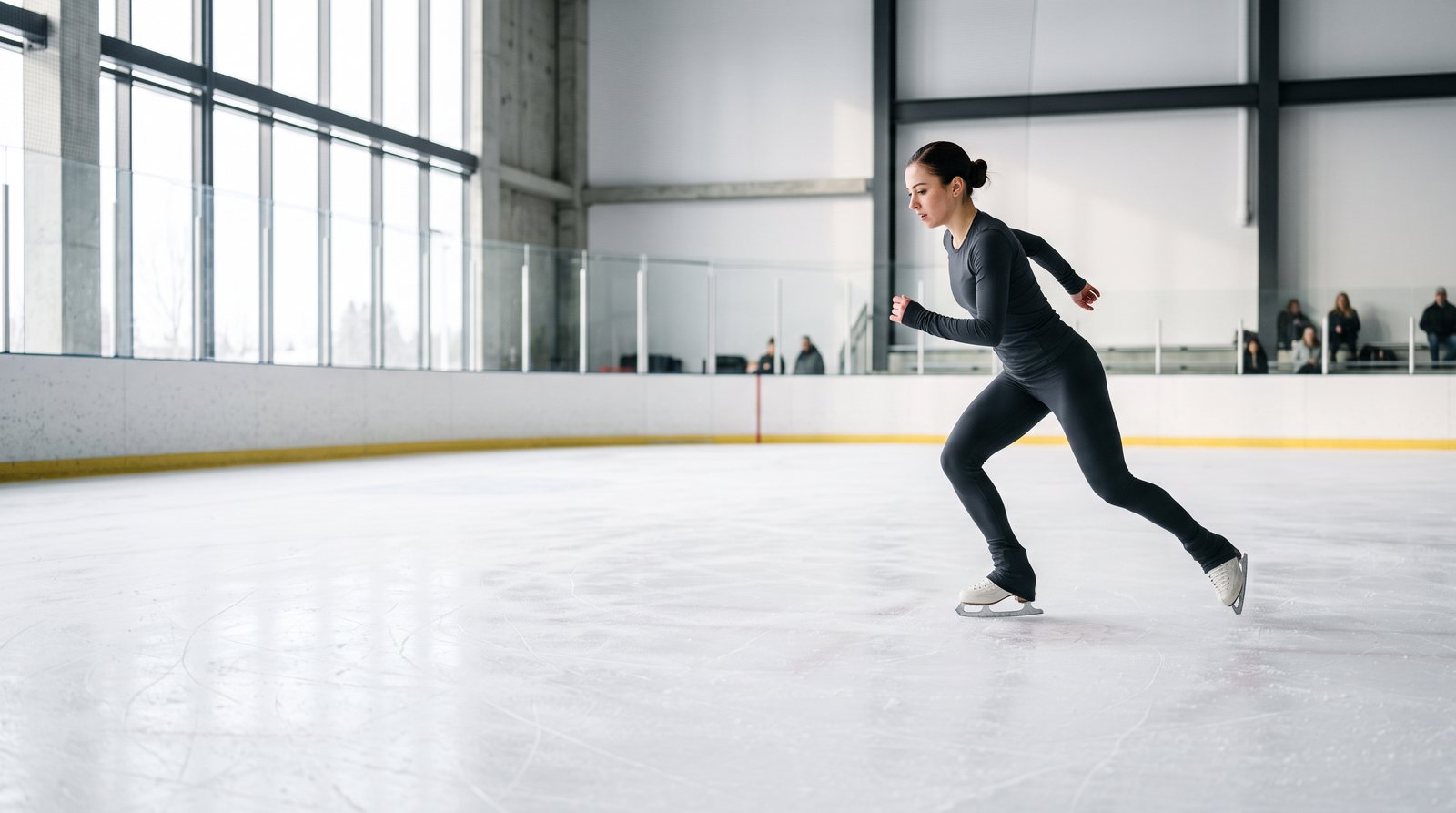
The figure skating jump is frequently misunderstood as a purely aerial event, a fleeting moment of defiance against gravity that begins and ends in the air. To the casual observer, the success of a triple Axel or a quadruple Lutz is measured by the number of rotations completed before the blade returns to the ice. However, for those who study the discipline of "Edge Work," the air is merely the consequence of what happens on the surface. The true narrative of a jump is written in the seconds leading up to the take-off, in the silent preparation that defines the skater’s relationship with the frozen ground. Training makes these invisible parts of the jump visible, allowing the skater to feel when the ice becomes a platform rather than a barrier.
At the heart of this preparation is the edge, the thin strip of steel that serves as the only point of contact between the athlete and the rink. A figure skating blade is ground with a concave groove, creating two distinct edges—inside and outside. The mastery of these edges allows a skater to generate power without the visible effort of a sprint. By leaning into the curve, a skater utilizes centripetal force, building momentum through deep, controlled strokes. This is the foundation of all technical prowess. When a skater prepares for a jump, the "invisible" work begins with the choice of edge. A fraction of a degree in the lean, or a slight shift in the pressure applied to the foot, determines whether the subsequent flight will be a soaring success or a faltering struggle.
The transition from the approach to the take-off is perhaps the most critical phase, yet it is often the least discussed. It requires a paradoxical combination of extreme tension and fluid relaxation. As the skater enters the final curve, the body must become a coiled spring, storing energy in the core and legs. This is where "invisible" training manifests most clearly. A skater must learn to read the ice through their feet, sensing the texture and temperature to adjust their timing. The take-off is a vaulting action where the momentum of the approach is redirected upward. The blade must bite into the ice at exactly the right angle, creating a temporary anchor that allows the skater to launch themselves into the rotation with absolute conviction.
Once the skater leaves the ice, the jump enters its most visible phase, but even here, the invisible mechanics of training are the primary drivers. The speed of rotation is governed by the conservation of angular momentum. By pulling the arms and legs tightly into the vertical axis, the skater reduces their moment of inertia, causing their rotational velocity to increase. This "snap" into position is a result of thousands of hours of off-ice conditioning, where the body is trained to find its center in an instant. The skater’s eyes remain fixed on a distant point, a technique known as spotting, which helps maintain orientation while the world spins. The invisible thread of focus is what keeps the axis straight, preventing centrifugal force from pulling the body out of alignment.
The air position itself is a study in controlled stillness amidst violent motion. While the skater is spinning at hundreds of revolutions per minute, every muscle must be engaged to resist the forces trying to pull the limbs outward. This is an active, high-tension posture that requires immense core strength. The "invisible" part of this phase is the skater’s internal map of their body in space. They must know exactly where their feet are, how their shoulders are leveled, and how much time remains before they must open up for the landing. This proprioceptive awareness is the silent partner of every successful jump, a sense developed through relentless repetition until the mechanics of flight become as natural as breathing.
As the rotation nears completion, the skater must prepare for the return to the ice, a transition that involves dissipating kinetic energy in a fraction of a second. The "check" of the rotation—the moment the skater extends their limbs to slow the spin—must be timed with absolute precision. If the check is too early, the jump will be under-rotated; if it is too late, the landing will be impossible to control. This is where "Edge Work" returns to the forefront. The landing is not a static event but a continuation of the flow. The skater must land on a clean back outside edge, using the knee and ankle as shock absorbers to smooth the transition from the vertical drop back into horizontal movement across the rink.
The beauty of a perfectly executed jump lies in its apparent ease, a quality that intentionally obscures the labor required to achieve it. This "invisibility" of effort is the ultimate goal of high-level training. When a skater glides away from a difficult jump with a serene expression, they are concealing the immense physical and mental strain of the preceding seconds. The discipline of figure skating is, in many ways, an exercise in editing—stripping away the extraneous movements and the visible signs of struggle until only the pure essence of the jump remains. It is a testament to the human capacity for refinement, where the most complex physical actions are polished into a single, seamless moment of grace that appears almost effortless to the untrained eye.
Ultimately, the study of jumps through the lens of "Edge Work" reveals that nothing in the sport is truly accidental. Every successful flight is the result of a thousand correct decisions made in the shadows of the practice rink. The "invisible" parts of the jump—the edge pressure, the muscle tension, the internal timing—are the true components of the athlete's art. By making these elements visible through training, the skater gains the power to command the ice, turning a cold, hard surface into a stage for the impossible. Alina West’s exploration reminds us that the most profound work is often the work that no one sees, the silent foundation of all visible triumphs. A jump rewards a considered study: give the mechanics and the silent preparation enough time to reveal their character.