Paddington dining
The London — Paddington pub on Underwood Street.
Situated on the quiet corner of Underwood and William Streets, The London Hotel has served as a quintessential Paddington local since 1875. Its heritage sandstone walls and lofty public bar offer a refined yet relaxed sanctuary for neighborhood life.
The London Hotel stands as a deliberate anchor at the intersection of Underwood and William Streets, a quiet retreat from the commercial intensity of Oxford Street. In Paddington’s dense grid of Victorian terraced houses, the pub functions as a primary landmark, its grand corner profile providing scale and orientation for the neighborhood. Unlike the more transient spaces of the main thoroughfare, The London possesses a weight that comes from over a century of operation. Its presence is marked by the arrival of locals who treat the building as an extension of their own domestic spaces. The building’s orientation allows it to catch the shifting light of the afternoon, signaling the transition from the working day to the social hours of the evening.
The origins of the site trace back to the mid-nineteenth century, with records suggesting the location began as a humble stone corner shop in 1857. By 1875, the structure had evolved into a formal tavern, reflecting the growth of Paddington as a residential suburb for Sydney’s expanding workforce. Throughout the late Victorian era and into the twentieth century, the London Tavern Hotel underwent various additions and renovations, including significant works in 1926 that refined its internal layout. These changes mirrored shifting social expectations, moving from the rough-hewn public houses of the gold rush to the more structured hotels of the Federation period. Despite these evolutions, the building has retained its essential character as a community hub, preserving physical evidence of its long history.
Architecturally, The London is an exemplar of the late nineteenth-century Sydney corner pub, a typology designed to maximize street frontage and visibility while providing diverse internal environments. The use of local sandstone connects the building directly to the geology of the Sydney basin, giving the facade a textured quality that has weathered the decades. The building’s design is characterized by confident proportions, featuring tall, arched windows that allow natural light to flood the interior—a feature that was both a practical necessity and a deliberate aesthetic choice to create an airy, welcoming atmosphere. The sturdy timber joinery further emphasizes the building’s utilitarian roots, even as the refined detailing around the entrances suggests a touch of the British flair that has long defined its identity.
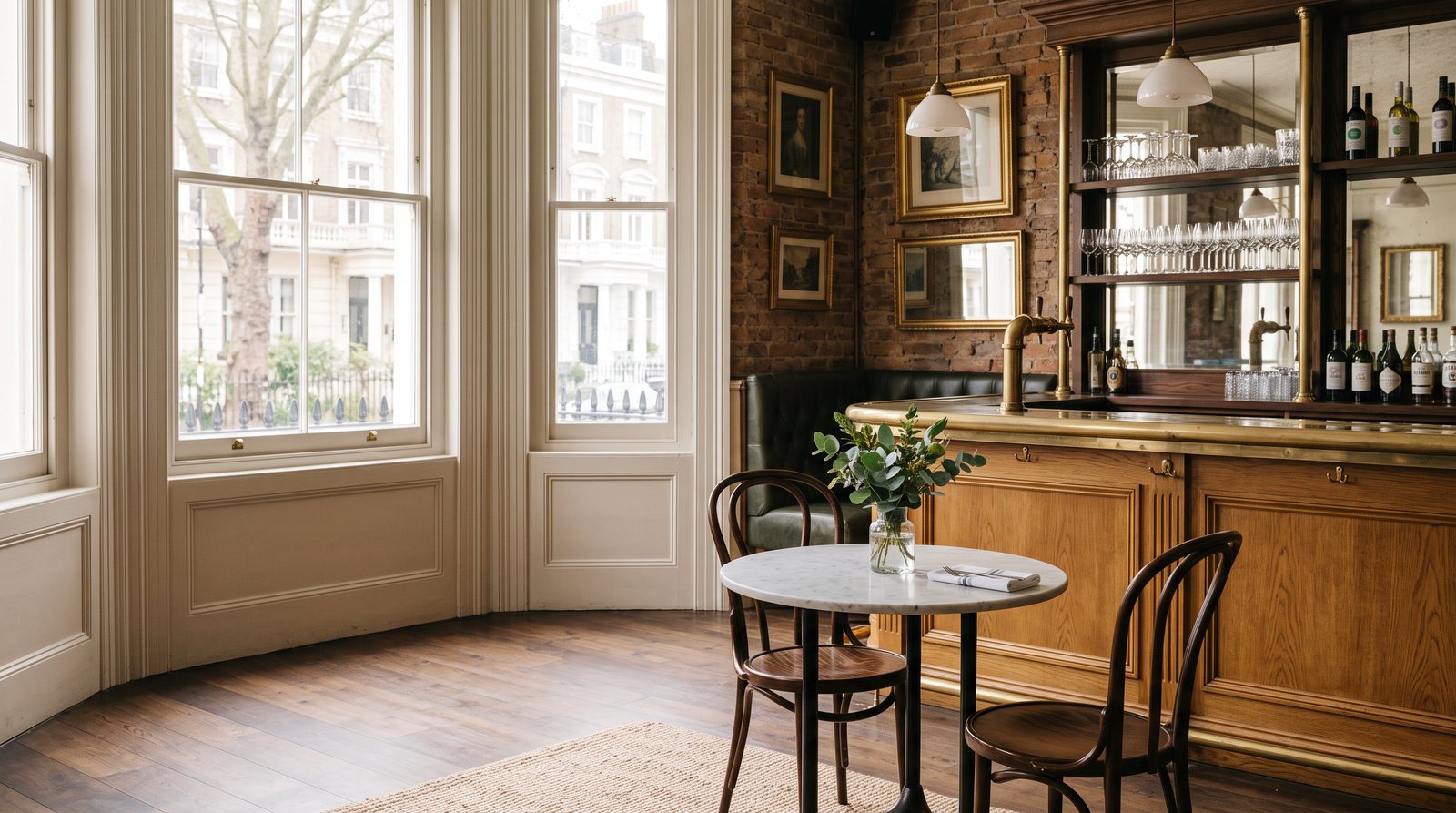
Entering the public bar is an exercise in scale and light, where the lofty ceilings and expansive windows create a sense of volume that is rare in the cramped residential quarters of Paddington. The interior layout is designed to facilitate different modes of social interaction, from the communal energy of the main bar to the more secluded corners where conversation can take a quieter tone. The materiality of the space—dark timbers, polished brass, and the cool touch of original stone—provides a sensory link to the past, grounding the visitor in the history of the room. This is not a space that demands attention through aggressive modernism; instead, it relies on the quality of its light to create an environment that feels both historic and contemporary.
The London’s relationship with Paddington is one of mutual definition; the pub anchors the suburb’s social life just as the suburb’s architectural heritage provides the pub with its context. Surrounded by well-preserved Victorian terraces, the hotel serves as a public living room for a community that often lives in compact quarters. The streets radiating out from the corner of Underwood and William are lined with the intricate ironwork and narrow frontages that define the area’s character, making the larger volume of the pub a necessary breathing space within the urban fabric. It is a place where the history of the neighborhood is not just remembered but actively lived, providing a reliable ground for the meeting of neighbors and the exchange of local news.
The upper levels of the hotel offer a different perspective on the building’s history, having transitioned from residential quarters to dedicated function spaces and dining areas. These rooms still retain a domestic scale, with their smaller windows and partitioned layouts recalling the era when the publican’s family and lodgers would have occupied the space. Today, these rooms are used for gatherings that range from the formal to the celebratory, yet they never quite lose the feeling of being inside a grand old house. The view from these elevated vantage points provides a unique look at the rooftops of Paddington, a sea of slate and corrugated iron that stretches toward the city skyline. This vertical separation allows the pub to function as a multi-layered institution for diverse social activities.
In the modern city, the role of the "local" has taken on a new significance as a "third place"—a social environment distinct from home and the workplace. The London Hotel fulfills this role with grace, offering a space that is neither entirely private nor aggressively public. The social fabric of the pub is woven from a diverse range of patrons, from long-term residents who remember the suburb before its gentrification to newer arrivals drawn by its heritage charm. This mix of people ensures that the atmosphere remains grounded, preventing the venue from becoming a mere museum piece. The British flair mentioned in its history is manifested not in kitsch decor, but in a certain understated hospitality and a commitment to the classic rituals of the pub.
The endurance of The London is a testament to the utility of good design and the resilience of community institutions. In an era where many historic pubs have been lost to corporate standardization, The London has managed to balance the demands of modern hospitality with the preservation of its heritage soul. It continues to operate as a functional piece of city infrastructure, providing food, drink, and social space to a neighborhood that values its history. The building stands as a keeper of Paddington’s collective memory, its sandstone walls having witnessed the transition of the area from a working-class industrial fringe to one of Sydney’s most sought-after residential enclaves. As long as there is a need for a quiet corner to wait out the afternoon, The London will remain a steady presence.