Studio practice
The quiet choreography of hands, paper, patience, and a very sharp crease.
A sharp crease is more than a line; it is a permanent decision in the life of a sheet of paper. In the studio, the intersection of geometry and patience reveals how a single square holds the potential for infinite structural complexity.
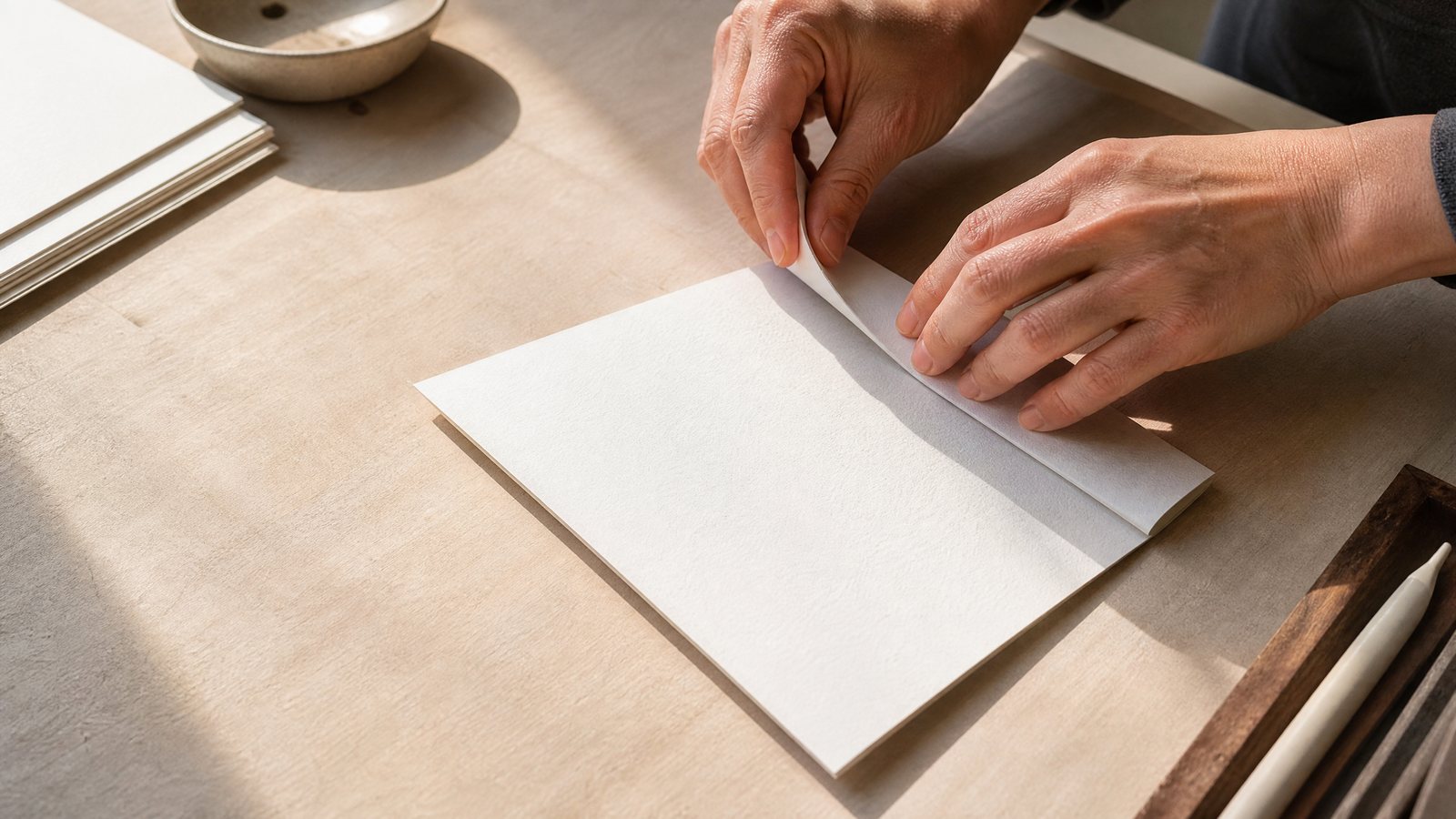
The studio of a paper artist is a sanctuary defined by silence and focused light. Here, the **choreography of creation** begins with the careful arrangement of a workspace. A flat, dark surface serves as the stage for the unfolding drama of geometry. Lighting is crucial; it must cast informative shadows across every new ridge without washing out the medium's subtle textures. Sora Finch operates with a deliberate slowness that contradicts the fast-paced digital world. Every movement is a rhythmic sequence preparing for the first contact between hand and paper. This is the **Hand / Fold** philosophy: that the quality of the finished object is inseparable from the quietude of the space.
To the uninitiated, paper is a simple commodity. But in advanced studio practice, it is a living material with a complex internal architecture. The choice of paper requires an intimate understanding of grain and tensile strength. Some papers possess a **memory** so sharp that a misplaced crease can never be erased, while others offer a forgiving, textile-like quality. The fibers—whether mulberry or wood pulp—determine how the sheet responds to the stress of a fold. In the Hand / Fold studio, the artist treats each square as a structural partner. The weight of the paper dictates the scale and complexity of the possible forms, from architectural studies to gossamer-thin models that mimic the delicacy of real leaves.
The first fold is a transformative event, a moment where the two-dimensional world is breached for the third. It requires a level of precision bordering on the mathematical, yet it is executed with a tactile sensitivity no machine can replicate. As the hands bring opposite corners together, the artist feels for the exact point of alignment. The **sharp crease** is the signature of this process, achieved through steady pressure and a decisive stroke of a bone folder. This initial line becomes the datum for every subsequent move, a permanent scar that redefines the geometry of the entire sheet. Even a fractional error here will propagate, compromising the **impossible balance** of the final work.
Patience in the studio is an active, disciplined engagement with the present. The choreography of hands and paper demands a mental endurance rarely found in modern life. As complexity increases, the number of folds can run into the hundreds, each requiring the same attention as the first. This is where patience manifests as a **meditative practice**. The artist must remain calm even when a difficult sequence threatens to tear the paper or when a structural collapse seems imminent. A profound psychological shift occurs during these long hours; the external world falls away, and the only reality is the relationship between the crease and the plane. This focus allows the maker to notice subtle changes in the paper’s resistance.
While the hands are the primary instruments, the practice is supported by a refined kit of tools. The **bone folder**, a smooth tool traditionally made from cattle bone, is the most essential companion. It allows for high-pressure creases without transferring oils from the skin to the paper. Rulers and drafting squares provide the necessary geometric rigor, ensuring every angle is true and every distance exact. However, the most important tool remains the artist's own sensory perception. The sound of the paper as it is folded—a crisp snap or a soft rustle—provides immediate feedback on the health of the fibers. This **sensory loop** allows the maker to listen to the material as much as they look at it.
Beneath the poetic surface of the folded form lies a rigorous foundation of mathematics. Every crease pattern is a map of geometric constraints, showing how a flat surface can be packed into a compact volume. The studio practice involves a constant dialogue between aesthetic beauty and the mathematical necessity of structural integrity. Concepts like **flat-foldability** are not just academic theories; they are practical rules governing whether a design will succeed. The artist must understand how vertices—points where multiple creases meet—distribute the internal stresses of the paper. This intersection of science and art gives the collection its unique character, showing that even the most delicate paper bird is governed by the same laws of physics that shape the largest bridges.
As the choreography nears its conclusion, the tension in the room changes. The final few folds are often the most difficult, as the paper has become thick with previous layers and internal resistance is at its peak. The artist’s hands must work with a combination of strength and extreme delicacy to bring the form to its final resolution. The completion of a work is the birth of a new object that holds the history of its creation within its folds. The finished piece stands as a testament to the hours of quiet labor, recording every decision made and every doubt overcome. The object now possesses a life of its own, ready to be moved by light and shadow.
The Hand / Fold philosophy represents a cultural movement back toward the **tangible**. In an era where complex structures are generated by algorithms, the act of folding paper by hand remains a powerful assertion of human agency. It is a reminder that some knowledge can only be acquired through the body, through the repetitive, patient interaction with a physical medium. The studio practice of Sora Finch is a defense of the slow, the quiet, and the precise. It suggests that profound innovations often come from ancient materials handled with new levels of care. By focusing on the choreography of the process, the artist elevates the craft into a **performance art**, where the final object is the evidence of a beautifully executed dance.
In the end, the sharp crease remains the most fundamental element, a simple line containing a world of meaning. It is the point where the artist’s will meets the paper’s nature, a permanent mark of deep concentration. As the light in the studio begins to fade, the shadows on the folded models deepen, highlighting the intricate networks of lines defining their form. These works are fragile, yet they possess a structural strength that belies their appearance. They are reminders that beauty and logic are not mutually exclusive, and that a single square of paper, when handled with enough patience, can become a gateway to the infinite. The quiet choreography continues, one fold at a time, ensuring the art of the sharp crease endures.