Orbital design
The most elegant satellite in the room is made from a single square of paper.
A single square of paper becomes a study in orbital efficiency, as designer Tomas Reed uses the ancient geometry of origami to solve the most complex deployment challenges of modern space engineering for his 'Folded Sky' series.
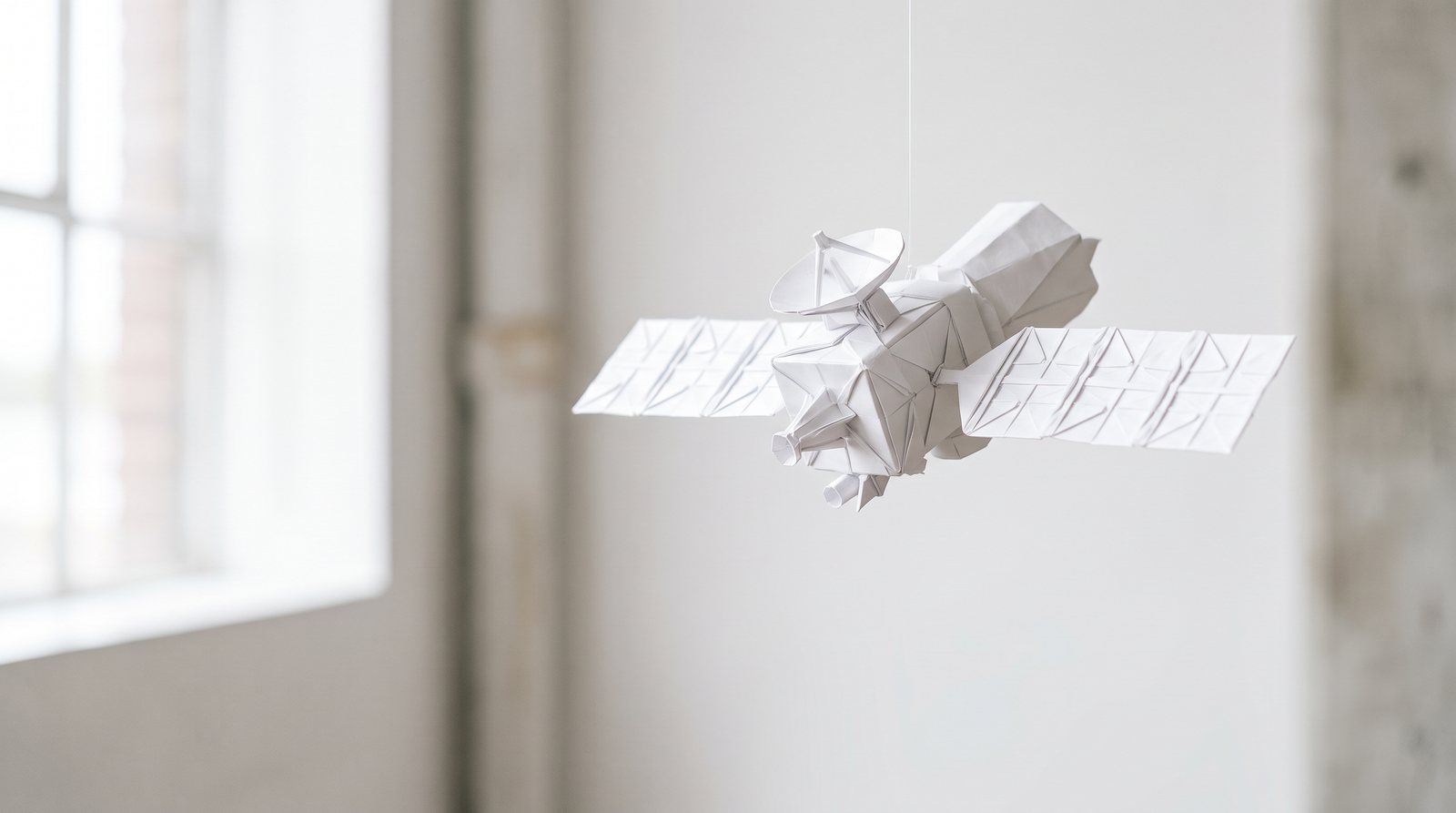
The intersection of traditional craftsmanship and modern aerospace engineering is nowhere more visible than in the delicate, geometric folds of a satellite model. At first glance, the work of Tomas Reed appears to be a study in fragility—a single square of paper transformed into a complex, multi-faceted structure that seems to defy the rigid expectations of orbital hardware. Yet, as Reed explores in his project, *Folded Sky*, the principles governing these paper models are identical to those required for the next generation of deep-space exploration. This convergence highlights how the ancient art of origami provides the mathematical solution to a very modern problem: how to pack immense, thin-film structures into the cramped confines of a rocket fairing. By focusing on the elegance of the single fold, Reed demonstrates that the most sophisticated solutions in space are often those that rely on the inherent properties of geometry rather than the brute force of mechanical hinges.
The philosophy of *Folded Sky* is rooted in the square. In traditional origami, the restriction to a single, uncut sheet of paper is a rigorous mathematical constraint that forces the designer to find efficiency within a closed system. For Tomas Reed, this serves as a perfect analogue for the mass and volume limitations of orbital launches. Every gram sent into orbit carries a significant cost, and every cubic centimeter of space inside a launch vehicle is precious. By applying the logic of paper folding to satellite design, engineers can create structures that are virtually two-dimensional during transit but expand into expansive, functional three-dimensional forms once they reach the vacuum of space. This transition from a compact state to a fully deployed configuration is a dance of geometry, where a single point of pressure can trigger a cascade of unfolding surfaces, much like the way a paper crane emerges from a series of deliberate creases.
While the models in Reed’s studio are made of paper, the underlying mathematics are being used by NASA and other space agencies to deploy massive solar arrays and radio antennas. A primary example is the Miura-ori fold. This particular pattern allows a large surface to be folded into a very small area with a single motion, and it has become a foundational element of modern deployable space structures. The elegance of the Miura-ori lies in its "developability"—the fact that the material does not need to stretch or tear to transition between states. When applied to high-tech membranes like Kapton, this allows for the creation of solar sails that can span hundreds of square meters while remaining thin enough to be stowed in a container the size of a suitcase. The paper models serve as the "ground truth" for these concepts, allowing designers to visualize the pathways of deployment before committing to expensive materials.
There is a specific visual language to these orbital models that sets them apart from traditional spacecraft. Instead of the boxy, metallic silhouettes of 20th-century satellites, Reed’s designs are characterized by sharp ridges, deep valleys, and a rhythmic repetition of form. The shadows cast by these folds indicate the structural integrity of the piece; a well-placed crease acts as a stiffener, allowing a thin sheet to maintain its shape against the forces of acceleration. In the studio, these models are often displayed against dark backdrops to emphasize their skeletal beauty, highlighting how a single surface can carry an entire system of sensors and communication arrays. The aesthetic is one of "functional minimalism," where every line on the paper represents a necessary boundary in the design’s logic, and every facet serves a purpose in the overall mission architecture.
A significant hurdle in space engineering is the reliability of moving parts. Traditional mechanical booms and hinges are prone to failure in the harsh environment of space, where extreme temperature fluctuations and vacuum welding can cause components to seize. Origami-inspired designs offer a compelling alternative by replacing discrete mechanical joints with continuous, flexible hinges integrated into the material itself. Tomas Reed emphasizes that a folded structure is inherently more robust because it distributes the energy of deployment across its entire surface rather than concentrating it at a few critical points. In his experiments with "Folded Sky," he demonstrates how a single square of paper can be engineered to self-deploy using stored elastic energy. This concept, when scaled up, could lead to satellites that are simpler, lighter, and far less likely to suffer from the deployment failures that have plagued many high-profile missions.
Beyond the mathematics, there is a deeply human element to Tomas Reed’s work. He views "Orbital design" as a form of architectural poetry, a way to bring grace to a field often dominated by cold, utilitarian logic. His process involves hours of trial and error with different paper weights and folding sequences. This patient approach is a reminder that even in an era of advanced computer modeling, there is no substitute for the tactile understanding of how a material behaves. Reed’s studio is a testament to this philosophy, filled with prototypes that each represent a small step toward a more perfect fold. It is this dedication to the craft that allows him to produce models that are not just engineering studies, but works of art that capture the imagination and invite the viewer to consider the vast possibilities of the cosmos.
The most elegant satellite in the room is defined by the clarity of its design. Whether it is a paper model sitting on a desk or a multi-billion dollar instrument orbiting the Earth, the principles of harmony and efficiency remain the same. Tomas Reed’s contribution to the field of orbital design is a reminder that we do not always need to invent new materials to move forward. Sometimes, the most profound progress comes from looking back at an ancient art form and finding within it the keys to the future. As we continue to reach for the stars, the quiet, deliberate folds of *Folded Sky* will remain a source of inspiration, proving that with enough patience and a single square of paper, there is no limit to what we can build.