Night craft
The paper crane is becoming a study in light, weight, and impossible balance.
The traditional paper crane is undergoing a quiet reappraisal as a masterclass in structural physics and light interaction. By examining the precise geometry of every crease, we discover how a single square of paper achieves a state of impossible balance.
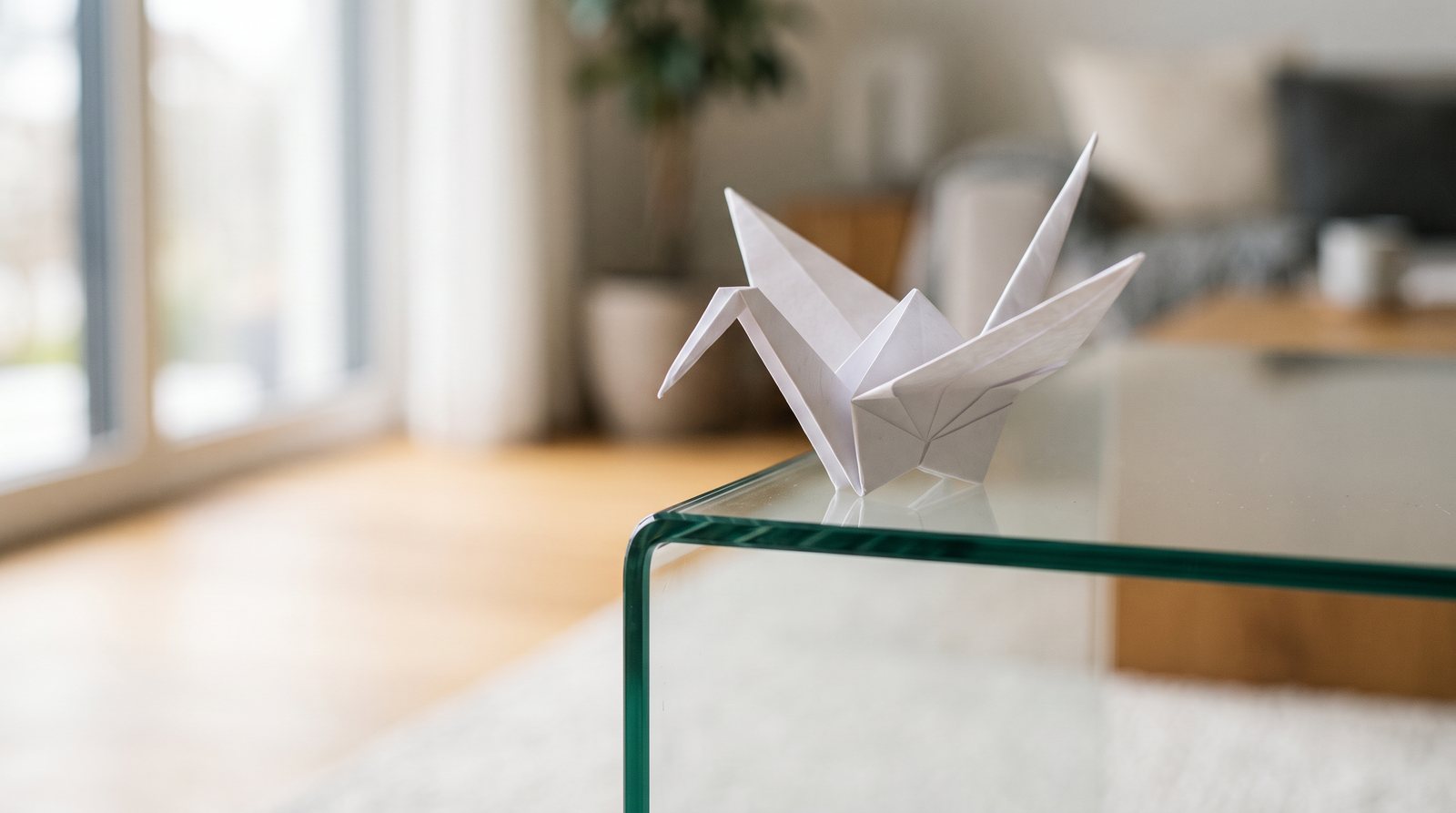
The process of creating a paper crane begins with a single, perfectly square sheet of paper. In its flat state, the paper is a field of potential. However, the first fold changes everything. As the corners are brought together and the paper is creased, a new set of physical properties emerges. The paper is no longer just a surface; it is becoming a structure. A crease is a permanent alteration of the paper’s fibers, a memory of a decision that dictates how the final form eventually stands against gravity. This initial transformation sets the stage for the crane's development, turning a two-dimensional object into a three-dimensional study of structural integrity and poise.
As the folding progresses into the bird base, the geometry of the crane becomes increasingly complex. Every fold must be executed with mathematical precision, as even a minor deviation in the early stages will be magnified as the layers multiply. The paper is folded back upon itself, creating reinforced sections that contrast with the thin, delicate edges of the wings. This distribution of mass allows the finished bird to maintain its poise. The maker is managing a system of structural tensions that hold the object together without the need for adhesive. Each fold contributes to the overall stability, ensuring that the finished crane can support its own weight while maintaining a sense of elegance.
In the quiet environment of a night craft studio, the interaction between the paper crane and light becomes a primary subject of study. When a white crane is placed upon a dark, reflective surface, such as black glass, it becomes a vessel for light. The sharp edges of the folds catch the ambient glow, creating a high-contrast map of highlights and deep shadows. A single fold can cast a long shadow that emphasizes the length of the neck or the span of the wings. In low-light conditions, the crane seems to glow from within, as the thinness of the paper allows a soft translucency. This visual interplay highlights the precision of the craft, making the subtle details of the construction visible to the observer.
The concept of weight in origami is a paradox. A paper crane is nearly weightless, yet it possesses a distinct physical presence that belies its material lightness. As the neck and tail are pulled out from the body, the crane enters a state of equilibrium. The weight of the folded head is countered by the length of the tail, while the broad base of the body provides a stable foundation. This "impossible balance" is the result of centuries of refinement in the craft, where the goal is to create a form that feels both grounded and ready to ascend. The crane sits as a testament to the balance of forces, demonstrating how a simple material can achieve a sophisticated state of rest.
For practitioners like Eli Venn, the act of folding is a study in patience and tactile feedback. The hands must learn to feel the thickness of the paper and the sharpness of the crease. This repetitive motion becomes a meditative ritual, a way to quiet the mind by focusing entirely on the physical task at hand. Each crane is a unique record of the maker’s focus at that particular moment. A slight hesitation in a fold or an extra-firm press of the thumb is preserved forever in the final object, making the craft a very personal form of expression. Through this patient process, the folder gains a deep appreciation for the relationship between the hand and the material.
The transition from a two-dimensional square to a three-dimensional bird is a feat of engineering that continues to inspire modern science. The way the crane’s wings can be collapsed and then expanded with a gentle pull is a principle now used in the design of solar panels for spacecraft and stents for medical procedures. In these contexts, the "impossible balance" of the crane is translated into the balance between compact storage and functional deployment. The crane serves as a bridge between ancient tradition and cutting-edge technology, proving that the principles of geometry and physics are universal and timeless. It remains a powerful example of how folding can transform a simple surface into a complex, functional system.
As the final folds are completed and the crane is "breathed into" by gently pulling the wings apart to inflate the body, the object takes on its final character. This act of inflation is the moment the crane truly becomes a bird. The flat, compressed layers of paper expand to create a hollow interior, giving the crane a sense of life and breath. Even a small crane, no larger than a fingernail, can hold its shape for years if the folds are secure. The durability of the paper, when treated with respect and precision, is surprising. The finished object is a physical manifestation of a set of rules followed to their logical conclusion, resulting in a form that is both fragile and remarkably strong.
Ultimately, the study of the paper crane is a study in the beauty of constraints. The maker is limited to a single square of paper and is forbidden from cutting or gluing. These limitations, rather than being restrictive, are what make the achievement of balance so significant. Every feature of the crane—the beak, the wings, the tail—must be coaxed out of the existing material. The "impossible balance" of the crane is a state of grace that is achieved through discipline and care, a quiet victory over the stubborn flatness of the material world. It teaches us that within fixed boundaries, there is an infinite potential for creativity and structural innovation.
When the crane is finally placed in its environment, whether it is hanging from a thread in a window or sitting on a shelf, it continues to interact with the world around it. It responds to the slightest movement of air, turning slowly and catching the changing light of the day. It becomes a focal point for attention, a small monument to the power of a simple idea. The paper crane offers a moment of stillness and clarity, reminding us that beauty can be found in the most humble materials. The crane remains a study in light and weight, a perfect expression of the harmony that can be achieved when hands, mind, and material are in alignment.