Learn
A Symphony of Silence Broken by Storms: The Fleeting Majesty of Earth’s Rarest Desert Wildflower Superblooms
In the world’s most arid reaches, life does not die but waits in a decades-long slumber for a single, soaking rain. When the clouds finally break, a silent landscape transforms into a vibrant, multi-colored carpet that defies the very definition of desolation.
To the casual observer, the hyper-arid stretches of the Atacama or the sun-scorched basins of Death Valley appear as monuments to finality, places where the very idea of biology seems to have been erased by the relentless weight of geology. Yet, beneath the parched, cracked crust of these seemingly sterile landscapes lies a hidden kingdom of profound patience, a biological "waiting game" that operates on a timescale far beyond the human pulse. These deserts are not empty; they are crowded with billions of tiny, desiccated seeds, each a microscopic capsule of genetic potential that has retreated into a state of metabolic suspension known as dormancy. In this profound stillness, life does not simply endure; it waits, sometimes for decades, for a specific, almost miraculous convergence of environmental triggers that will signal the end of its long vigil. This strategy of ephemeral existence is a masterclass in evolutionary timing, allowing delicate annuals to bypass the lethal heat of the desert summer by existing as inanimate specks of dust, only emerging when the environment is briefly, tentatively, hospitable.
The catalyst for this transformation is as rare as it is transformative: a steady, soaking rain that must penetrate deep into the mineral-rich soil. It is not enough for a passing storm to dampen the surface; for the desert to truly wake, a threshold must be met, often exceeding half an inch of precipitation, which serves to wash away the chemical inhibitors that keep the seeds locked in their slumber. This process of leaching is a sophisticated biological safeguard, ensuring that the seeds do not germinate after a light drizzle that would leave the resulting seedlings to wither in the returning heat. Once these chemical shackles are removed, the seeds undergo a rapid, almost violent awakening. Within hours of the soil reaching the correct temperature and moisture level, the dormant embryos begin to swell, drawing in water and restarting their long-stilled metabolic engines. This is the moment of scientific wonder where the inanimate becomes the animate, a subterranean revolution that happens in the dark, silent hours following a storm, as billions of tiny roots begin their frantic search for purchase in the damp earth.
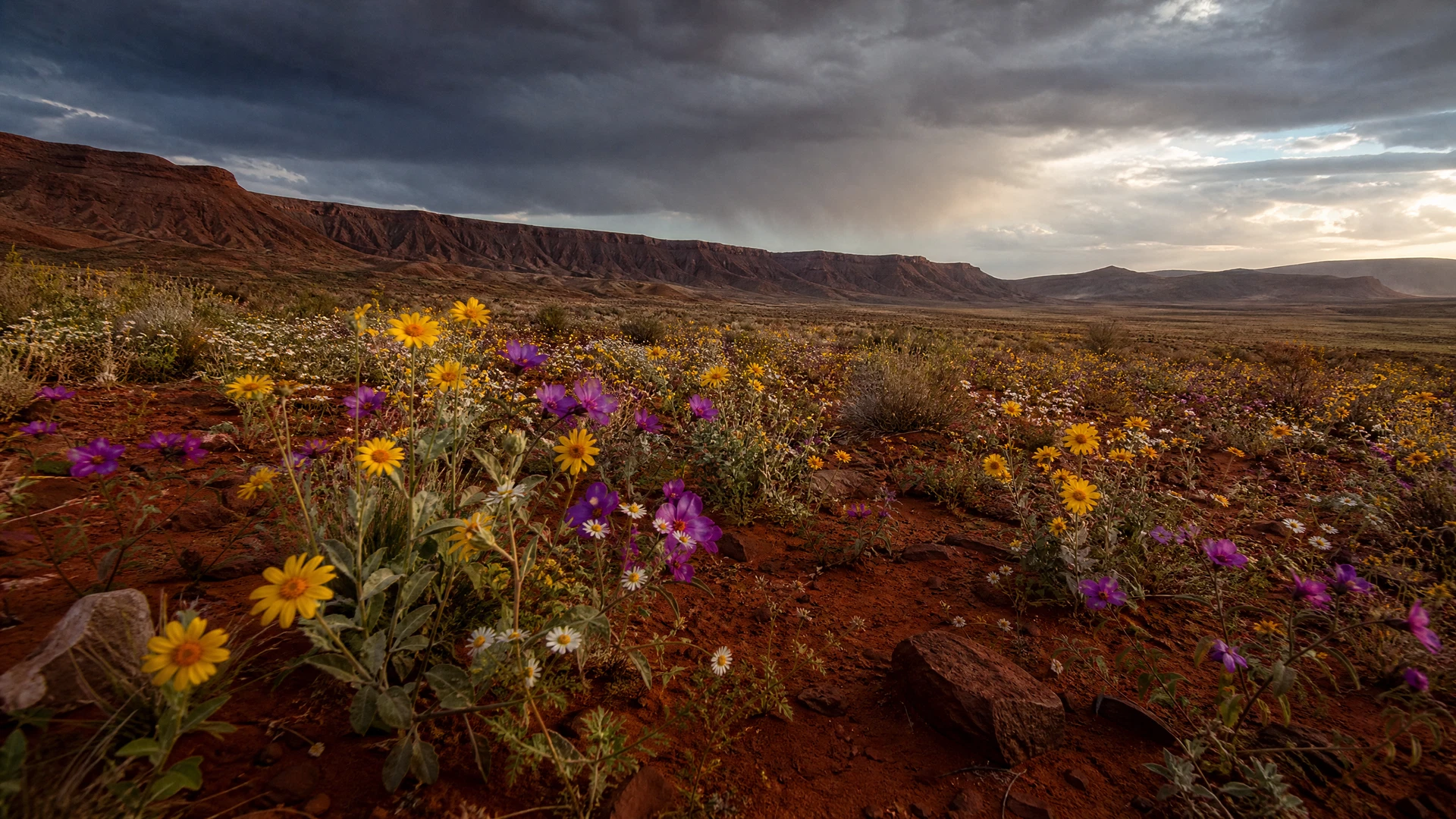
What follows is a phenomenon known as a "superbloom," a term that scarcely captures the sheer, overwhelming scale of the visual transformation that sweeps across the desert floor. Almost overnight, the monochromatic browns and grays of the salt flats are obliterated by a riotous, shimmering carpet of gold, purple, and white. In Death Valley, the Desert Gold sunflowers turn the valley floor into a sea of liquid sunlight, while in the Atacama, the Cistanthe blossoms paint the jagged hills in hues of deep magenta. This is not merely an aesthetic event; it is a massive, synchronized biological broadcast. The air, usually sterile and dry, becomes thick with the scent of nectar and the hum of insects that seem to appear from nowhere, drawn to this sudden oasis. The scale of the bloom is so vast that it can be seen from orbit, a vibrant patch of color on the Earth’s surface that marks a temporary victory over the encroaching void. For the traveler standing in the midst of this explosion, the experience is one of profound cognitive dissonance—the knowledge that this lush, vibrant meadow was a barren wasteland just weeks prior, and will return to that state just as quickly.
However, the beauty of the superbloom is inextricably tied to its fragility, as these plants are locked in a desperate, high-stakes race against the inevitable return of the sun. The life cycle of an ephemeral wildflower is a frantic sprint; from germination to flowering and seed production, the entire process must be completed in a matter of weeks before the moisture evaporates and the temperatures soar back into the lethal range. There is no room for error; if a plant fails to produce seeds before the heat returns, its genetic line ends there. This urgency drives a spectacular display of reproductive effort, as the plants channel every available joule of energy into their blossoms to attract the pollinators necessary for cross-fertilization. Once the seeds are set, the parent plants wither and die with startling speed, their dried husks adding a brief layer of organic matter to the soil. The new generation of seeds, however, falls into the cracks of the parched earth, settling into the dust to begin their own long, silent wait, perhaps not to be seen again for another twenty years.
As breathtaking as these events are, they are shrouded in a growing cloud of scientific uncertainty, particularly as the global climate begins to shift in unpredictable ways. While the basic triggers for a superbloom are understood, the increasing frequency of extreme weather events and shifting precipitation patterns are making these rare spectacles even more difficult to predict. Some researchers worry that rising temperatures may trigger premature germination, leading to "false starts" where seedlings emerge only to be scorched before they can reproduce, potentially depleting the desert’s ancient seed banks. Furthermore, these hyper-arid blooms serve as a critical terrestrial analog for astrobiologists, who study the survival of microbial life in the Atacama’s salt-crusted soils to understand how life might persist in the similarly hostile environments of Mars. The superbloom is thus more than a beautiful anomaly; it is a vital window into the limits of life on Earth and beyond, a reminder that even in the most inhospitable silence, there is a patient, enduring capacity for renewal that we are only just beginning to comprehend.