Learn
The Externalized Intelligence of a Brainless Architect: How Slime Moulds Navigate the World Through Living Maps and Slime
Lacking a central nervous system, the vibrant yellow slime mould solves complex spatial puzzles by leaving a physical record of its own history. This remarkable organism challenges our understanding of cognition by externalizing its memory into a shimmering trail of chemical clues.
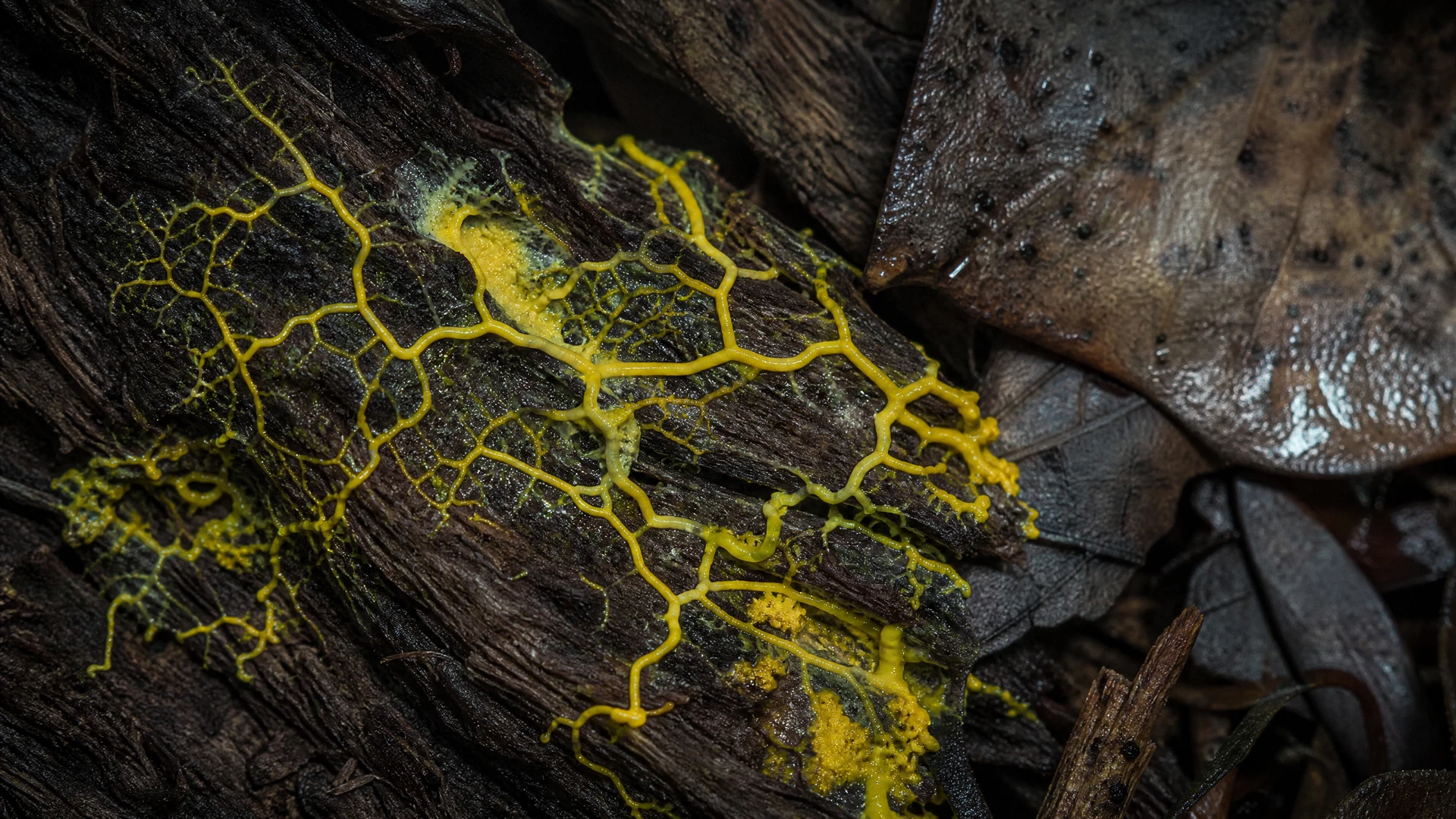
Physarum polycephalum, a bright yellow, gelatinous amoeboid, defies the traditional hierarchy of life. This single-celled organism can grow to several square meters, containing millions of nuclei within a single membrane [1]. Lacking a brain, heart, and nervous system, it still exhibits behaviors that we typically associate with higher-order intelligence [2]. To witness a slime mould in action is to see a living, pulsing network that seems to think with its entire body. It does not possess the grey matter we associate with decision-making, yet it navigates the world with a terrifyingly efficient logic, solving problems that would challenge a human engineer [1]. This "brainless" architect suggests that cognition is not exclusive to complex neural structures, but a property emerging from biological movement [3]. Its constant, fluid exploration proves that life does not always require a central command to achieve greatness. In the quiet corners of the forest floor, it weaves a tapestry of survival that is as beautiful as it is mathematically precise, proving that the simplest forms of life often hold the keys to the most complex questions of existence.
The most famous demonstration of this intelligence occurs within the confines of a laboratory maze, a setting that strips away the complexity of the wild to reveal the organism's core logic. Placed into a labyrinth with two distinct food sources—typically oat flakes—at separate exits, the mould does not simply wander aimlessly or rely on blind luck [1]. Initially, the organism expands its dendritic network to fill every available corridor, exploring the space with a frantic, pulsing energy. It is a biological search engine, casting its net wide to understand the topography of its environment. However, once it makes contact with the nutrients, a remarkable transformation begins. The mould begins to retract its pseudopodia from the dead ends and less efficient routes, systematically dismantling the parts of its body that serve no purpose [1]. Through a decentralized process of optimization, it reinforces the tubes along the shortest path between the food sources, eventually leaving behind a single, thick vein of yellow protoplasm that represents the most efficient solution to the maze [2]. This shape optimization is not merely a reaction to food, but a sophisticated calculation by the entire cell, proving efficiency can be achieved through collective behavior [1].
This feat of engineering is not driven by a central command, but by the physics of its own internal flow and a process known as shuttle streaming. The slime mould’s body is a series of interconnected tubes that pulse rhythmically, driving the flow of cytoplasm back and forth [2]. As the organism detects a food source, the frequency and intensity of these contractions increase in the tubes nearest to the nutrient. This rhythmic pulsing drives the flow of cytoplasm, and the tubes themselves respond to the increased shear stress by thickening and becoming more robust [2]. Conversely, the tubes that do not experience this high-frequency flow begin to wither and eventually disappear. It is a living feedback loop where the act of successful navigation literally reshapes the organism’s anatomy [1]. The slime mould does not "decide" which path is best in the way we might; instead, the path that is most efficient becomes the most physically resilient. Scientific uncertainty remains regarding how exactly the organism senses chemical gradients over distances without specialized sensory organs, but the result is undeniable: a structural logic that allows the organism to solve complex spatial problems through the simple application of fluid dynamics and biological response [3].
Perhaps the most startling aspect of the slime mould’s intelligence is its ability to remember where it has been without a brain. As the organism explores, it leaves behind a translucent trail of extracellular slime—a chemical footprint that acts as an externalized spatial memory [2]. When the mould encounters its own previous trails, it instinctively senses the chemical composition and avoids those areas, preventing itself from wasting energy by re-exploring territory it has already vetted [3]. This is a form of cognition that exists outside the body, a physical record of the past that guides the actions of the present. While scientists acknowledge some uncertainty regarding the exact molecular mechanisms that allow the mould to "read" these trails, the ecological result is clear: the slime mould possesses a memory that is written into the environment itself [2]. This externalized intelligence allows it to navigate complex, changing landscapes with a level of precision that seems impossible for a single-celled blob. By outsourcing its mind to the environment, the organism creates a living map that ensures survival in the face of uncertainty [3].
The implications of this brainless brilliance extend far beyond the laboratory maze and into the heart of human engineering and philosophy. Researchers have used slime moulds to model human transportation systems, finding that the organism’s networks often mirror the efficiency of our most advanced rail and road designs [1]. In one experiment, a slime mould recreated the Tokyo rail system; the resulting network mirrored the actual infrastructure designed by engineers over decades, but was achieved without central planning [3]. Today, the slime mould serves as a biological blueprint for the development of autonomous, reactive navigation systems in soft robotics and the design of more resilient communication networks [2]. It reminds us that nature has been solving engineering problems for billions of years, often using methods that are far more elegant and sustainable than our own. By studying the slime mould, we are not just learning about a strange yellow fungus-like creature; we are discovering a new way of thinking about the world—one where intelligence is not a localized spark within a skull, but a distributed, living process that flows through every branch of the tree of life.
References [1] Nakagaki, T., et al. (2000). Maze-solving by an amoeboid organism. Nature, 407, 470. https://www.nature.com/articles/35035159 [2] Reid, C. R., et al. (2012). Spatial memory in a brainless organism. PNAS, 109(43), 17490. https://pmc.ncbi.nlm.nih.gov/articles/PMC3491460/ [3] Smithsonian. (2021). How Brainless Slime Mold Stores Memories. https://www.smithsonianmag.com/smart-news/how-brainless-slime-mold-stores-memories-180977097/