Learn
The Silent Geometry of the Namib: Unveiling the Enigmatic Origins of Nature’s Most Mysterious Desert Fairy Circles
Across the sun-scorched plains of the Namibian desert, thousands of barren voids form a rhythmic tapestry that continues to baffle the scientific community. These enigmatic fairy circles represent a complex biological struggle for survival, where water and life engage in a high-stakes game of geometric organization.
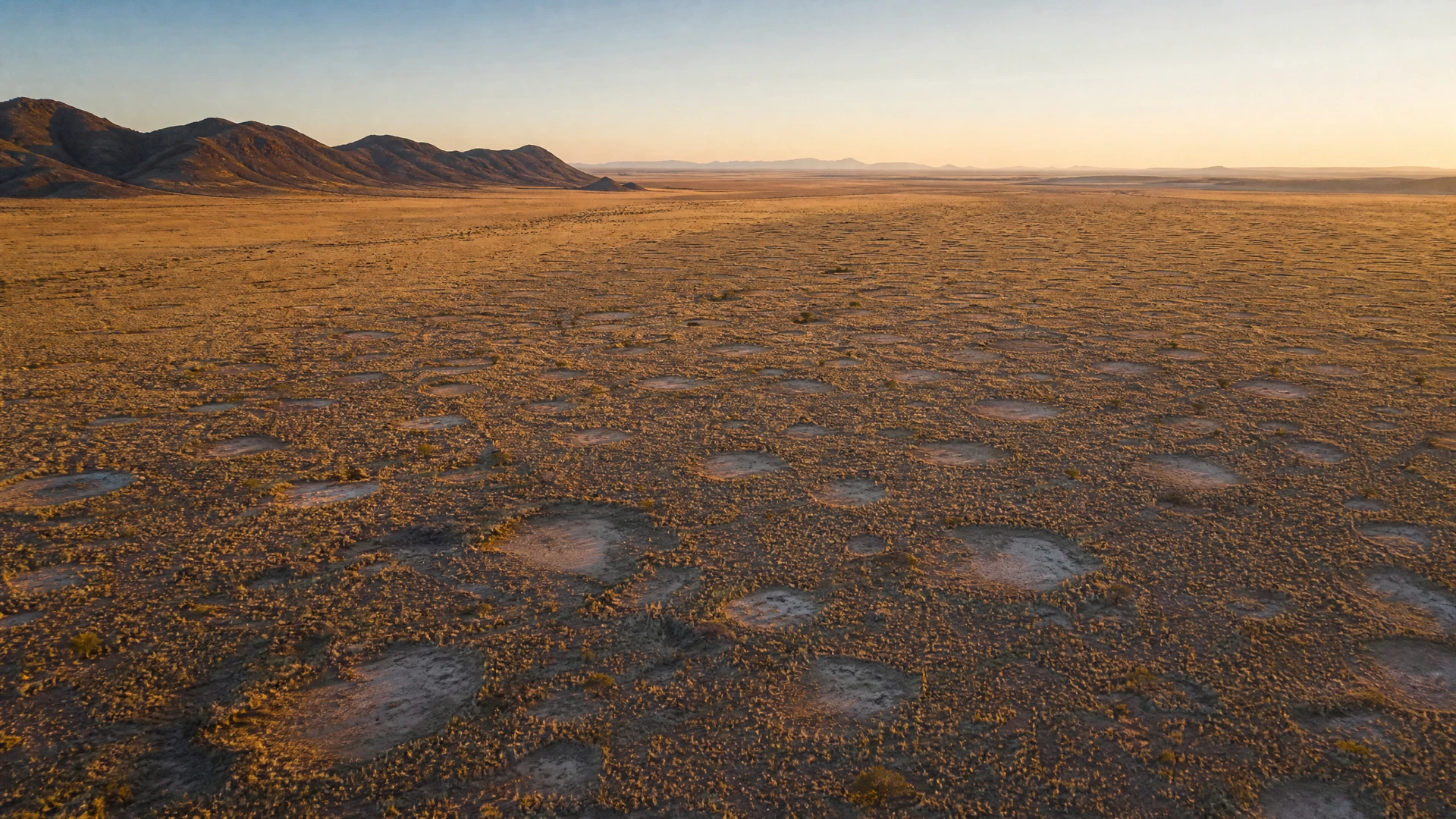
From the cockpit of a low-flying aircraft, the Namibian desert reveals a sight that feels less like a natural landscape and more like a carefully orchestrated piece of land art. Thousands upon thousands of circular voids punctuate the sea of golden Stipagrostis grass. These are the "fairy circles," a phenomenon that has fascinated travelers and scientists alike for decades. Each circle is a perfectly barren patch of red earth, often fringed by a ring of vegetation that is taller and lusher than the surrounding plains. For the local Himba people, these were once believed to be the footprints of gods or patches of earth poisoned by the breath of a subterranean dragon. However, for the modern ecologist, they represent one of the most enduring mysteries of the natural world—a silent, geometric choreography of survival etched into one of the harshest environments on Earth. The sheer regularity of these patterns, which stretch for hundreds of miles across the Namib and have recently been discovered in the Australian Outback, suggests a deep, underlying logic that transcends mere chance.
One of the most compelling explanations for these structures centers on the industrious activities of the sand termite. Proponents of this theory argue that these insects are the desert’s primary engineers, deliberately clearing vegetation from specific patches to create subterranean water reservoirs. By consuming the roots of the grasses within the circle, the termites prevent the plants from transpiring precious moisture back into the atmosphere. Instead, the rainwater that falls on these barren spots seeps deep into the sandy soil, where it remains trapped and protected from the scorching sun. This creates a permanent "wet patch" that sustains the termite colony throughout the long, grueling dry season. The lush ring of grass that often surrounds the circle is, in this view, a fortunate byproduct—a fringe of vegetation that has tapped into the edges of the termites' hidden reservoir. This biological engineering is a masterclass in resource management, allowing a tiny insect to thrive in a landscape where most other life forms wither and die.
However, a rival school of thought suggests that the architects of these circles are not insects, but the plants themselves. This theory, known as vegetation self-organization, posits that the patterns emerge from an intense, decentralized competition for water. In the hyper-arid Namib, moisture is the ultimate currency, and every blade of grass is a ruthless competitor. According to this model, a small patch of grass that happens to be slightly more robust than its neighbors will begin to draw water from the surrounding soil, creating a "zone of depletion" around it. As the central plants grow, they establish a feedback loop: their roots extend further, pulling moisture from the center of the patch and making it impossible for new seedlings to take root there. Over time, this results in a barren void—a fairy circle—surrounded by a ring of high-performing grass that has successfully monopolized the local water supply. This process is a classic example of a Turing pattern.
The debate between the "termite" and "self-organization" camps has been one of the most spirited in modern ecology, with researchers often finding evidence that seems to support one theory while contradicting the other. For instance, while termite nests are frequently found in Namibian circles, they are notably absent from the similar formations discovered in Western Australia. This discrepancy has led some scientists to question whether a single explanation can truly account for the phenomenon across different continents. In recent years, a new consensus has begun to emerge, suggesting that the truth may lie in a synthesis of both ideas. Unified models now propose that termite activity and plant competition are not mutually exclusive but may actually work in tandem. In this integrated view, termites might initiate the patches, while the plants’ own water-seeking behaviors reinforce and stabilize the circular geometry over decades. This scientific uncertainty is not a failure of understanding, but a reflection of the desert’s complexity, reminding us that nature rarely adheres to the simple, binary explanations we often seek to impose upon it.
Beyond the question of their origin, fairy circles serve as a vital indicator of the health and resilience of the desert ecosystem. These formations are not static; they possess a lifecycle of their own, appearing, growing, and eventually disappearing over the course of thirty to sixty years. By organizing themselves into these rhythmic patterns, the vegetation is able to maximize the utility of every drop of rain, ensuring that at least some plants can survive even the most severe droughts. The circles act as a form of natural insurance, a spatial strategy that prevents the entire landscape from collapsing into total desertification. When the rains do come, the barren centers of the circles function as miniature catchments, funneling water to the roots of the peripheral grasses and allowing them to bloom with extraordinary vigor. This optimization of scarce resources is a testament to the invisible intelligence of the landscape, a proof that even in the most desolate corners of the globe, life finds a way to impose order upon chaos.
Ultimately, the fairy circles of the Namib remind us that we are still guests in a world full of secrets. Whether they are the work of tiny subterranean architects, the result of a fierce botanical struggle, or a combination of both, these patterns stand as enduring symbols of nature’s ingenuity. They invite us to look closer at the ground beneath our feet and to appreciate the silent, geometric logic that governs the wild. In an era where we often feel we have mapped and measured every corner of the planet, the fairy circles remain a beautiful anomaly—a reminder that there are still mysteries that defy our best efforts to solve them. In the desert's vast, golden silence, the circles continue their slow, rhythmic dance, a testament to the fact that even in the absence of water, the earth itself can be a canvas for the most extraordinary stories of survival.