Learn
The Silent Recall: How the Sensitive Mimosa Pudica Redefines the Limits of Botanical Intelligence and Memory
Beyond its famous reflexive collapse, the Mimosa pudica harbors a sophisticated capacity for learning and long-term memory. Recent experiments suggest this brainless organism can discern between threat and harmlessness, challenging our traditional understanding of cognitive life.
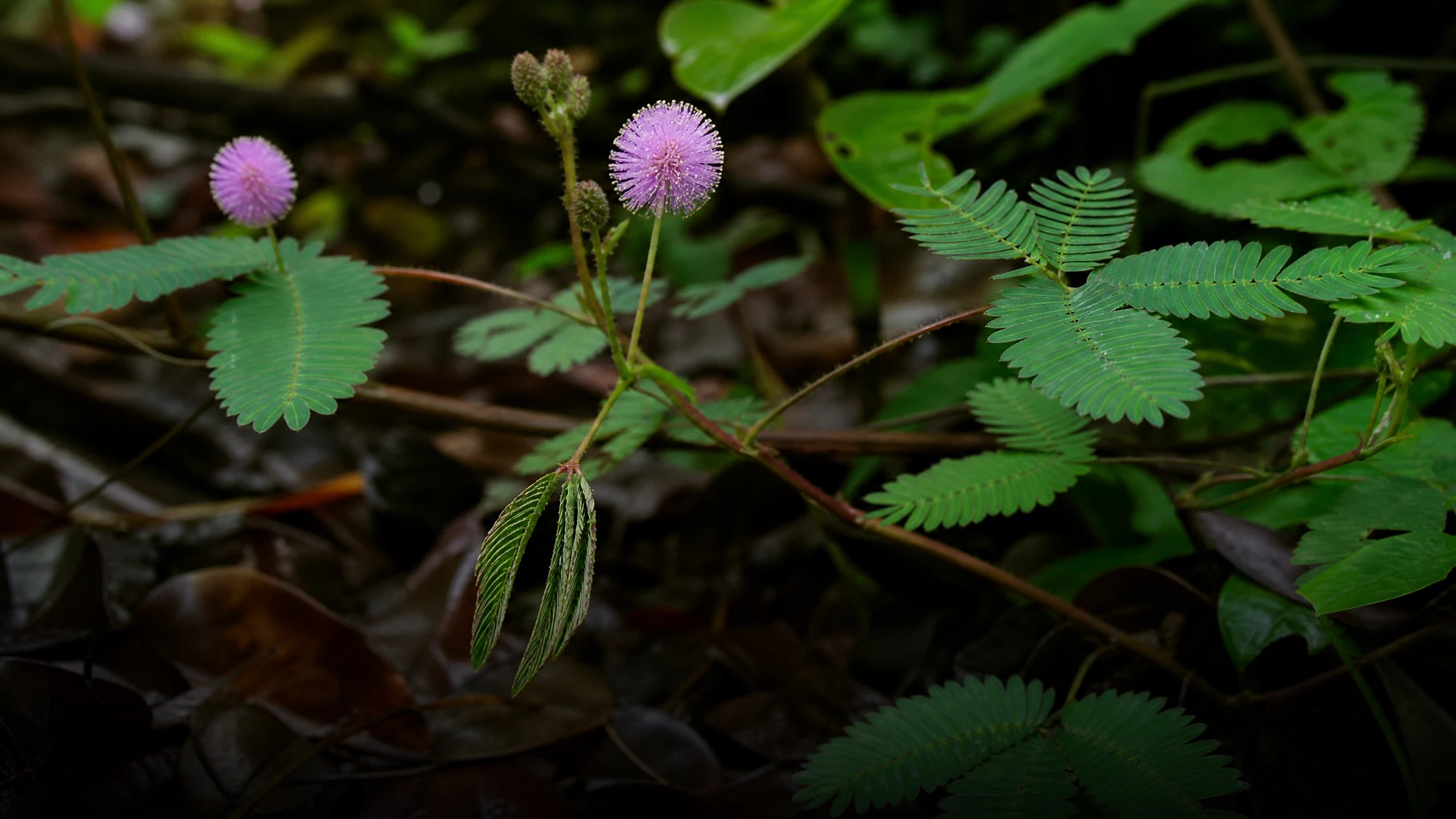
The encounter begins with a soft, almost imperceptible touch, a fleeting brush against the delicate, fern-like leaflets of the Mimosa pudica. In an instant, the plant responds with a mechanical grace that seems more animal than vegetable, folding its green fringe inward and drooping its stems as if in a sudden, shy retreat. This rapid movement, known to botanists as thigmonasty, is not merely a visual trick but a sophisticated hydraulic operation centered within specialized motor organs called pulvini. Located at the base of each leaflet and petiole, these pulvini act as biological hinges. When the plant senses physical contact, an internal electrical signal triggers a sudden efflux of potassium and chloride ions from the cells on one side of the pulvinus. This chemical shift forces water to rush out of the cells via osmosis, leading to a dramatic collapse in turgor pressure. Within seconds, the rigid structural support of the leaf vanishes, causing the plant to fold and droop.
Evolutionarily, this defensive posture is a high-stakes gamble for the Mimosa pudica. By folding its leaves, the plant effectively hides its most nutritious parts from hungry herbivores and reduces its visual profile, potentially appearing as a dry, unappealing twig to a passing insect. However, this protection comes at a significant metabolic cost. A folded leaf cannot capture sunlight, meaning every second spent in a defensive state is a second lost for photosynthesis—the very process that fuels the plant's growth and survival. Furthermore, the act of re-inflating the pulvini with water to reopen the leaves requires a considerable expenditure of energy. Because of this trade-off, the plant cannot afford to be paranoid; it must be able to distinguish between a genuine threat, such as the nibbling of a caterpillar, and a harmless environmental disturbance, like a falling raindrop or a gust of wind. This necessity for discernment sets the stage for a level of behavioral complexity that challenges our traditional definitions of botanical passivity, suggesting that the Mimosa pudica is not just reacting to its environment, but actively interpreting it.
The most compelling evidence for this interpretation comes from the pioneering work of evolutionary ecologist Monica Gagliano, whose experiments have pushed the boundaries of plant behavioral science. Gagliano devised a specialized apparatus to subject Mimosa pudica plants to a series of controlled, non-harmful drops. Initially, the plants responded as expected, snapping their leaves shut the moment they felt the sudden descent. However, as the drops continued at regular intervals, something remarkable happened: the plants stopped reacting. They remained fully open, their leaves unfurled even as they were repeatedly dropped. To ensure this wasn't simply a case of "fatigue"—where the plants were too exhausted to move—Gagliano touched the leaves manually. Immediately, the plants folded. This proved that the Mimosa had not lost the ability to move; rather, it had "learned" that the specific stimulus of the drop posed no danger. This process, known as habituation, was previously thought to be a trait exclusive to animals with central nervous systems, yet here was a brainless weed demonstrating the same capacity for behavioral modification through experience.
Even more startling than the plant’s ability to learn was its capacity for retention. Gagliano found that once the Mimosa pudica had habituated to the dropping stimulus, it remembered the lesson for an extraordinary length of time. Even after being left undisturbed in a quiet environment for twenty-eight days, the plants did not revert to their original defensive behavior when dropped again; they remained open, recalling their previous training. This duration of memory exceeds that of many complex animals, including several species of insects. The mechanism behind this botanical memory remains a subject of intense scientific inquiry and uncertainty. Without a brain or a network of neurons to store information, how does a plant "remember"? Some researchers suggest that the information may be encoded through epigenetic changes—modifications to the way genes are expressed without altering the DNA sequence itself. Others point to the plant's complex internal signaling systems, which use electrical pulses and chemical neurotransmitters like glutamate, similar to those found in the human brain, to transmit information across the organism's body.
The discovery of memory in Mimosa pudica has ignited a fierce debate within the scientific community regarding the nature of intelligence and the validity of the emerging field of "plant neurobiology." Critics argue that using terms like "learning" and "memory" for plants is anthropomorphic and misleading, suggesting that these behaviors are merely sophisticated biochemical reflexes rather than true cognitive processes. They caution that without a centralized nervous system, a plant cannot possess consciousness or intent. However, proponents of plant intelligence argue that our definitions are too narrow, centered entirely on the animal model of a brain. They suggest that intelligence should be defined by an organism's ability to process information, learn from the past, and make decisions that improve its chances of survival. In this view, the Mimosa pudica represents a decentralized form of intelligence, where every cell participates in a collective awareness of the environment. While the exact mechanisms of this awareness remain shrouded in mystery, the plant's ability to balance the costs of defense against the needs of growth suggests a level of strategic discernment that is undeniably sophisticated.
Ultimately, the story of the Mimosa pudica invites us to reconsider our relationship with the botanical world. We often perceive plants as static, passive background elements in the drama of life, yet they are active participants in their own survival, navigating a complex world with tools we are only beginning to recognize. The sensitive plant’s ability to remember the past and adapt to the present reveals an elegance in nature that transcends the need for a brain. It reminds us that life is resourceful, finding ways to store knowledge and exercise choice even in the absence of the structures we typically associate with thought. As we peer closer at the glistening pulvini and the rhythmic folding of the leaflets, we are not just seeing a reflex; we are witnessing a quiet, green intelligence at work. The Mimosa pudica stands as a testament to the idea that memory is not a luxury of the mind, but a fundamental necessity of life, a silent recall that allows even the most humble weed to navigate the shifting dangers of the world with wisdom.