Learn
The Cathedral of the Deep: How a Single Titan Sustains an Abyssal City for Decades
When a great leviathan breathes its last, its descent into the lightless abyss initiates a spectacular multi-generational legacy of life. For decades, a single carcass serves as a biological powerhouse, fueling a complex ecosystem that thrives in the extreme pressure of the deep sea.
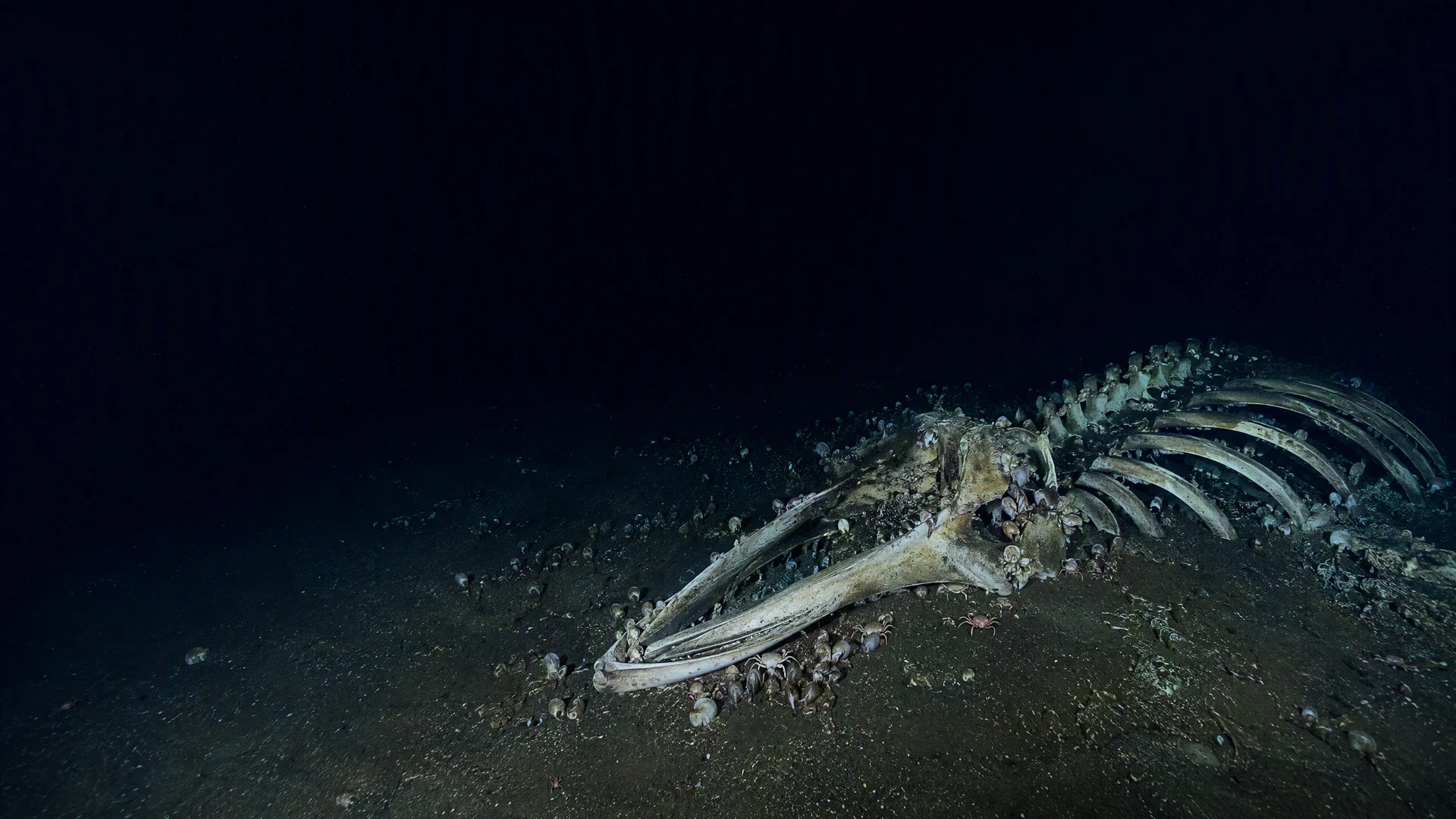
The ocean’s surface is a realm of shimmering light and frantic energy, but as one descends through the water column, the world transforms into a vast, pressure-cooker void of eternal midnight. For the great whales—the blue, the fin, the humpback—life is lived across thousands of miles of open water, a journey of migrations and songs. Yet, it is their final act that perhaps leaves the most profound mark on the planet. When a whale dies, its massive body, weighing dozens of tons, begins a slow, somber descent known as a "whale fall." In the nutrient-poor deserts of the deep sea, where life usually subsists on the meager "marine snow" of tiny organic particles drifting from above, a single whale carcass represents a windfall of unimaginable proportions. It is the equivalent of two thousand years of normal food supply arriving all at once, a biological miracle that turns a patch of barren silt into a thriving, multi-generational metropolis. This descent is not merely a sinking; it is the planting of a garden in the abyss, a transition from a single roaming life to a stationary foundation for thousands of others.
The first stage of this ecological succession is a frenzy of activity known as the mobile scavenger phase. Within hours of the carcass settling onto the bathyal or abyssal floor, the scent of decay travels through the cold currents, summoning the deep’s most efficient cleaners. Sleeper sharks, slow-moving but persistent, arrive to tear at the blubber, while hundreds of hagfish—slime-producing, jawless wonders—burrow into the soft tissues, consuming the whale from the inside out. This stage is a spectacle of raw survival, where the soft tissue that once powered a leviathan is stripped away in a matter of months. Despite the darkness, the site becomes a hub of high-energy interaction, as these large scavengers process the bulk of the organic matter. Scientists have noted that the efficiency of this stage is crucial; the rapid consumption prevents the carcass from being buried by sediment, ensuring that the nutrients remain accessible to the smaller, more specialized inhabitants that will follow once the giants have had their fill.
As the bones are picked clean of flesh, the second act begins: the enrichment opportunist stage. This period, which can last for several years, sees the colonization of the whale fall by a dense carpet of smaller organisms. Polychaete worms, including the strikingly named "zombie worms," and various species of crustaceans swarm the site, feeding on the remaining scraps and the nutrient-enriched sediment surrounding the skeleton. The sheer volume of organic material leaches into the mud, creating a localized chemical environment that is radically different from the surrounding seafloor. During this time, the diversity of life at the site skyrockets. Tiny snails, limpets, and amphipods find shelter and sustenance in the nooks and crannies of the vertebrae. It is a period of intense colonization where the "opportunists" take advantage of the high-nutrient pulse, their populations exploding in a localized boom that defies the general scarcity of the deep ocean. The carcass has now become more than food; it is a complex habitat, a reef of bone and marrow.
The most scientifically fascinating phase is the sulfophilic stage, which can persist for decades. As the soft tissues vanish, the focus shifts to the bones themselves, which are rich in lipids (fats). Deep within the porous structure of the skeleton, specialized bacteria begin to break down these fats in the absence of oxygen, producing hydrogen sulfide as a byproduct. This chemical process mirrors the conditions found at hydrothermal vents and cold seeps, allowing for a unique form of life called chemoautotrophy. Here, life does not depend on the sun, but on the chemical energy stored in the whale’s bones. Giant tube worms and specialized clams, which harbor symbiotic bacteria, flourish in this sulfur-rich environment. This stage reveals the whale fall as a bridge between different deep-sea ecosystems, potentially acting as "stepping stones" for species to migrate across the vast, inhospitable stretches of the ocean floor. The discovery of Osedax worms, which lack a digestive system and instead use acid-producing roots to dissolve bone, highlights the extreme evolutionary adaptations triggered by a single carcass.
Eventually, even the chemical energy is exhausted, leaving behind the reef stage. The mineral remains of the skeleton, now bleached and brittle, serve as a hard substrate in a world dominated by soft mud. Deep-sea anemones, cold-water corals, and sponges attach themselves to the ribs and skull, utilizing the elevation to filter-feed from the passing currents. While the primary feast is over, the whale’s legacy continues as a physical landmark. There remains significant scientific uncertainty regarding the frequency of these events; because the deep ocean is so vast and largely unexplored, we do not yet know how many whale falls exist or how critical they are to the global carbon cycle. What is certain, however, is the profound elegance of the process. In the silent, lightless depths, the end of a titan’s journey is never truly an end. It is a transformation—a testament to nature’s ability to recycle every ounce of energy, ensuring that even in the most remote corners of our planet, life finds a way to bloom from the bones of the past.