Learn
The Ethereal Descent of the Polar Sea Stalactite: How Brinicles Sculpt Frozen Architecture Beneath the Arctic Tides
Descending from the underside of polar ice, these hollow tubes of supercooled brine transform the silent depths into a crystalline graveyard. While they act as a lethal force for seafloor life, scientists believe these structures may hold the chemical secrets to the origins of existence.
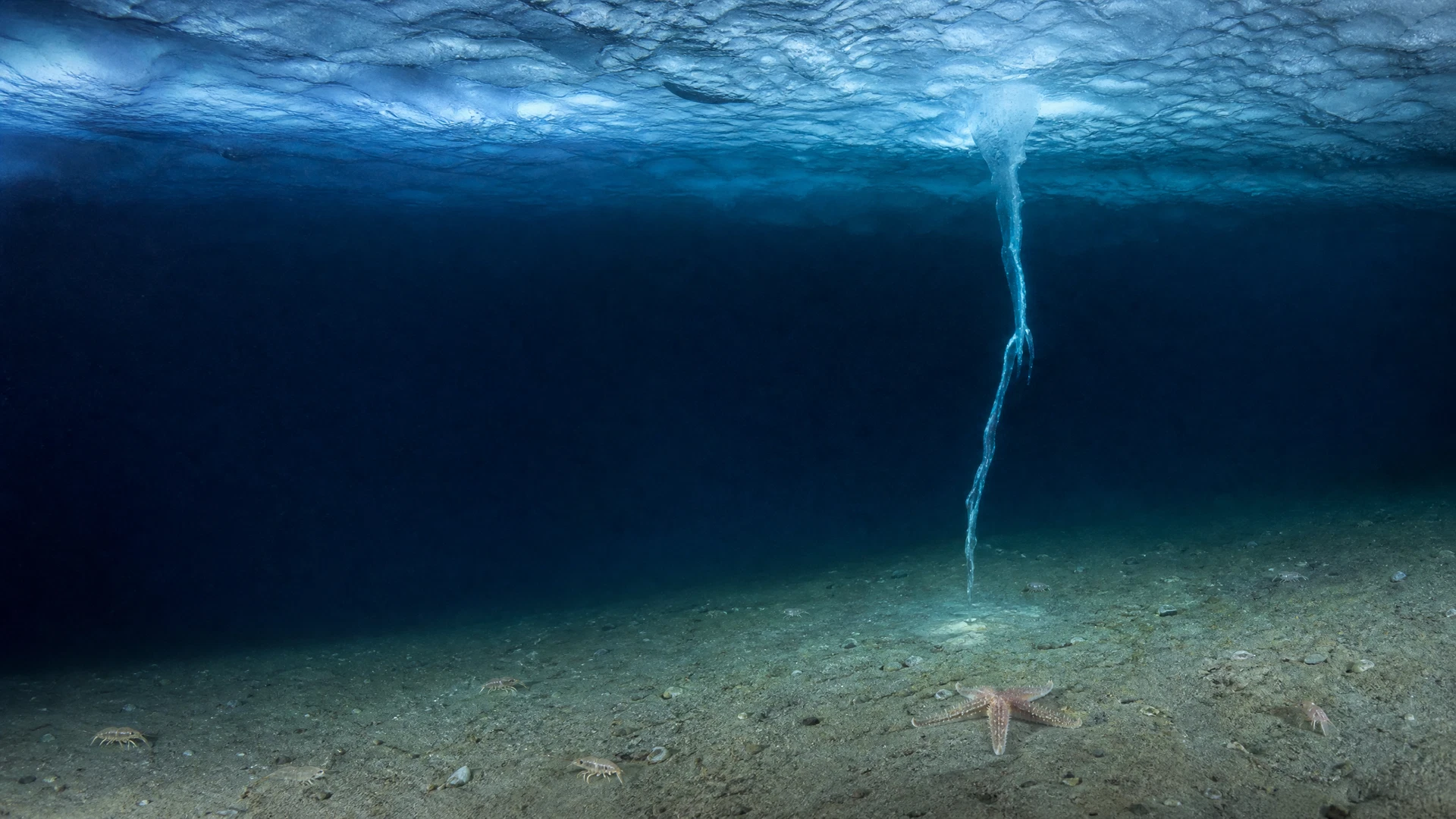
In the lightless, pressurized realms beneath the polar ice caps, a slow-motion drama unfolds that challenges our understanding of fluid dynamics and thermal architecture. Here, the ocean surface is not a boundary but a living ceiling of white, jagged floes that constantly interact with the saline depths below. Among the most haunting phenomena in this sub-zero wilderness is the brinicle, a structure often described as a "sea stalactite" due to its uncanny resemblance to the mineral formations found in limestone caves. Unlike their terrestrial counterparts, which grow over millennia through the slow drip of mineral-rich water, brinicles are ephemeral, crystalline conduits of concentrated salt that can descend several meters in a matter of hours. They appear as ghostly, translucent fingers reaching down from the ice ceiling, surrounded by a faint, shimmering haze of supercooled brine that marks their rapid descent through the water column. This silent, vertical migration represents one of the most extreme manifestations of temperature and salinity gradients on Earth, turning the under-ice environment into a cathedral of fleeting, frozen glass.
The birth of a brinicle is a masterclass in thermodynamic exclusion and the relentless laws of buoyancy. When seawater freezes at the surface, the resulting ice crystals are composed of relatively pure water, forcing the salt out into the surrounding liquid through a process known as brine rejection. This creates pockets of highly concentrated, supercooled brine within the ice matrix. Because this brine is significantly denser and colder than the seawater beneath it—often reaching temperatures as low as -23 degrees Celsius—it eventually breaches the ice’s lower boundary and begins to sink. As this frigid, saline stream moves downward, it acts as a heat sink, promptly solidifying the surrounding waters of lower salinity upon impact. This creates a delicate, hollow sheath of ice that grows longer and thicker as the brine continues to flow through its center. The resulting structure is both a pipe and a pillar, a fragile yet relentless monument to the extreme conditions of the polar seas. The internal flow of brine remains liquid even as the exterior walls solidify, creating a self-sustaining conduit that channels the intense cold of the surface directly into the heart of the deep ocean.
While the descent of a brinicle is a visual marvel, its arrival on the seafloor marks the beginning of a lethal transformation that earns it the chilling moniker, the "finger of death." As the hollow tube touches the silty bottom, the supercooled brine does not simply stop; it continues to spill out, spreading across the terrain like a liquid frost that defies the typical behavior of water. In these deep-sea environments, life moves at a glacial pace; the deliberate movements of seafloor dwellers, such as sea stars and urchins, are ill-equipped to escape the sudden, crystalline web that begins to envelop them. The brine, being denser than the surrounding water, flows along the contours of the seabed, creating a river of ice that traps everything in its path. The ice does not merely cover these creatures; it integrates them into a sprawling, jagged landscape of brine-soaked frost, turning a vibrant ecosystem into a silent, white necropolis within minutes. This interaction highlights the brutal efficiency of thermal gradients in the abyss, where a few degrees of difference can mean the distinction between life and an everlasting icy sepulcher. The speed of this process is particularly striking, as it transforms the seafloor from a place of slow-moving biological activity into a static, crystalline graveyard in a timeframe that feels almost supernatural.
Beyond their role as agents of destruction, brinicles have captured the imagination of astrobiologists and chemists who see them as "inverted chemical gardens." There is significant scientific discussion regarding the role these structures might have played in the emergence of life on early Earth. The hollow walls of a brinicle provide a unique environment characterized by steep chemical gradients and significant electrical potentials—conditions that are remarkably similar to those found at hydrothermal vents. Some researchers hypothesize that these cold, saline chimneys could have acted as primitive laboratories for the concentration of organic molecules, potentially offering a cold-start alternative to the hot-origin theories of life. However, much remains uncertain; the difficulty of observing these structures in their natural, high-pressure environments means that our understanding of their long-term chemical stability and their prevalence across the global oceans is still evolving. Scientists are still debating the exact mechanisms of ion exchange within the ice walls and whether these structures could truly sustain the complex prebiotic chemistry required for life to take hold, leaving a significant gap in our knowledge of deep-sea thermodynamics.
The study of brinicles extends far beyond our own planet, serving as a vital analog for the icy-ocean moons of our solar system, such as Jupiter’s Europa and Saturn’s Enceladus. If these celestial bodies harbor subsurface oceans beneath their frozen crusts, it is highly probable that brinicle-like structures are actively shaping their internal environments. The possibility that these "sea stalactites" could be facilitating the exchange of chemicals and energy between the ice and the deep ocean makes them a primary target for future robotic exploration. By understanding the delicate balance of salt, temperature, and pressure that allows a brinicle to form on Earth, we gain a blueprint for searching for biological signatures in the most remote corners of the galaxy. In the silence of the polar night, these icy fingers are not just symbols of death, but potential signposts pointing toward the very roots of existence in the cosmos. They remind us that the most hostile environments often hold the most profound secrets, waiting to be unfrozen by human curiosity and the relentless pursuit of scientific discovery.