Hunter Valley
The Soft Echo of Strings and Smoke as the Hunter Valley Fades to Gold at Twilight
As the heat of the day recedes from the ancient Pokolbin soil, a different rhythm takes hold among the vine-checkered slopes. It is a time when the sharp light of the Australian sun softens into a bruised palette of violet and amber, and the air carries the faint, evocative scent of wood-smoke. This experience is not merely about the wine or the music, but the collective sigh of a landscape settling into repose. From the vantage of an elevated terrace, one watches the shadows lengthen across the Broken Back Range, accompanied by the gentle vibration of an acoustic guitar. It is a moment of profound stillness and sensory richness, where the simple pleasures of fire-blistered crusts and chilled Semillon become a bridge between the day’s labor and the night’s quietude.
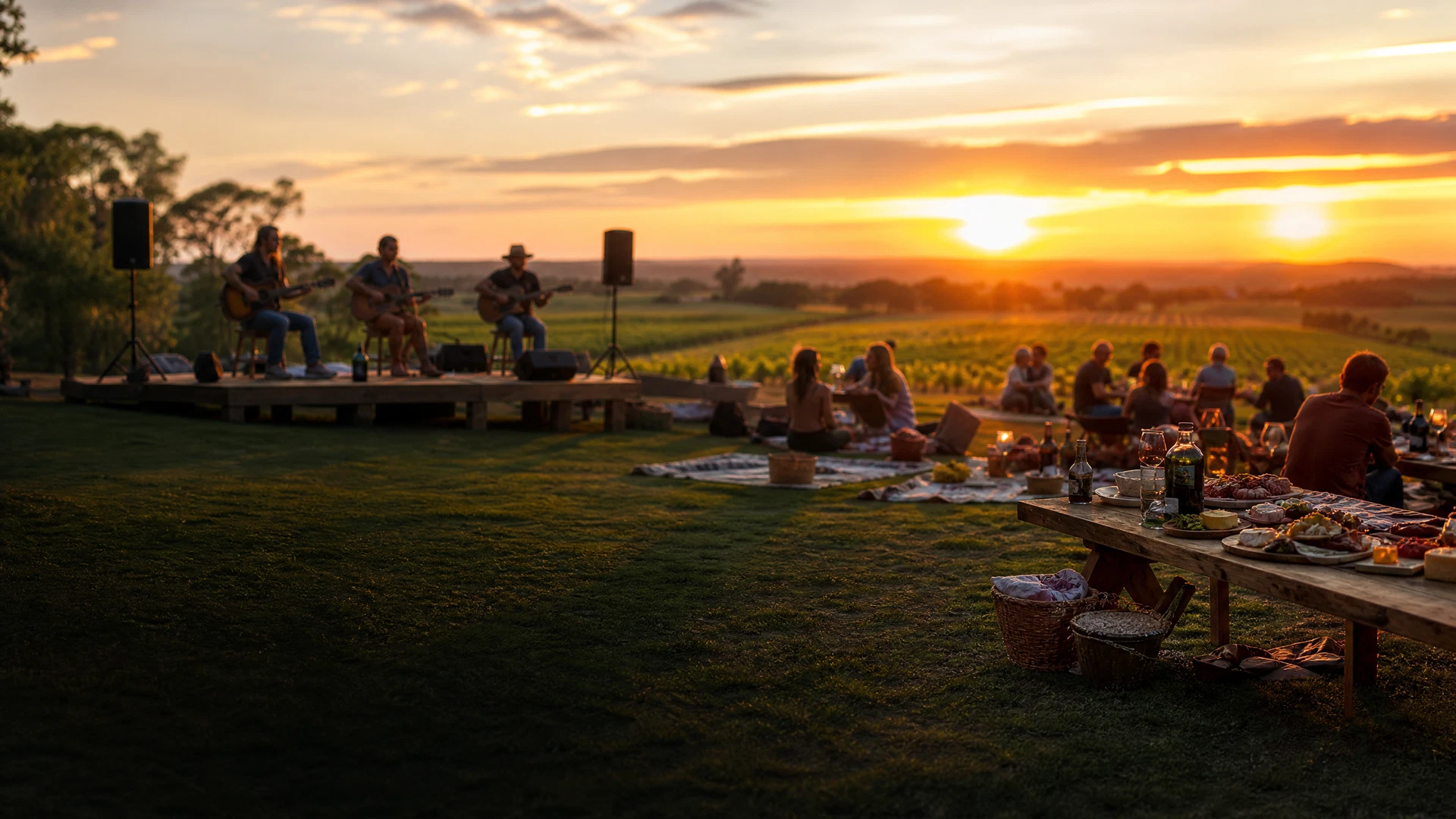
There is a particular quality to the air in the Hunter Valley as the afternoon begins its slow, inevitable surrender to the evening. The intense, bleaching heat that defines the Australian viticultural heartland starts to pull back, leaving behind a residue of warmth that radiates from the parched earth and the gnarly trunks of ancient vines. This is a landscape that has long been cared for, a place where the Wonnarua people have walked for millennia, and their presence seems to linger in the stillness that descends between the rows. As the light begins to tilt, the valley floor transforms into a mosaic of elongated shadows and brilliant, liquid gold, signaling the start of a ritual that is as much about the passage of time as it is about the celebration of the harvest.
At the heart of this transition lies a setting that feels both grounded in the local soil and whispered from a distant Mediterranean dream. The architecture here, with its sun-drenched stone and open-air courtyards, serves as a frame for the natural drama unfolding to the west. From the elevated vantage of a stone balcony, the eye is drawn immediately to the Broken Back Range, a rugged spine of sandstone that guards the valley’s secrets. The mountains, which appear as a dusty green during the height of noon, now begin to shift through a spectrum of bruised plums and deep indigos. It is a theatrical backdrop that requires no artifice, providing a sense of scale that makes the clink of glassware and the murmur of conversation feel intimate and precious.
The soundtrack to this visual feast is provided by the gentle, percussive thrum of an acoustic guitar, its notes carried on a breeze that smells of cooling eucalyptus and dry grass. Local musicians, who understand the specific cadence of this valley, weave melodies that seem to rise directly from the earth. There is no urgency in the music; it is a slow, rhythmic accompaniment to the setting sun, a series of chords that fill the spaces between thoughts. The sound drifts through the vine trellises, occasionally punctuated by the laughter of a distant table or the sharp, clean crack of a bottle being opened. It is a sonic tapestry that reinforces the sense of repose, grounding the visitor in the immediate, fleeting beauty of the present moment.
In the lower courtyard, the atmosphere is defined by the primal, comforting scent of wood-smoke. A large oven, its belly glowing with the embers of local hardwoods, stands as a focal point for a more casual communion. Here, the process of creation is visible and tactile; the dusting of flour, the stretch of dough, and the quick, searing heat that blisters a crust into a work of charred art. There is a profound simplicity in sharing a pizza in the open air, the heat of the fire contrasting with the cooling evening. The flavors are honest and direct, a reflection of a region that prizes substance over spectacle, and the smoke provides a sensory bridge to the rugged bushland that hems in the cultivated fields.
For those seeking a more refined perspective, the upper terraces offer a different culinary dialogue. Here, the offerings are smaller, more precise, and deeply connected to the nearby coast. The briny, metallic brightness of an oyster, chilled to the point of crispness, serves as a perfect counterpoint to the thickening heat of the dusk. Scallops, seared gently and finished with a whisper of citrus butter, reflect the elegance of the setting. It is a sophisticated interplay of textures that mirrors the complexity of the landscape itself—the rugged mountains meeting the delicate fruit of the vine. This elevated experience allows for a quiet observation of the social hum below, a moment of detachment that heightens the appreciation of the valley’s bounty.
No sunset in this region would be complete without the presence of the wine that has made these slopes famous. In the glass, a local Semillon or a young Shiraz becomes a vessel for the valley’s character. The white wines, often lean and citrus-driven in their youth, possess a crystalline clarity that seems to capture the morning’s dew, while the reds carry the weight and spice of the sun-baked earth. As the light fades, the liquid in the glass catches the final rays, glowing like a liquid topaz or a deep garnet. To sip these wines while looking out over the very rows from which they were harvested is to participate in a cycle of renewal that has defined this community for generations.
The "golden hour" in the Hunter Valley is not merely a photographic phenomenon; it is an emotional state. There is a brief window, perhaps twenty minutes in length, where the world seems to hold its breath. The light becomes so thick and honeyed that it feels as though one could reach out and touch it. The geometric precision of the vine rows is highlighted in sharp relief, and the silver-green leaves of the olive trees shimmer with an almost supernatural intensity. It is a time for reflection, a moment to acknowledge the sheer, unadorned beauty of a working landscape. The wistfulness of the hour comes from the knowledge of its brevity, the understanding that this perfect alignment of light, sound, and flavor is already beginning to dissolve.
As the final sliver of the sun disappears behind the jagged peaks of the range, the music finds its final resolution and the first stars begin to prick through the deepening violet of the sky. The wood-smoke still hangs low in the air, a fading memory of the fire’s heat, and the valley settles into a profound, velvet silence. The transition is complete; the day’s energy has been transmuted into a quiet, collective satisfaction. Leaving the estate, one carries the residue of the experience—the taste of salt and smoke, the echo of a minor chord, and the visual imprint of a mountain range turning to shadow. It is a reminder that in a world of constant movement, there are still places where one can simply watch the light fail and find peace in the darkness.