Hunter Valley
A Quiet Dawn at the Tee: Navigating the Mist-Veiled Fairways of Australia’s Oldest Wine Country
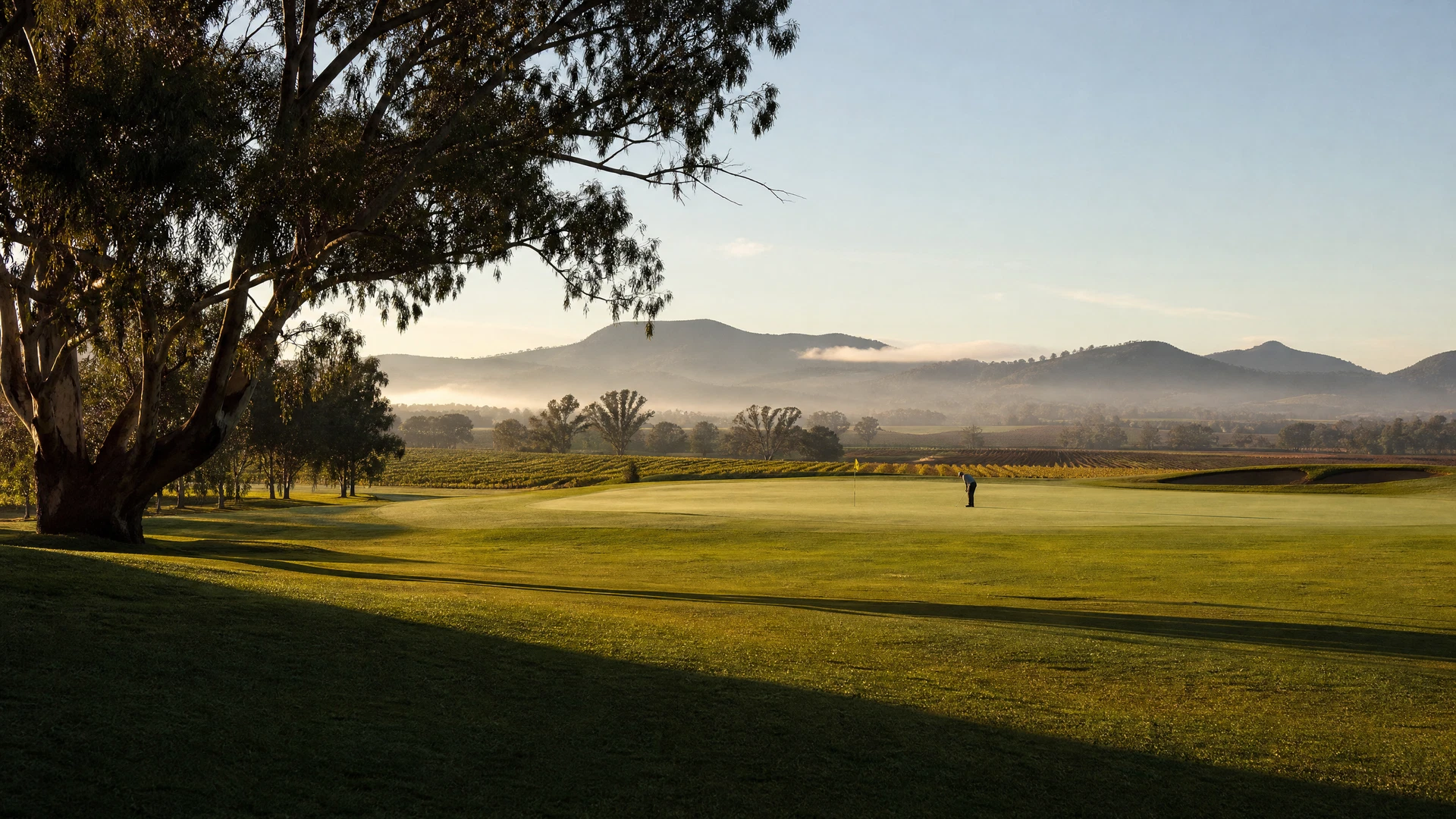
There is a fleeting silence that descends upon the Hunter Valley just before the first light of day breaks over the Brokenback Range. For those who rise with the sun, the reward is a landscape transformed—a world of silver mist clinging to ancient vine rows and dew-heavy fairways that stretch toward the horizon like velvet. In this viticultural heartland, the pursuit of the perfect swing becomes a meditative journey. Whether navigating dramatic elevation changes or avoiding sand traps that punctuate the rolling terrain, the experience is less about the scorecard and more about the profound stillness of a valley awakening. It is a morning defined by the scent of damp earth and the quiet camaraderie of those who know the best rounds are played before the world begins to stir.
The journey begins in the indigo hours, a time when the valley is still dreaming. As the car winds through the quiet lanes of the lower Hunter, the headlights catch the ghostly silhouettes of Shiraz vines, their gnarled arms reaching out from the dark soil. There is a crispness to the air here that vanishes by noon, a lingering chill that demands a light sweater and a steady hand. Arriving at the clubhouse, the sound of gravel crunching underfoot is the only disruption to a silence so deep it feels physical. The staff move with a practiced efficiency, preparing motorized carts that still carry the scent of yesterday’s sun. Here, at the edge of the day, the anticipation is not just for the game ahead, but for the slow revelation of the landscape as the shadows begin to retreat.
As the clock strikes six-thirty, the first tentative rays of gold begin to crest the jagged peaks of the mountain range that guards the valley’s western edge. It is a transformative moment; the grey-blue world suddenly ignites with warmth, and the low-lying mist that blankets the hollows begins to glow like incandescent silk. Standing on the first tee, the view is staggering. The fairway is a ribbon of emerald, darkened by the heavy dew that will soon be brushed away by the first flight of the ball. To the left, the structured geometry of a neighboring vineyard provides a stark, beautiful contrast to the organic curves of the course. It is a reminder that in this region, sport and agriculture are not merely neighbors but partners in a shared aesthetic.
Navigating a championship layout in this region requires more than just technical skill; it demands an appreciation for the valley’s unique topography. One might find themselves standing on an elevated tee box, looking down at a green that seems impossibly distant, framed by a phalanx of strategically placed bunkers that glow white in the morning light. The elevation changes are significant, turning a simple walk into a series of grand reveals. As you ascend a ridge, the entire sub-region unfolds below—a mosaic of cellar doors, pastoral estates, and the endless, rhythmic lines of the vines. The wind, still gentle at this hour, carries the faint, sweet smell of ripening grapes, a sensory cue that you are playing in a garden as much as on a golf course.
There is a particular hole, perhaps the seventh on a signature course, where the boundary between the fairway and the vineyard simply vanishes. Here, a stray hook might find its way into the heart of a Shiraz block, the white ball resting against the dark, iron-rich earth that gives the local wines their character. It is a humbling experience to stand so close to the source of the region’s fame, realizing that the very soil you are walking upon is the lifeblood of the valley. The vines themselves are a silent audience, their leaves fluttering in the rising breeze as if acknowledging the effort of the golfer. It is a physical interaction with a landscape that has been cultivated for generations.
As the sun climbs higher, the mist begins to lift, but it lingers in the low-lying pockets of the rough, creating a sense of mystery. Out of these white veils, the valley’s permanent residents often emerge. A mob of eastern grey kangaroos might be seen grazing near a water hazard, their ears twitching at the sound of a well-struck iron. They are unbothered by the presence of golfers, moving with a languid grace that mirrors the unhurried pace of the morning. The birds, too, are in full chorus now—the raucous laugh of a kookaburra or the melodic warble of a magpie providing a natural soundtrack to the round. It is a reminder that despite the manicured perfection of the greens, this is still a wild place, a bushland sanctuary at its core.
The middle holes often present a tactical puzzle, where the beauty of the surroundings can be a distraction from the hazards at hand. Dozens of bunkers, their edges sharp and daunting, guard the approaches to the greens like silent sentinels. The sand is cool and damp from the night, requiring a different touch than the sun-baked traps of the afternoon. As the dew begins to evaporate, the greens speed up, their surfaces becoming true and fast. There is a meditative quality to the putting process here, the silence of the valley allowing for a level of concentration that is rare in more urban settings. Every stroke is a dialogue with the land, a test of how well one can read the subtle slopes and hidden breaks of the ancient soil.
By the time the back nine is well underway, the character of the morning has shifted. The golden light has turned to a brilliant, clear white, and the last vestiges of the mist have vanished into the blue sky. The air begins to lose its chill, replaced by a growing warmth that hints at the heat to come. The shadows, once long and dramatic, are shrinking toward the base of the trees. The cool, damp fairways are now dry and springy underfoot, and the golfers who started at dawn find themselves finishing their rounds just as the rest of the valley is beginning to wake. It is a satisfying transition, a sense of having captured the best part of the day before the crowds arrive.
As the final putt drops and the clubs are packed away, there is a profound sense of accomplishment that transcends the final score. Retiring to the clubhouse balcony, a cold drink in hand, the view of the course you have just traversed is different now. The fairways are dotted with other players, and the stillness of the dawn has been replaced by the hum of activity. But for those who were there at first light, the memory of the mist-veiled vines and the orange glow on the mountain peaks remains. It is a reminder that the Hunter Valley is a place of cycles—of harvests, of seasons, and of the daily rhythm of the sun. To play golf here is to become a part of that rhythm, a participant in the timeless beauty of the valley.