Hunter Valley
The Silent Stones of Wollombi: A Wistful Journey Through the Hunter Valley’s Living Nineteenth-Century Heritage
There is a specific kind of silence that settles over the Hunter Valley when the morning mist refuses to lift, a quietude that feels less like an absence of sound and more like a presence of history. In the small, preserved village of Wollombi, this atmosphere is not merely a seasonal occurrence but a permanent resident. Tucked away at the junction of the Wollombi Brook and Congewai Creek, this settlement serves as a gateway to a past etched in hand-chiseled sandstone and timber slab. To walk its heritage circuit is to step out of the frantic pace of modern viticulture and into a landscape where the nineteenth century still breathes, offering a poignant reminder of the convicts and pioneers who carved a life out of the rugged Australian bush.
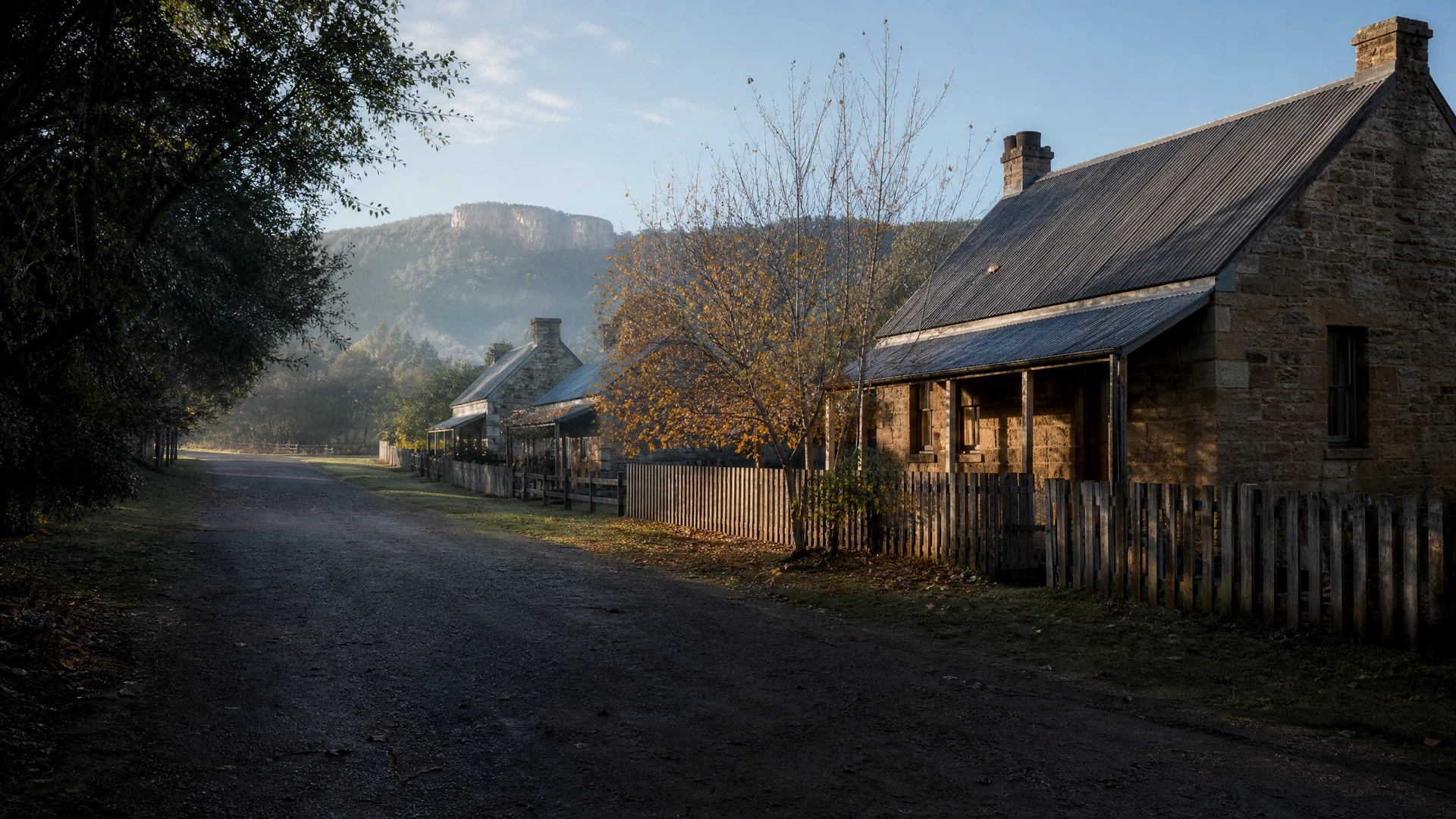
The approach to Wollombi feels like a slow descent into a different era, as the rolling vineyard slopes of the lower valley give way to the shadowed, timbered ridges of the Yengo wilderness. Here, the air seems thicker with the scent of damp earth and eucalyptus, especially when a silver-grey fog clings to the valley floor, blurring the lines between the present day and the village’s colonial inception. Wollombi is defined by its edges—the edge of the wild, the law, and memory. It was once a vital stop for those traversing the Great North Road, a convict-built artery that connected Sydney to the fertile north, and today, it remains a sanctuary for those seeking a connection to the enduring spirit of the land.
At the heart of the village stands the Endeavour Museum, housed within the austere walls of the 1866 courthouse and police station. To enter this building is to feel the weight of early colonial governance, where the scent of aged cedar joinery mingles with the cool, damp breath of the original holding cells. The craftsmanship is undeniable, yet there is a melancholy to the precision of the timberwork, a reminder of the order that was imposed upon a landscape that often felt lawless. As one wanders through the exhibits, the artifacts of daily life—rusted tools, faded photographs, and delicate lace—speak of a community that was both isolated and deeply interconnected, bound together by the shared challenges of a frontier existence and the steady, rhythmic pulse of the nearby brook.
A short stroll along the level path leads to the village’s architectural jewels: the sandstone churches that stand as sentinels of faith in a changing world. St John’s Anglican Church, a Gothic-style masterpiece designed by the renowned Edmund Blackett, rises from the earth with a grace that seems to defy the heaviness of its materials. Nearby, St Michael’s Catholic Church tells a more resilient story; having survived the devastating flood of 1893, the entire structure was painstakingly relocated to higher ground, stone by stone. There is a profound wistfulness in the sight of these buildings, their golden masonry glowing in the late afternoon sun, serving as a testament to a time when the spiritual and the physical were inextricably linked, and the community’s devotion was literally built into the landscape.
The heritage walk is not merely a collection of buildings but a narrative of human labor, most notably evidenced by the proximity to the Great North Road. This road, a monumental feat of engineering achieved through the forced toil of thousands of convicts, remains a haunting presence in the valley. The stones underfoot and the culverts that line the path are silent witnesses to a history of hardship and endurance. To walk here is to acknowledge the ghosts of those who were forgotten by the official records, their presence felt in the geometric precision of a hand-cut block or the curve of a retaining wall. It is a sobering reflection on the cost of progress and the way the Australian landscape has been shaped by hands that were often in chains.
Contrastingly, the village’s social continuity is found in the enduring presence of the Wollombi Store and the historic Tavern. The store, dating back to 1841, continues to serve as a hub for both locals and travelers, its timber floors worn smooth by generations of footsteps. Across the way, the Tavern has been a gathering place since 1868, its traditional architecture and rustic charm providing a sense of grounding in an increasingly digital world. There is a comforting rhythm to the life here, where the clink of glasses and the murmur of conversation feel like an echo of the nineteenth-century teamsters and settlers who once sought refuge within these same walls. It is a reminder that while the world outside may accelerate, the basic human need for community and connection remains unchanged.
On the outskirts of the village, a more personal and poignant history awaits at the grave of Jane Pendergast. Located just beyond the boundaries of the consecrated cemetery, this solitary resting place serves as a quiet monument to a life that did not quite fit within the established norms of the time. There is a deep, resonant sadness in the isolation of the site, yet it also possesses a strange beauty, surrounded by the untamed bushland that Jane would have known so well. It invites a moment of introspection, a chance to consider the stories that fall through the cracks of history and the individuals whose legacies are preserved not in grand monuments, but in the quiet corners of a rural valley, whispered by the wind through the gum trees.
The village of Wollombi does not exist in a vacuum; it is deeply entwined with the rugged topography of the surrounding Yengo National Park. The towering sandstone cliffs and dense forests of the park provide a dramatic backdrop to the village’s gentle circuit, a constant reminder of the ancient landscape that predates colonial settlement by millennia. This connection to the wild gives Wollombi a sense of perspective, a realization that the nineteenth-century structures, however enduring they may seem, are but a brief chapter in a much longer story. The heritage walk encourages a slower pace, an invitation to observe the way the light plays across the ridges and the way the local birdlife claims the historic eaves, bridging the gap between the human and the natural worlds.
As the walk concludes and the sun begins to dip behind the western ranges, a sense of wistful gratitude often takes hold. Wollombi is not a museum frozen in time, but a living village that honors its past while continuing to evolve. The heritage walk offers more than just a history lesson; it provides a space for contemplation, a chance to walk alongside the shadows of the past and find a sense of stillness in a restless age. Leaving the village, one carries away the texture of the hand-chiseled stone, the scent of the woodsmoke, and the enduring silence of the valley. It is a journey that lingers in the mind long after the car has climbed back toward the modern world, a quiet reminder that the past is never truly gone, but simply waiting to be remembered.