Hunter Valley
The Quiet Anchor of the Great North Road: A Wistful Afternoon at Wollombi’s Historic Sandstone Tavern
In the golden, slanting light of a Hunter Valley autumn, the village of Wollombi stands as a serene testament to the passage of time. Here, at the junction of the convict-carved Great North Road, the historic Wollombi Tavern offers more than just a place to rest; it provides a portal into a slower, more deliberate era of Australian rural life. Between the weathered sandstone of nineteenth-century churches and the gentle murmur of the Wollombi Brook, visitors find a rare stillness that defies the modern pace. This is a story of shadows lengthening over ancient masonry, the legend of a local brew, and the quiet magic of a Sunday afternoon spent where history and the present moment collide in a soft, amber glow.
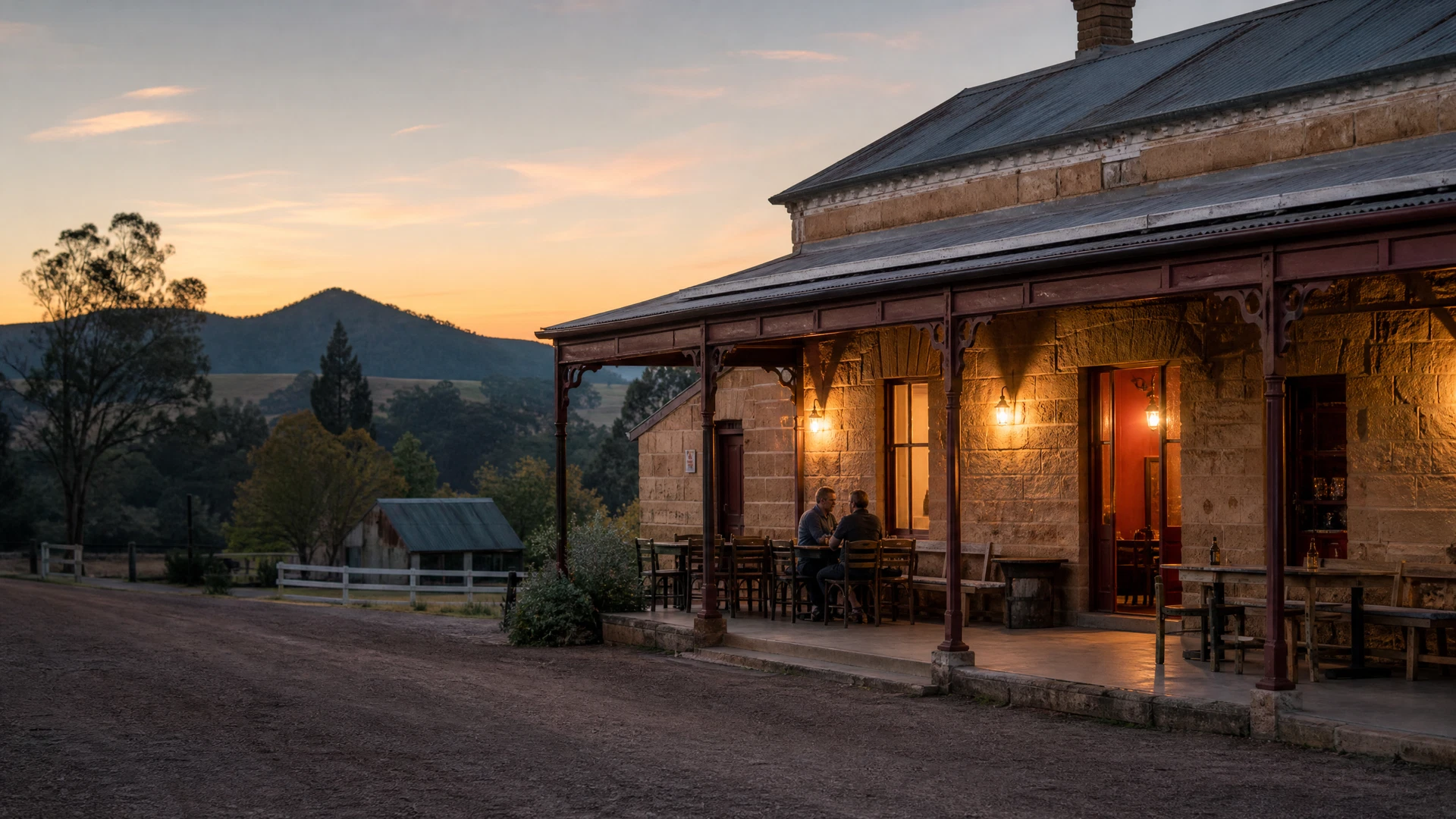
The Great North Road does not merely lead to Wollombi; it delivers you with a weight of history that feels almost physical. Carved by convict hands nearly two centuries ago, Tourist Drive 33 serves as a rhythmic introduction to a landscape where the modern world loses its grip. As the bitumen twists through the fringes of Yengo National Park, the air cools and the bushland parts to reveal the patient valleys of the Hunter. Arriving here on a Sunday afternoon is like exhaling a breath you didn't know you were holding. The village, nestled at the confluence of history and geography, feels like a stage where the actors have departed, leaving only sandstone architecture. The tavern, standing proudly at the crossroads, is the destination for anyone seeking the soul of this quiet corner.
To walk through Wollombi is to move through a gallery of colonial endurance. The village is anchored by structures that have weathered floods, fires, and the slow erosion of decades. St Michael’s Catholic Church, a stoic monument of sandstone, stands as a reminder of a community that moved its foundations to higher ground after the 1893 inundation. Nearby, the Endeavour Museum—housed in the former 1866 courthouse—retains the sharp lines of colonial masonry and the elegant weight of cedar joinery. These buildings are not mere relics; they are the skeletal remains of a frontier ambition that carved order out of the wild scrub. In the late afternoon, the sandstone takes on a luminous quality, as if the stones are releasing the warmth gathered over a century of observation.
At the heart of this heritage sits the Wollombi Tavern, a site that has hosted weary travelers since the Wine Saloon opened in the 1840s. The current iteration, established in 1868, carries the stories of a resilient life. It survived the reconstruction necessitated by a catastrophic 1959 fire, an event that solidified its status as a regional icon. There is a specific dignity in a building that has seen the transition from horse-drawn carriages to the modern visitors who arrive via the winding forest roads. Inside, the air is thick with the scent of seasoned timber and the low hum of local conversation. It is a place where the floorboards groan under history, and every corner holds a shadow containing a fragment of a forgotten pioneer’s dream.
Stepping into the tavern’s sprawling beer garden is an exercise in surrender. The space flows toward the banks of the Wollombi Brook, where the water moves with a lethargy that matches the afternoon’s mood. Under the shade of ancient trees, long timber tables host a mosaic of travelers—bikers, families, and solitary dreamers nursing a glass of amber liquid. The brook acts as a natural boundary, its slow current reflecting the silver-green of overhanging gums and the pale blue of the vast Australian sky. Here, the requirements of the week are replaced by the simple pleasure of watching a dragon-fly skim the water or listening to the rhythmic call of a kookaburra. It is a sanctuary where the clock stops, allowing the landscape to speak in its own language.
As the clock ticks toward four, the atmosphere undergoes a magical transformation. The light, filtered through the smoke-blue haze of the Yengo ridges, becomes directional and dramatic. Long, spindly shadows stretch across the dusty wooden verandas, and the textures of weathered timber and corrugated iron roofs become hyper-vivid. This is the hour of the "wistful ink," when the landscape seems to be composing its own poetry. The golden light emphasizes the deep pits and tool marks in the sandstone of the nearby buildings, making the labor of the convicts who built the Great North Road feel startlingly recent. There is a sense of suspended animation, a collective realization that this alignment of light is fleeting. It is a moment that demands a pause, or perhaps just the soft clink of a glass.
No visit is complete without an encounter with the legend of "Dr. Jurd’s Jungle Juice." This potent local concoction, a dark blend that has fueled decades of regional folklore, is as much a part of Wollombi as the sandstone itself. Born from the tavern’s mid-century history, the drink has become a symbol of the village’s idiosyncratic spirit—a reminder that even in a place so steeped in formal history, there is always room for a bit of wild, rural irreverence. To sip the juice while sitting on the veranda is to participate in a ritual of pub culture. It is a beverage that defies easy categorization, blending the sweetness of the land with a kick that recalls the ruggedness required to survive in the early colony. It is the enduring taste of the valley.
Sitting there, one reflects on the thousands who have passed through this junction. The Great North Road was once a lifeline of sweat and sorrow, a path for those seeking a new life and those forced to build the infrastructure. The tavern has been the silent witness to it all—the hopeful arrivals, the weary departures, and the quiet lives lived in the shadows. There is a profound melancholy in the realization that while we are merely passing through on a Sunday excursion, the land and its stone sentinels remain. The ghosts of the 1840s saloon seem to linger just out of sight, their presence felt in the way the wind ruffles the leaves or the way the tavern’s lights twinkle as the dusk settles. We are all just travelers.
Eventually, the return journey begins to exert its influence. The winding curves of Tourist Drive 33 require a steady hand and enough daylight to navigate the forest shadows safely. As the last notes of local music fade and the tavern’s sandstone exterior turns a deep purple in the twilight, the departure feels like a small bereavement. Leaving Wollombi is a slow process of re-entering the present century. The drive back toward the neon lights of the city or the cellar doors is marked by a lingering sense of stillness, a mental souvenir of an afternoon where time was allowed to stretch and breathe. The tavern remains behind, a quiet anchor at the crossroads, waiting for the next Sunday, the next traveler, and the next golden hour to illuminate its ancient stones.