Hunter Valley
The Silent Ascent Over Pokolbin Where the Morning Mist Lingers Like a Half-Forgotten Dream of Gold
Before the first light touches the ancient ironbark huts of the Hunter Valley, a quiet ritual begins in the shadows of Pokolbin. There is a specific, fragile beauty in the moments preceding dawn, where the air is sharp with frost and the world remains suspended in a silver-grey hush. To rise above the vineyards in a hot-air balloon is to surrender to the whims of the wind, drifting over a landscape etched by generations of viticulture and the deep history of the Wonnarua and Darkinjung lands. It is a journey of quietude and fire, a fleeting elevation that offers a rare perspective on the structured geometry of the vines and the enduring silhouette of the Broken Back Range, culminating in a celebration of the day’s arrival.
The world at four in the morning is a place of whispers and shivering anticipation, a liminal space where the boundaries between dreams and the waking world are blurred by a thick, silver frost. We gathered in the dim light of Peterson House, our breath blooming in the cold air like small, ephemeral ghosts. There is a peculiar intimacy in this shared pre-dawn vigil, a collective surrender of sleep in pursuit of something as ancient and elemental as the wind. As we moved toward the launch site, the grass crunched under our boots, a rhythmic percussion in the stillness of the Pokolbin valley. The darkness felt heavy, yet it was charged with the promise of the coming light, a silent wait for the fire that would soon lift us away from the earth and into the waiting sky.
The silence was abruptly shattered by the violent, rhythmic roar of the propane burners, great tongues of orange flame licking into the hollow bellies of the nylon envelopes. It is a visceral transformation to witness; what was once a crumpled, lifeless heap of fabric begins to swell and heave, growing into a towering, vibrant giant that strained against its tethers. We stood on the periphery, occasionally invited to hold a rope or steady a seam, feeling the immense heat radiate against our faces while the rest of our bodies remained encased in the valley’s icy grip. There is a raw, industrial beauty in this process, a marriage of elementary physics and sheer human will that feels both archaic and miraculous in the shadow of the modern world.
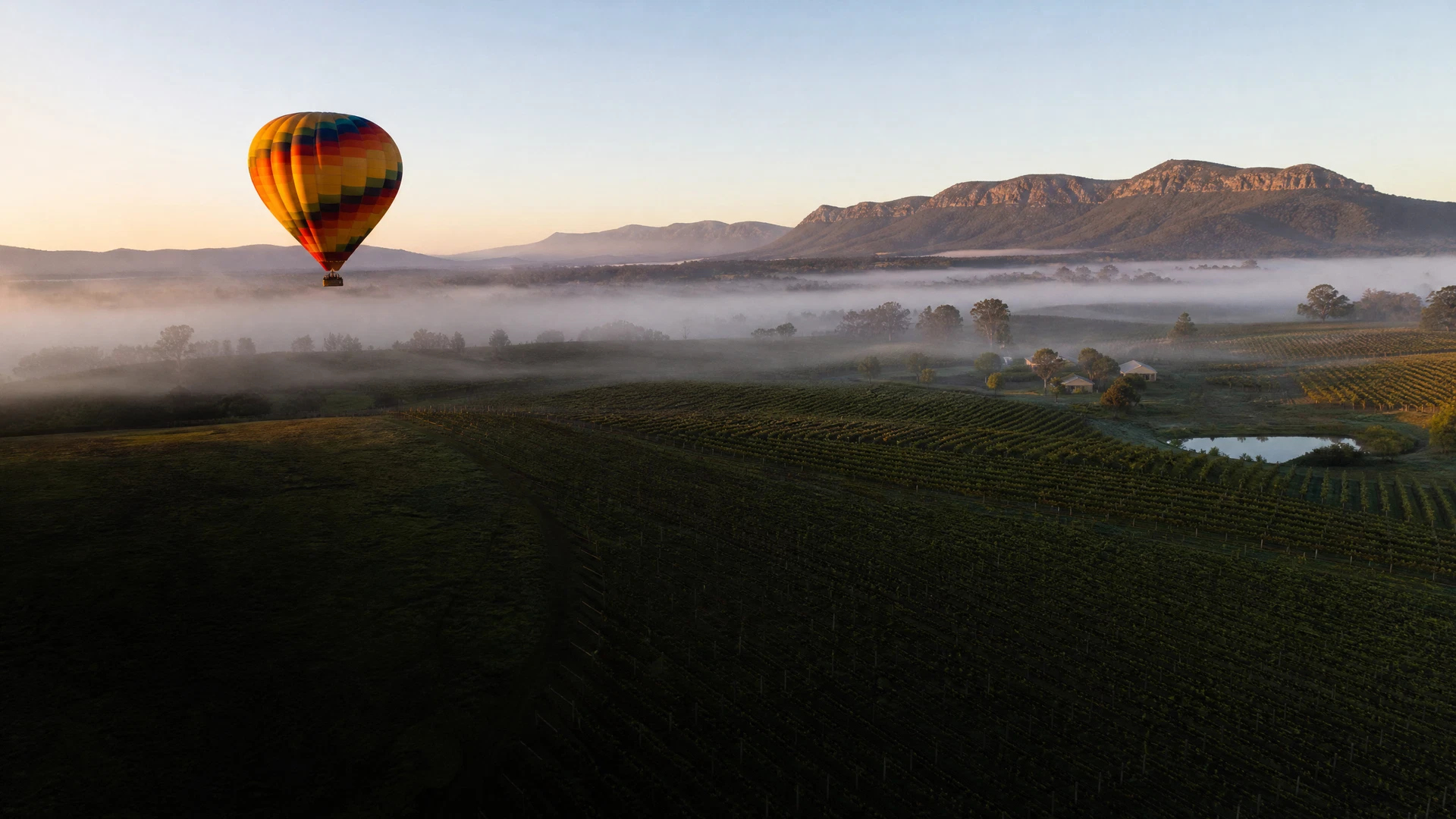
Then came the moment of departure, not a sudden jolt, but a gentle, almost imperceptible loosening of the earth’s hold. One moment the basket was grounded in the dew-heavy soil, and the next, the world began to sink away from us. There is no sensation of movement, only the realization that the trees are shrinking and the horizon is expanding. As the pilot eased off the burner, a profound, heavy silence settled over us, broken only by the distant bark of a dog or the faint rustle of the wind through the canopy below. We were no longer mere spectators of the landscape; we had become part of the atmosphere, drifting with the same effortless grace as the morning mist that clung to the hollows of the Rothbury hills.
Below us, the structured geometry of the Hunter Valley revealed itself in a tapestry of green and gold, a testament to the enduring legacy of Australia’s oldest wine district. From this height, the vineyards of Pokolbin looked like a meticulously embroidered quilt, the rows of Semillon and Shiraz vines tracing the contours of the Wonnarua and Darkinjung traditional lands. It is a landscape shaped by both nature and necessity, where the ancient soil meets the ordered hand of the viticulturist. We drifted over ironbark huts and modern cellar doors, the history of the region laid bare in the varying textures of the earth. There is a wistful quality to seeing the world from this perspective, a reminder of the fragility and the resilience of the life that thrives in these sun-drenched valleys.
As we ascended toward two thousand feet, the sun finally crested the horizon, a molten sliver of gold that transformed the grey dawn into a riot of color. The light caught the edges of the Broken Back Range, turning the jagged peaks into silhouettes of bruised purple and burning orange. The valley floor, previously hidden beneath a layer of low-lying fog, began to glow as if illuminated from within. The mist swirled and dissipated in the warmth, revealing the hidden dams that mirrored the sky like scattered shards of glass. It was a moment of pure, unadulterated clarity, where the complexities of the world below seemed to vanish, replaced by the simple, breathtaking beauty of the light as it reclaimed the land from the night.
There is a specific kind of solitude to be found at such an altitude, a feeling of being suspended in a glass jar of silence. The air here is thinner, sharper, and carries the scent of nothing but the sky itself. We looked out across the expanse toward Lovedale and beyond, the distant hills fading into a soft blue haze that suggested an infinite horizon. In the basket, conversation was sparse, as if speaking too loudly might shatter the fragile peace of the morning. We watched other balloons in the distance, tiny, colorful spheres suspended in the void, appearing as stationary as stars. It is a humbling experience to be so small against the vastness of the Australian sky, a silent observer of a world that continues to turn regardless of our presence.
The descent was a slow, reluctant return to reality, a gradual narrowing of the perspective as the details of the earth began to sharpen once more. The individual leaves on the vines became visible, and the cattle in the paddocks looked up with mild curiosity as we drifted low over their heads. The pilot navigated with a quiet, practiced precision, seeking a clearing amidst the vines for our landing. When the basket finally touched the ground, it was with a series of soft thuds and a final, grounding slide across the damp grass. We stepped out, our legs feeling strangely heavy after the weightlessness of the flight, and joined in the communal effort of deflating the envelope, a grounding ritual that signaled the end of our celestial journey.
We concluded the morning with a traditional champagne breakfast, the bubbles sharp and bright against the lingering chill of the dawn. Sitting amongst the vines, the sun now high and warm on our backs, the experience already began to feel like a memory, something ethereal and half-remembered. The Hunter Valley had returned to its usual rhythm—the tractors starting up, the cellar doors preparing for the day’s visitors—but for us, the world felt subtly different. We had touched the silence of the clouds and seen the sun rise over the ancient hills from a place of absolute stillness. As we drove away from Pokolbin, the wistful ache of the experience remained, a quiet reminder that the most beautiful moments are often those that are the most fleeting.