Craft
Ceramicists are treating the firing schedule as part of the design.
Beyond the shaping of clay, contemporary ceramicists are reclaiming the kiln’s heat as a primary design tool, transforming the firing schedule from a final technical step into a deliberate act of creative composition.
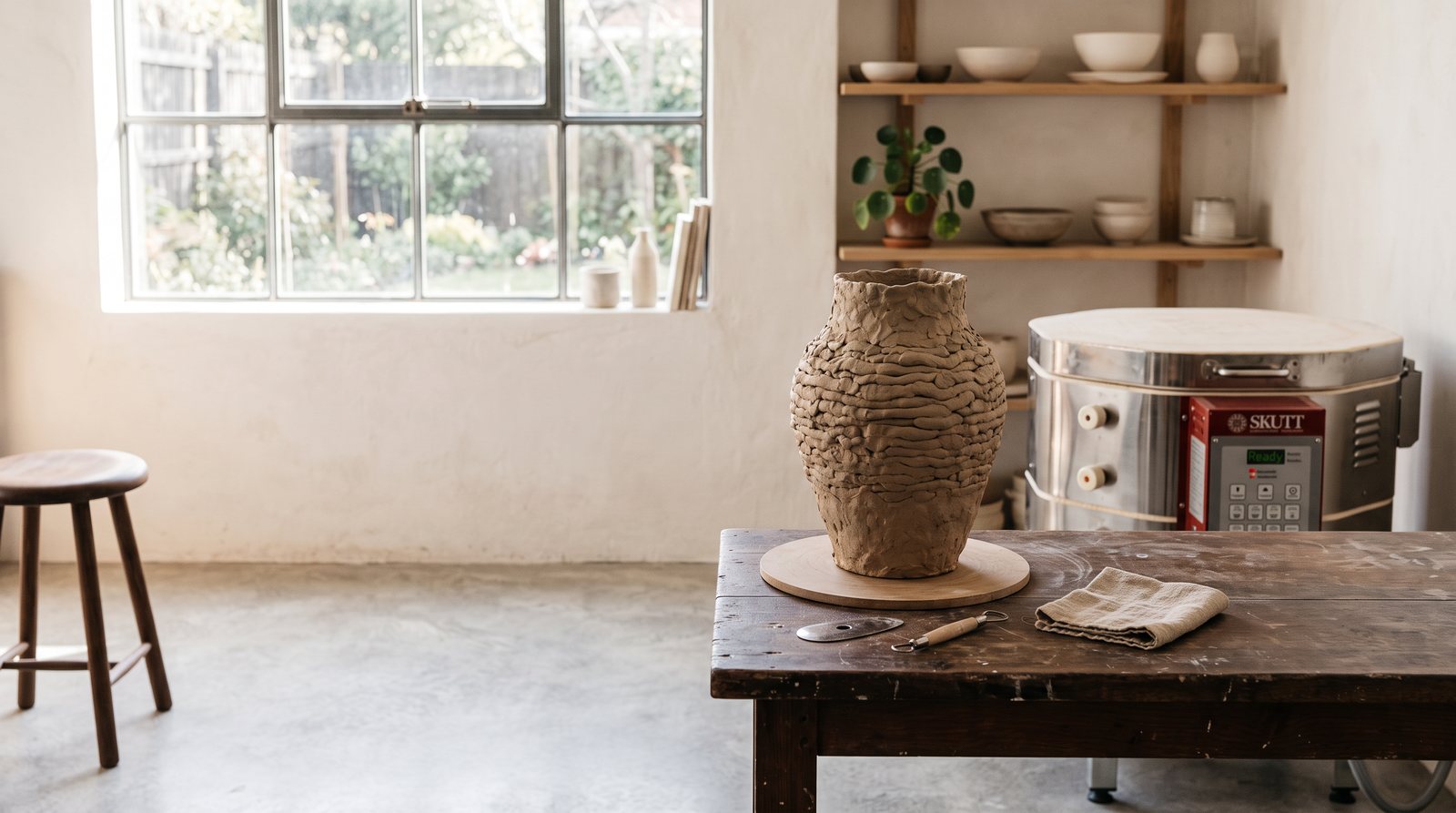
The tradition of ceramics has long treated the firing process as a final, somewhat unpredictable hurdle—a necessary transformation where the maker’s influence ends once the kiln door is sealed. However, a growing movement within contemporary craft is reframing the firing schedule not as a technical conclusion, but as a primary design phase. By treating the kiln as an active participant rather than a passive oven, ceramicists are discovering that the way heat is applied and withdrawn can be just as expressive as the initial shaping of the clay. This shift requires a deep understanding of thermal dynamics and material science, moving the artist from the potter’s wheel into the realm of atmospheric management and precision temperature control. The resulting works are not merely shaped by hands but are fundamentally defined by the invisible currents of heat that circulate within the firing chamber.
Central to this new approach is the concept of heat work, which differs from simple temperature measurement. While a thermometer indicates a specific degree, heat work accounts for the duration of exposure to that heat, allowing the clay and glazes to undergo complex chemical changes. By manipulating the rate of temperature rise—the ramp—artists can influence how minerals in the clay body migrate to the surface or how glaze components melt and mingle. A slow ramp might allow for a more thorough vitrification, resulting in a denser object, while a rapid ascent might trap gases within the material, creating intentional textures that define the work’s final character. This mastery of time and temperature transforms the kiln from a tool of completion into a tool of composition, where every degree matters.
The atmosphere inside the kiln—whether oxidation, where oxygen is plentiful, or reduction, where it is starved—acts as a chemical brush that alters the final appearance of the piece. In a reduction firing, the kiln environment seeks oxygen from the metallic oxides within the clay and glazes, fundamentally altering their molecular state and color. A copper-based glaze that would appear green in an oxidation environment can be transformed into a deep, vibrant oxblood red when the firing schedule includes a sustained reduction period at specific temperature thresholds. Ceramicists are now choreographing these atmospheric shifts with precision, alternating between states to layer effects that were once considered the result of happy accidents but are now the product of rigorous design.
If the heating phase is about transformation, the cooling phase is about stabilization and the process of crystallization. The firing schedule does not end at the peak temperature; rather, the "down-ramp" or controlled cooling is where many of the most sophisticated surface effects are achieved. By holding the kiln at specific temperatures during the descent, artists can encourage the growth of macro-crystals within the glaze, resulting in surfaces that shimmer with depth and a unique tactile quality. Conversely, a rapid "quench" might freeze a glaze in a glassy, transparent state, preserving the raw color and texture of the underlying clay. This level of control allows the designer to specify the visual and tactile quality of the piece long after the physical forming is complete, making the cooling cycle a critical part of the artistic intent.
The integration of digital kiln controllers has revolutionized the ability to execute these complex firing schedules with high repeatability. These devices allow for the programming of multi-step sequences that would be nearly impossible to manage manually over the long durations required for high-fire ceramics. However, this technology does not replace the artisan’s intuition; instead, it provides a more reliable bridge between the artist’s intent and the kiln’s behavior. By analyzing data from previous firings, makers can refine their schedules, treating each "burn" as a data point in a larger trajectory of design experimentation.
Beyond aesthetics, the firing schedule is a critical factor in the structural integrity and durability of the ceramic object. The rate at which chemically combined water is driven off and the speed at which the clay passes through the quartz inversion point—a critical temperature where silica crystals change shape—determine whether a piece survives the fire or succumbs to stress fractures. By designing schedules that respect these physical transitions, ceramicists can push the boundaries of form, creating delicate, gravity-defying structures that would otherwise be impossible to fire successfully. The design, therefore, is not just about what the object looks like, but how it survives the intense physical trial of the kiln, ensuring that the final form is both beautiful and permanent.
The practice of maintaining a detailed kiln journal is essential to this design-centric approach, acting as both a technical log and a creative manifesto. These records serve as a technical archive, documenting every ramp, soak, and cooling cycle alongside the resulting visual and structural outcomes in meticulous detail. Theo Muir and other contemporary practitioners view these journals not just as logs, but as blueprints for future work and shared knowledge. By mapping the relationship between the firing schedule and the finished object, the journal becomes a creative tool that allows for the reproduction of specific effects and the systematic exploration of new ones. It is through this documentation that the firing schedule is elevated from a hidden process to a visible, shared vocabulary of craft.
Ultimately, treating the firing schedule as part of the design process represents a maturation of the ceramic medium. It acknowledges that the beauty of a ceramic object is not just a result of the maker’s hand, but of a collaborative partnership with heat, chemistry, and the passage of time. As ceramicists continue to experiment with the boundaries of the kiln, the distinction between "making" and "firing" continues to blur into a single, unified creative act. The kiln is no longer a black box where work disappears to be finished; it is a dynamic studio space where the most critical design decisions are made in the presence of the flame, resulting in objects that are as much a product of the fire as they are of the earth. This holistic approach ensures that every element of the process is imbued with the artist's vision.