World city
The Vertical Soul of Valparaíso: A Voyage Through Chile’s Jewel of the Pacific
Perched precariously on the steep cliffs of the Chilean coast, Valparaíso is a labyrinth of creaking funiculars, vibrant street art, and maritime echoes that tell the story of a city once known as the most important port in the Southern Hemisphere.
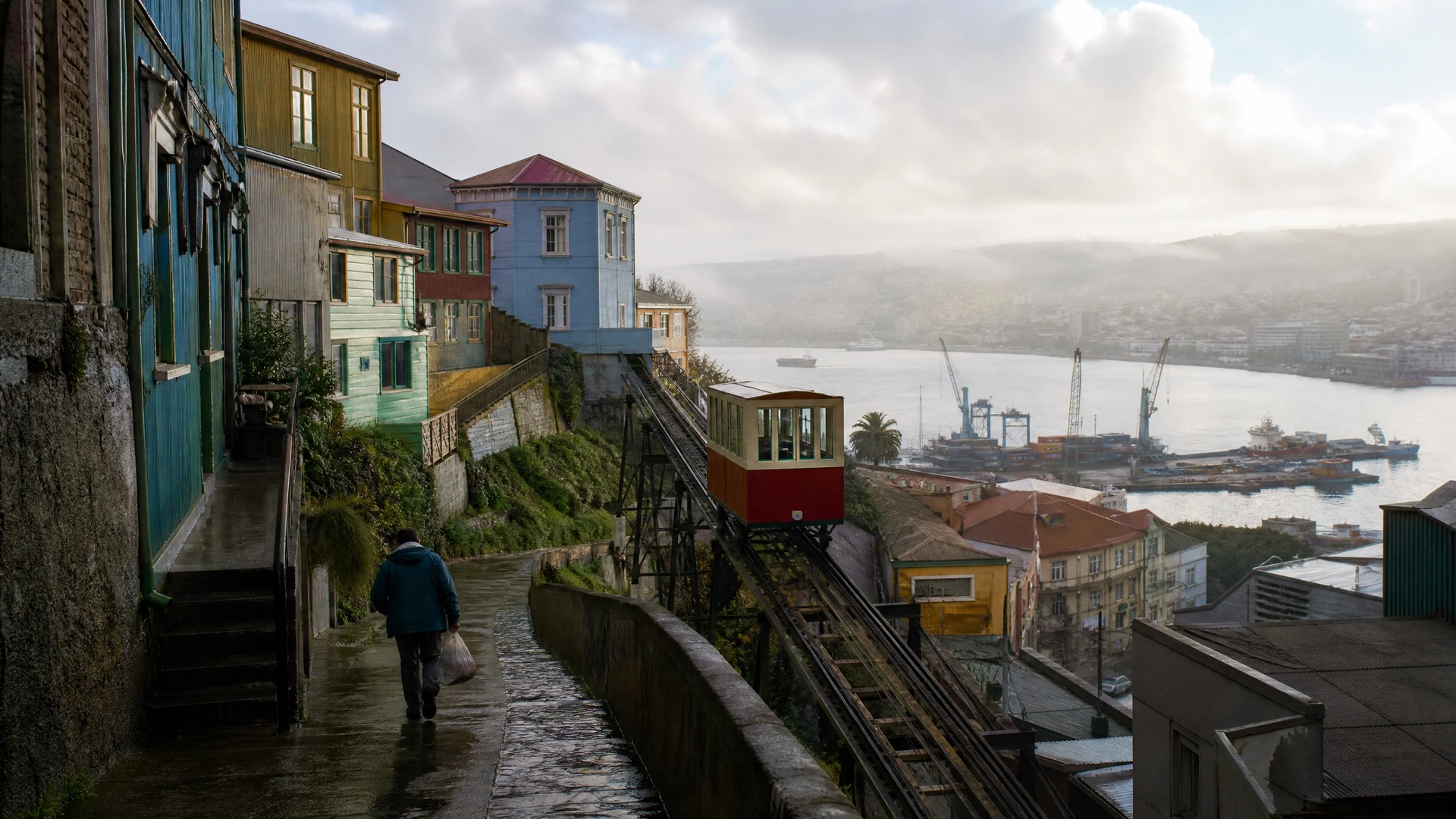
The first encounter with Valparaíso is a sensory overload, a dizzying cascade of color that seems to defy gravity. Arriving from the modern sprawl of Santiago, the landscape shifts as the road winds toward the Pacific, revealing a natural amphitheater where the urban fabric is stitched across more than forty distinct hills, or cerros. Here, the city clings to the land with houses of corrugated metal and weathered wood painted in every conceivable shade—turquoise, ochre, and deep crimson. This is the 'Jewel of the Pacific', a place where the air is thick with salt spray and the sound of distant foghorns. It is a city of verticality, where every corner turned offers a new, breathtaking perspective of the harbor below.
To understand Valparaíso’s wistful soul, one must look back to the mid-19th century, when the city was the undisputed queen of South American trade. Before the Panama Canal opened in 1914, every ship rounding Cape Horn stopped here, bringing a global mosaic of immigrants. British and German merchants built grand Victorian mansions on Cerro Alegre and Cerro Concepción, while the port hummed with the energy of a thousand languages. This golden age earned the city its UNESCO World Heritage status, but also left a lingering nostalgia. When the canal opened, maritime traffic vanished, leaving the city to settle into a graceful, gritty decay. Today, that history is visible in the rusted ironwork and faded grandeur of the Customs House.
The mechanical heart of the city lies in its funiculars, the 'ascensores' that have served as the lifeblood of the hills for over a century. At their peak, nearly thirty of these wooden carriages crawled up the near-vertical slopes. Today, a handful remain in operation, including the iconic Ascensor El Peral and Ascensor Concepción, the city’s oldest. Riding one is a rite of passage; the wooden doors creak shut, the gears groan, and for a few moments, you are suspended in mid-air, looking out over red-tiled roofs. These elevators are essential tools for residents, providing a vital link between the working-class 'Plan'—the flat area by the sea—and the bohemian enclaves above, remaining as functional as the day they were built.
Walking through Cerro Alegre and Cerro Concepción is like stepping into a living gallery where the boundaries between art and life are blurred. These neighborhoods, once the domain of wealthy European traders, are now the epicenter of Valparaíso’s bohemian spirit. Narrow, cobblestone alleys are lined with boutique hotels, cozy cafes serving strong Chilean coffee, and art studios where local creators work in the soft coastal light. The architecture is a peculiar blend of styles—Victorian bay windows, intricate wooden fretwork, and the ubiquitous corrugated metal siding that protects homes from the harsh sea air. It is a place for aimless wandering, where a flight of stairs might lead to a hidden terrace or a quiet, leaf-strewn plaza.
While architecture provides the bones, street art provides the voice. Valparaíso is world-renowned for its murals, which cover everything from grand retaining walls to the smallest doorway. This is a sophisticated, sanctioned form of expression that transforms the city into a 'Museo a Cielo Abierto' (Open Air Museum). In the Cerro Bellavista district, murals are particularly dense, featuring works by Chile’s most famous artists. Themes range from the political to the whimsical, reflecting the city’s resilient identity. A stroll reveals massive portraits, surrealist dreamscapes, and abstract patterns that dance across the hills. This prolific creativity is a testament to the city’s ability to reinvent itself, using its weathered walls as a canvas for a vibrant, modern future.
No visit is complete without paying homage to its most famous resident, the Nobel laureate poet Pablo Neruda. His house on Cerro Bellavista, La Sebastiana, is as eccentric and ship-like as the man himself. Neruda sought a home that 'seemed to float in the air, but was well grounded in the earth', and he found it in this tall, narrow structure with panoramic views. The house is filled with his collections of nautical curiosities—old maps, figureheads, and colored glass—each room reflecting his whimsical nature. Standing on the top floor, where Neruda watched New Year’s Eve fireworks, one feels the connection between his poetry and the city’s rugged spirit. La Sebastiana is a physical manifestation of the wistful ink defining Valparaíso’s heritage.
Descending from the hills to the 'Plan', the atmosphere shifts from bohemian to industrious. The flatlands are where daily business takes place, centered around Plaza Sotomayor and the Monument to the Heroes of Iquique. Here, the Chilean Navy has its headquarters, and streets are lined with grand banks and administrative buildings from the city’s commercial peak. The port remains a hive of activity, with massive container ships dominating the waterfront. Watching the cranes move in a synchronized dance against the backdrop of the hills is a reminder that despite its artistic reputation, Valparaíso is still a working city. The contrast between the grit of the port and the beauty of the cerros gives the city its unique, multi-layered character.
Navigating the lower reaches offers its own charms, notably the historic trolleybus system. These green and cream electric buses, the second-oldest in South America, hum quietly along the flat avenues, their overhead wires crisscrossing the sky like a giant spiderweb. They are a nostalgic way to see the city’s traditional side, passing local markets and traditional diners. For a true taste of local culture, one must stop for a 'chorrillana'—a mountain of french fries topped with sautéed onions, beef, and fried eggs. It is a hearty meal reflecting the city’s rugged roots. The best time to visit is during the southern summer, from December to March, when the coastal mist clears to reveal the full brilliance of the city.
As the sun sets over the Pacific, casting a golden glow across the cascading hills, Valparaíso takes on a cinematic quality. The lights of the cerros begin to twinkle like a fallen constellation, and the sound of a distant tango or a street musician’s guitar drifts through the air. It is a city that demands patience and a willingness to get lost, rewarding the curious traveler with discovery at every turn. Valparaíso may no longer be the primary gateway to the Pacific, but it remains a gateway to a rich, layered history and a vibrant, living culture that continues to inspire. It is a place of wistful beauty, where the past is never truly gone, but simply painted over in a new, more brilliant shade.