World city
Standing at the Navel of the World: A Journey Through the Layered History of Cusco.
High in the Peruvian Andes, the former capital of the Inca Empire stands as a living testament to a collision of worlds, where ancient stone foundations support colonial grandeur and the thin mountain air carries the echoes of a civilization that never truly faded.
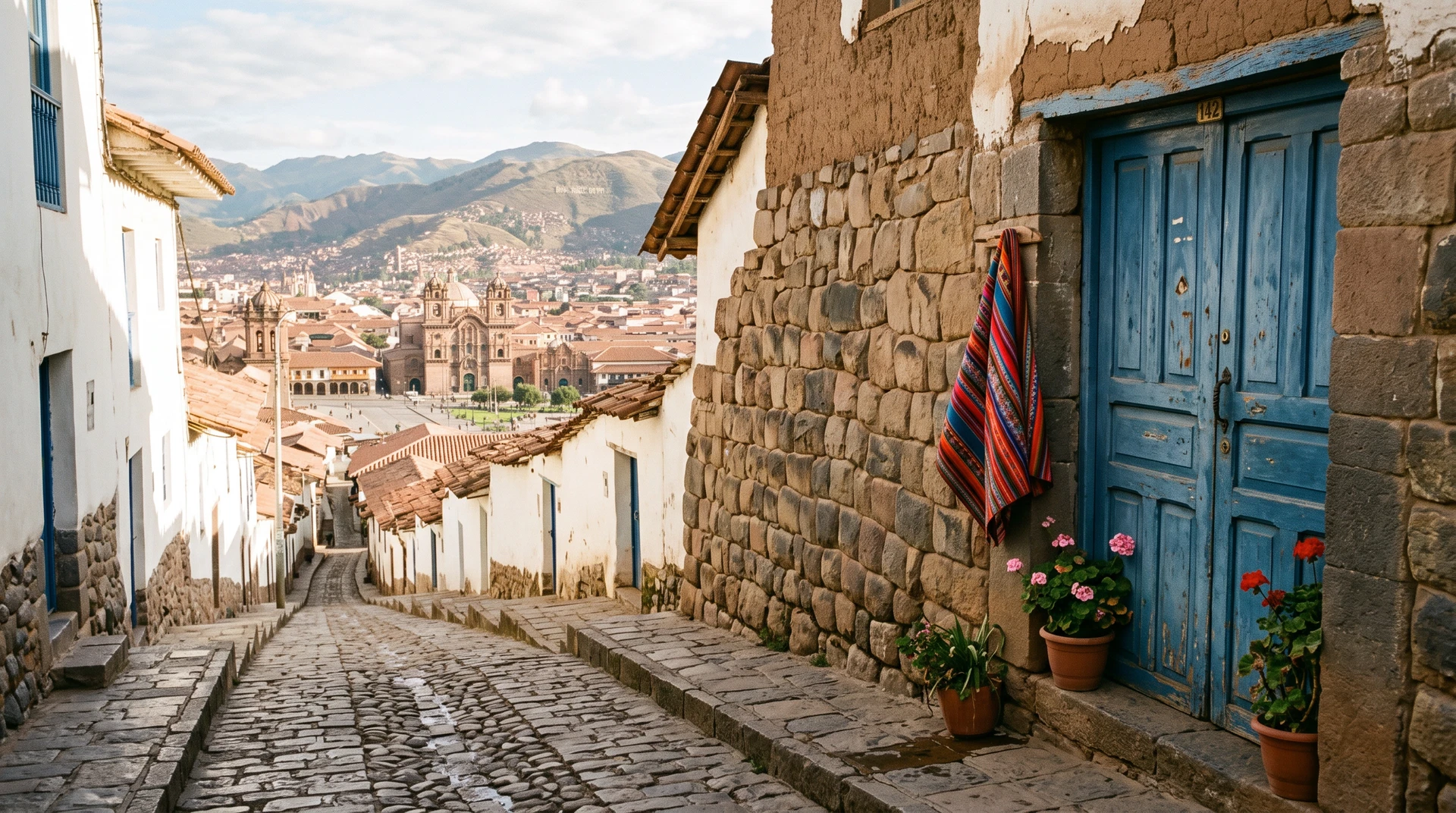
Stepping off a plane into the thin, crisp air of Cusco is a physical confrontation with history. At 3,400 meters above sea level, the atmosphere is noticeably sparse, forcing a slower, more deliberate pace that suits the city’s contemplative character. The first view is almost always a sea of terracotta-tiled roofs clinging to the emerald slopes of the Huatanay Valley, a sight that has greeted travelers for centuries. Here, the altitude is not merely a geographic fact but a gateway to a different rhythm of life. Visitors are often greeted with a steaming cup of mate de coca, a traditional herbal remedy for the soroche, or altitude sickness, that serves as the first sensory introduction to the Andean world. As the body adjusts to the sparse oxygen, the eyes begin to trace the remarkable contours of a city that was once the undisputed 'Navel of the World.'
Known to the Incas as Qosqo, the city was originally designed by the visionary ruler Pachacutec in the 15th century to resemble the shape of a puma, a sacred animal in Andean cosmology. The megalithic fortress of Sacsayhuaman formed the head, while the sacred temple of Qorikancha sat at the loins. Today, while the urban sprawl has blurred these ancient outlines, the spiritual and administrative gravity of that design remains palpable. The rectilinear layout of the historic center is a direct Incan legacy, a grid of narrow passages that lead inevitably to the Plaza de Armas. Walking these streets feels like navigating a three-dimensional timeline, where every corner reveals a new layer of the complex, often violent, synthesis between the indigenous Tawantinsuyu empire and the Spanish conquistadors who arrived in 1533.
The most striking feature of Cusco’s urban fabric is the architectural syncretism that defines its skyline. After the conquest, the Spanish did not merely replace the Incan city; they built directly upon it. The result is a surreal visual dialogue: massive, mortarless Incan walls of dark diorite and green andesite serve as the indestructible foundations for whitewashed colonial mansions and ornate baroque churches. These Incan bases, built with a precision that allows not even a razor blade to pass between the stones, have survived devastating earthquakes that leveled the Spanish structures above them. This 'living history' is perhaps best exemplified by the Twelve-Angled Stone on Hatun Rumiyoc Street, a masterpiece of ancient engineering that stands as a silent witness to the superior craftsmanship of a culture that understood the shifting temper of the earth.
At the heart of this layered identity is Qorikancha, the Incan Temple of the Sun. Once the richest temple in the empire, its walls were reportedly covered in sheets of solid gold that reflected the morning sun. Today, the colonial Church of Santo Domingo sits atop these sacred ruins, its bell tower rising from a base of curved Incan masonry. The interior is a profound space of syncretism, where the austere, light-filled chambers of the Incan sun-worshippers transition into the dark, incense-heavy chapels of Spanish Catholicism. It is a place where the 'Navel of the World' feels most literal, a point of convergence for two distinct spiritual universes that have spent five centuries learning to inhabit the same physical space.
For a more intimate look at the city’s creative soul, one must climb the steep, lung-bursting inclines to the San Blas district. Known as the bohemian quarter, San Blas is a labyrinth of narrow cobblestone alleys lined with artisan workshops and whitewashed adobe buildings. The neighborhood is famous for its iconic blue balconies and the master craftsmen who have lived here for generations, producing everything from intricate religious sculptures to vibrant hand-woven textiles. The Plazoleta San Blas, with its quiet stone fountain and small church, offers a sanctuary from the bustling tourism of the lower city. Here, the air smells of woodsmoke and damp stone, and the sound of a distant charango often drifts through the open doors of a hidden courtyard cafe.
Descending from the heights of San Blas, the sensory experience shifts dramatically at the San Pedro Market. Housed in a cavernous iron structure designed by Gustave Eiffel in 1925, the market is the city’s vibrant communal stomach. It is a place of dizzying variety, where rows of vendors sell everything from fluorescent-colored Andean potatoes and giant kernels of corn to traditional delicacies like cow head soup. The air is thick with the aroma of freshly baked bread and tropical fruits, punctuated by the sharp scent of medicinal herbs. It is here that the Quechua language is most frequently heard, spoken by women in traditional wide-brimmed hats and layered skirts who have traveled from the surrounding mountains to trade their goods, maintaining a market tradition that predates the arrival of the Spanish.
Cusco’s cultural vitality is not confined to its museums or markets; it erupts into the streets during the city’s many festivals. The most famous, Inti Raymi, or the Festival of the Sun, takes place every June during the winter solstice. Thousands of participants in elaborate period costumes reenact ancient rituals at the Plaza de Armas and Sacsayhuaman, drawing a direct line back to the height of the Inca Empire. However, even on ordinary days, the presence of the past is inescapable. The vibrant llicllas (shawls) worn by local women, the continued use of ancient agricultural techniques in the nearby hills, and the deep reverence for Pachamama (Mother Earth) all suggest that for the people of Cusco, history is not a closed book but a continuous, breathing presence.
As the sun begins to dip behind the Andean peaks, the city undergoes a final, magical transformation. The harsh, high-altitude light softens into a deep indigo, and the street lamps cast long, flickering shadows against the stone walls. The Plaza de Armas becomes a stage of golden light, with the twin towers of the Cathedral glowing against the darkening sky. The temperature drops sharply, a reminder of the city’s alpine location, and the thin air becomes crisp and cold. Locals and travelers alike gather under the colonial arcades, seeking the warmth of a hearty bowl of quinoa soup or a glass of pisco sour. It is in these quiet, transitional moments that Cusco feels most profound—a city that has survived empires and earthquakes to remain the enduring heart of the Andes.
Ultimately, Cusco is a destination that demands more than just a checklist of ruins. It requires a willingness to engage with its contradictions and a patience for its physical challenges. Whether one is standing in the shadow of a massive Incan wall or watching the clouds drift over the red-tiled roofs from a high vantage point, the city offers a rare sense of perspective. It is a place where the weight of the past does not feel like a burden, but rather a sturdy foundation upon which the present continues to be built. To visit Cusco is to stand at the center of a world that was once lost, only to find that its spirit is very much alive in every stone and every breath of mountain air.