World city
Montreal: The Luminous Intersection of Old-World Elegance and Avant-Garde Resilience.
From the cobblestone whispers of Vieux-Montréal to the creative pulse of Mile End, Canada’s cultural capital offers a sensory journey through a city that thrives on linguistic fusion, world-class circus arts, and a resilient spirit that defies the seasons.
Montreal is a city that breathes through its contradictions, a North American metropolis with a soul that feels centuries older and distinctly European. To walk its streets is to participate in a rhythmic linguistic dance, where Bonjour and Hi are uttered in the same breath, creating a dual identity that is neither fully French nor entirely English, but something entirely new and avant-garde. This cultural hybridity is the bedrock of the city’s famous joie de vivre, a spirit of exuberant living that persists whether the sun is baking the pavement during a humid festival summer or the wind is whipping off the Saint Lawrence River in the depths of a sub-zero winter. It is a place where creative resilience is not just a concept but a lived reality, visible in every weathered brick and every soaring circus act that calls this island home.
The journey into Montreal’s heart inevitably begins in Vieux-Montréal, where the city’s colonial roots are etched into narrow, cobblestone corridors that wind toward the maritime heritage of the Old Port. Here, the ornate Notre-Dame Basilica stands as a testament to a grander era, its deep blue ceiling and intricate wood carvings drawing the eye upward in a silent prayer of architectural mastery. The district feels like a preserved memory, yet it remains vibrantly alive, with the scent of saltwater and history mingling in the air. As you walk past the limestone facades and iron-wrought balconies, the transition from the historic port to the modern financial core is seamless, reflecting a city that honors its past while relentlessly pushing toward a future defined by its own unique aesthetic and maritime resilience.
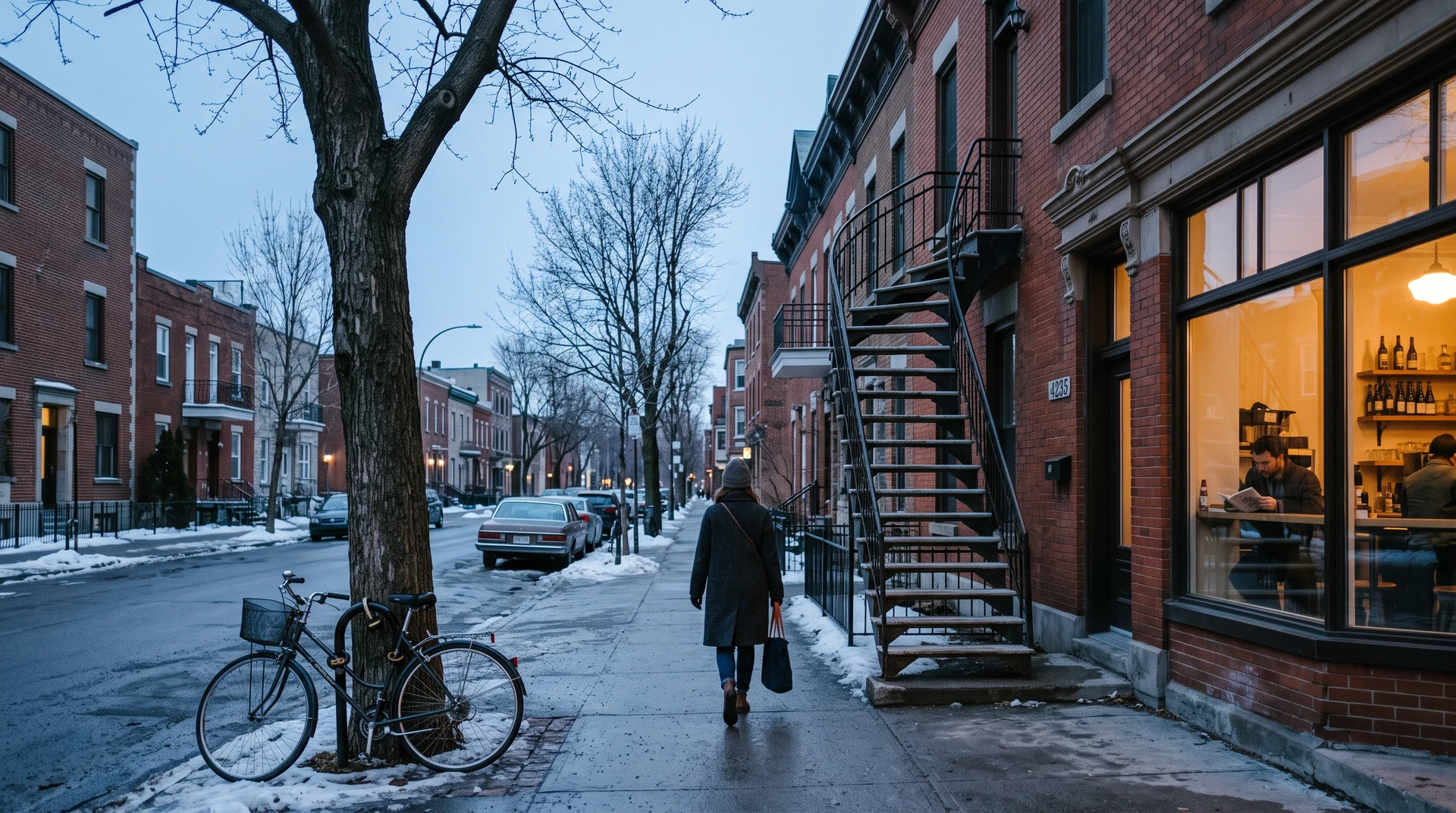
Moving north, the atmosphere shifts as you enter the Plateau Mont-Royal, a district that serves as the bohemian pulse of the city. The Plateau is defined by its iconic outdoor spiral staircases—wrought-iron structures that wind elegantly up the fronts of Victorian triplexes, a pragmatic solution to saving indoor space that has become a visual shorthand for Montreal itself. These streets are a canvas of colorful cornices and lush greenery, where the masonry tells stories of generations of immigrants who shaped the neighborhood’s character. There is a sense of quiet intimacy here, a village-like feel where residents linger over espresso at corner cafes and the pace of life slows just enough to appreciate the rhythmic beauty of the urban landscape.
The bohemian energy of the Plateau naturally flows into Mile End, a creative enclave that has garnered a global reputation as a hub for artists, musicians, and thinkers. This neighborhood is perhaps best known for its culinary landmarks, specifically the wood-fired bagels of St-Viateur. The scent of sesame and honey-water-boiled dough wafting from these twenty-four-hour ovens is a local sensory landmark, drawing queues of locals and visitors alike at all hours of the night. Mile End is a place where the old-world charm of traditional bakeries coexists with avant-garde galleries and indie boutiques, creating a dense, walkable tapestry of creative expression. It is in these few blocks that the city’s dual linguistic identity feels most harmonious, a melting pot of ideas and flavors that defines the modern Montrealer.
Beyond the brick and mortar, Montreal’s cultural heartbeat is physically manifested in its world-leading circus arts scene. As the global headquarters of Cirque du Soleil and home to the Cité des Arts du Cirque, the city has transformed the traditional circus into a high-art form that blends athleticism with profound theatricality. This dedication to the physical arts is not confined to the stage; it permeates the city’s very atmosphere, suggesting a place where the impossible is merely a starting point for creative exploration. The sight of acrobats training in the parks or the large-scale installations in the Quartier des Spectacles serves as a constant reminder that Montreal is a city that values the spectacular, the daring, and the whimsical in equal measure.
The Quartier des Spectacles itself is a testament to Montreal’s commitment to the public arts, a dedicated district designed to host the city’s many world-class events, including the legendary International Jazz Festival. During the summer months, these streets are transformed into a vibrant pedestrian zone where the music of the world echoes off the surrounding buildings. But even when the stages are gone, the district remains a visual feast, serving as a canvas for large-scale urban murals that celebrate the city’s icons. None is more poignant than the towering mural of Leonard Cohen, whose gravelly voice and poetic soul remain synonymous with the city’s identity. His image, looming over the streetscape, serves as a silent guardian of Montreal’s musical and literary legacy.
Navigation in Montreal is an experience in itself, facilitated by the STM metro system, which is as much a gallery of nineteen-sixties architecture as it is a transit network. The unique rubber-tired trains glide quietly through stations that each feature distinct artistic designs, from vibrant stained glass to brutalist concrete structures. For those who prefer the open air, the BIXI bike-share system offers a way to traverse the scenic Lachine Canal paths, where the city’s industrial past meets its active modern lifestyle. This infrastructure is a pragmatic adaptation to the city’s extreme seasonal shifts, allowing life to continue unabated even when the temperature drops. The Underground City, or RÉSO, provides a thirty-three-kilometer network of climate-controlled walkways that connect transit hubs and commercial centers, ensuring that Montreal’s pulse never skips a beat, regardless of the weather.
Ultimately, Montreal is a city of creative resilience, a place that has mastered the art of transformation while holding fast to its core identity. Whether you are exploring the subterranean labyrinths of the RÉSO or standing atop Mount Royal to watch the sun set over the sprawling urban canopy, there is an unmistakable sense of belonging that the city offers. It is a destination that demands to be felt rather than just seen, a sensory journey through history, art, and the enduring spirit of its people. As the blue hour settles over the Plateau and the interior glows of the bay windows begin to flicker on, one realizes that Montreal is not just a place on a map, but a living, breathing testament to the beauty of cultural fusion and the persistent joy of the human spirit.