World city
The Golden Palimpsest: Unearthing the Faded Splendor and Vibrant Soul of Palermo.
In the heart of Sicily, Palermo stands as a defiant testament to centuries of conquest and rebirth, where the air is thick with the scent of fried panelle and the glint of Byzantine gold illuminates a city of crumbling Baroque palaces and resilient, sun-drenched streets.
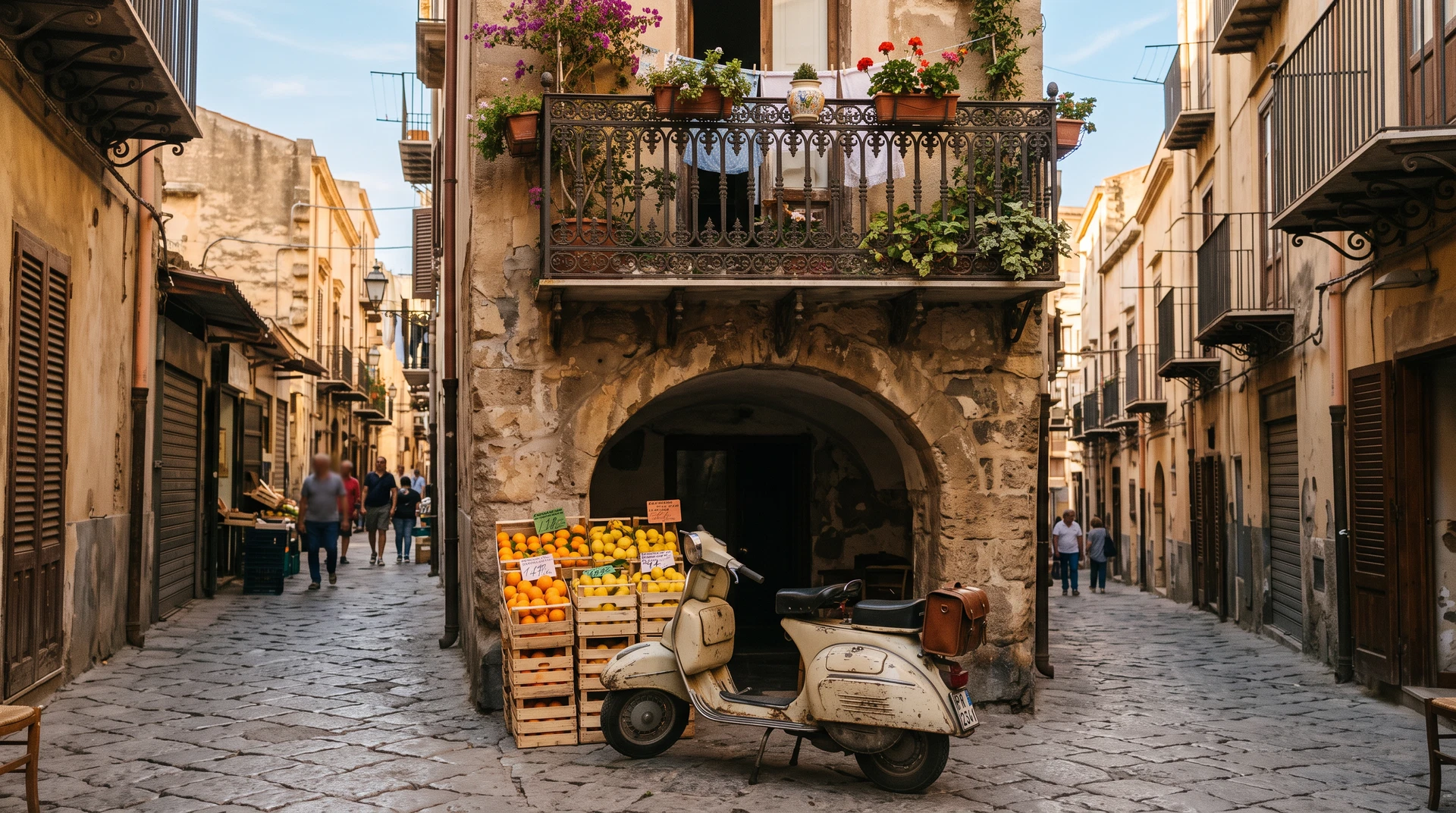
The first thing that hits you in Palermo is the sound—a rhythmic, guttural chant known as the abbanniate, the traditional call of street vendors echoing through the winding arteries of the Ballarò market. It is a sensory assault that feels less like modern Italy and more like a North African souk, a legacy of the city’s Arab past. Under tattered canvas awnings that filter the fierce Sicilian sun into a soft amber, the air is a heavy perfume of sea salt, woodsmoke, and sizzling panelle. To walk through Ballarò is to witness the city at its most raw, where silver swordfish glisten on ice and crates of blood oranges are stacked like glowing embers against a backdrop of weathered stone.
Palermo is a historical palimpsest, a parchment written upon and rewritten by successive waves of conquerors. From the Phoenicians and Arabs to the Normans and Spanish, each civilization has left an indelible mark on the city’s DNA. This layered identity is a physical presence seen in the faces of the Palermitani and heard in a dialect carrying the ghosts of Arabic and Norman French. The city does not hide its scars; instead, it wears them with a weary, noble pride. It offers a version of Italy that is deeper and far more enigmatic than the polished veneers of the north, inviting visitors to discover the echoes of a thousand years of Mediterranean history.
If the markets represent the city’s gritty heart, the Palazzo dei Normanni houses its spiritual peak. Tucked within this ancient fortress is the Palatine Chapel, a sanctuary that Guy de Maupassant described as the most beautiful church in the world. To step inside is to be enveloped in a celestial glow; every square inch of the walls is covered in Byzantine gold mosaics that vibrate with internal light. The chapel is a masterclass in the 'Norman-Arab-Byzantine' style, featuring a Fatimid-style wooden muqarnas ceiling hanging over Christian iconography. It is a space where the three great cultures of the medieval Mediterranean met in a rare moment of harmonious collaboration, leaving behind a pinnacle of human artistry.
A short walk from the palace brings you to the Quattro Canti, the heart of the city’s Baroque expansion. This intersection is a masterpiece of urban staging, where four curved facades rise to meet the sky, adorned with statues of the seasons and Spanish kings. The genius of the design lies in the light; at any hour, the sun illuminates at least one facade, casting the others into dramatic shadow. Just beyond lies the Palermo Cathedral, a structure that is architecturally schizophrenic. Over the centuries, it has served as a Byzantine church, a Great Mosque, and a Catholic cathedral. Its exterior is a dizzying mashup of Gothic arches and Moorish patterns, reflecting the city’s restless inability to settle on a single identity.
There is a specific beauty in Palermo that locals call faded splendor. It is found in the crumbling palaces of the Kalsa district, where staircases lead to ballrooms with peeling frescoes. This atmosphere of decaying grandeur is best embodied by the Teatro Massimo, Italy’s largest opera house, a temple to the city’s late 19th-century golden age. Its massive Neoclassical portico and vast, resonant interior speak of a time when Palermo was one of the wealthiest capitals in Europe. Yet, even here, the grit of the city is never far away. The opera house stands as a majestic island of order in a sea of chaotic narrow lanes, a reminder that the sublime and the mundane are always in tension.
To understand Palermo, one must embrace its gritty, vibrant intensity. This is not a city of manicured parks; it is a city of life lived out in the open. The streets are a theater where the drama of daily life plays out in real-time. You see it in the communal tables of the friggitorie, where locals hunch over plates of arancine, and in the sudden processions that snake through the streets during saint’s days. There is a raw honesty to the city that can be jarring—the peeling plaster, the tangled wires, the relentless buzz of Vespas—but it is precisely this lack of artifice that makes Palermo compelling. It remains a living organism that refuses to be a museum.
Navigating the massive historic center requires a willingness to get lost. The layout is a labyrinth of narrow lanes that defy modern logic and make public transport irrelevant. To walk these streets is to engage in urban archaeology, where a sudden turn might reveal a hidden Baroque fountain or a tiny artisan’s workshop. The scale is intimate and human, yet the density of detail is exhausting. There is no better way to experience the city than to simply set out on foot, letting the sights and smells guide you through the various quarters—the Kalsa, the Albergheria, and the Seralcadio—each with its own distinct personality and secrets waiting to be uncovered in the ancient stone.
The best time to witness the city’s transformation is during the shoulder seasons of late spring or early autumn. In April, May, and June, the air is fresh, and the honey-toned stone seems to absorb the sunlight, radiating a warmth that softens the edges of the crumbling facades. In September and October, the summer heat breaks, giving way to a golden light that is a photographer’s dream. This is when the city is at its most photogenic, as the long shadows of the late afternoon crawl across the Quattro Canti and the domes of the churches glow against a deepening blue sky. Visiting during these months allows for a more contemplative pace, avoiding the intense August crowds.
In the end, Palermo is a city that demands to be felt rather than just seen. It is a place of profound contradictions—gold and grit, silence and shouting, history and the immediate present. It does not offer the easy charms of Florence; instead, it offers something more complex and rewarding. It is a city that has survived every attempt to tame it, remaining stubbornly itself through millennia of change. To visit Palermo is to step into a story that is still being written, a narrative of resilience and beauty that continues to unfold in the shadow of Mount Pellegrino. It is a destination that stays with you long after you have left, a memory of golden mosaics and the Mediterranean.