World city
The Golden Scars of the Danube: A Journey Through Budapest’s Imperial Echoes and Ruined Hearts.
Between the regal heights of Buda and the restless pulse of Pest, Hungary’s capital thrives in a wistful dialogue of architectural eclecticism, where thermal waters and reclaimed ruins tell a story of a city that wears its history as a badge of resilience.
Budapest lives in the reflection of the Danube, a metropolis divided by a river but united by a shared sense of melancholic grandeur. On the western bank, the hills of Buda rise with aristocratic dignity, while to the east, the flat plains of Pest hum with the energy of a modern capital. Walking its streets is stepping into a living archive of Central European history, where the weight of the Austro-Hungarian Empire still hangs in the air, challenged by the gritty spirit of a new generation. It is a place where the past is etched into the very stones, from the bullet-scarred facades of the Jewish Quarter to the shimmering Zsolnay tiles that crown its most opulent palaces.
Crossing the Chain Bridge toward District I, the ascent to Castle Hill is a journey to the city’s medieval roots. Here, the Neo-Romanesque Fisherman’s Bastion stands as a sentinel over the water, its seven white towers representing the original Magyar tribes. The bastion is a theatrical stage, offering panoramic views that frame the Hungarian Parliament Building in a way that feels almost too perfect to be real. Walking through the cobblestone streets of the Castle District, one is surrounded by a stillness that contrasts with the noise below. The Matthias Church, with its kaleidoscopic roof, serves as a reminder of the centuries of coronations and conflicts that have shaped the Hungarian identity.
The true character of Budapest, however, lies in its Architectural Eclecticism—a stylistic collision that defines its urban identity. It is a city that refuses to be confined to a single era, instead choosing to weave together Gothic Revival, Baroque, and Art Nouveau into a seamless, if sometimes jarring, tapestry. The Gresham Palace is perhaps the finest example of this floral Secessionist spirit, its ironwork and mosaics speaking to a time of unbridled optimism at the turn of the 20th century. Yet, just a few blocks away, one might find a weathered courtyard where the plaster has long since crumbled, revealing the raw brickwork beneath. This juxtaposition is not a sign of neglect but a deliberate embrace of the city’s scars, a wistful dialogue between the imperial dream and the harsh realities of the decades that followed.
In the heart of District VII, the Jewish Quarter offers a different kind of reclamation. Once a site of profound tragedy and later urban decay, this neighborhood has transformed into the epicenter of the Budapest ruin bar phenomenon. Szimpla Kert, a former stove factory, pioneered this movement, turning a derelict space into a labyrinthine social hub filled with mismatched furniture, vintage curios, and local art. There is a haunting beauty in these spaces; they are not polished or sanitized for tourism but remain defiantly raw. The ruin aesthetic reflects a city that does not seek to erase its history but rather to inhabit it, finding new life in the abandoned courtyards and forgotten corners of the old Jewish ghetto, where the echoes of the past mingle with the laughter of the present.
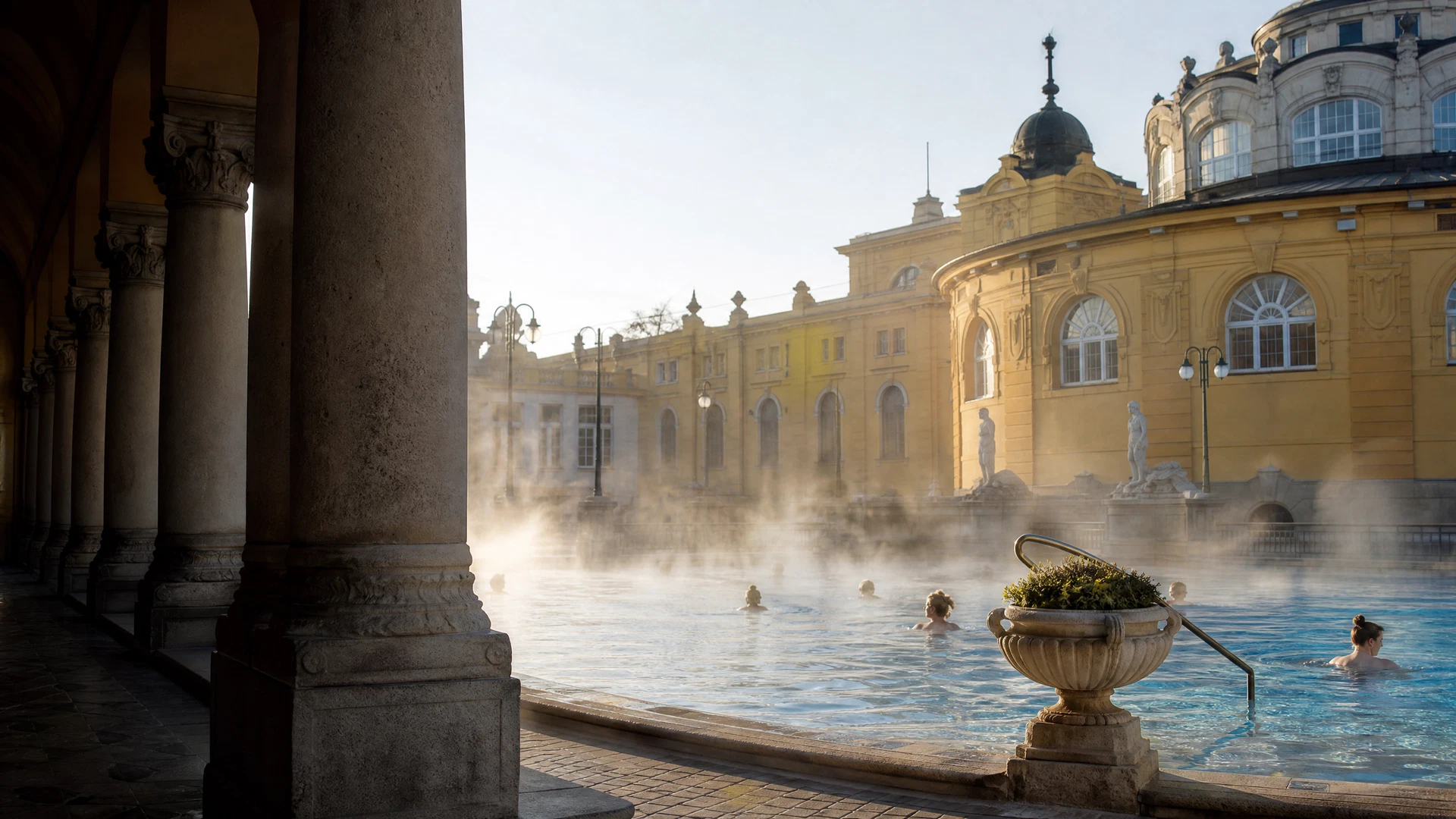
No exploration of Budapest is complete without a descent into its thermal waters. With 123 natural springs bubbling beneath the surface, the city has fostered a communal bathing culture that dates back to the Ottoman occupation. The Széchenyi Thermal Bath, a vast Neo-Baroque complex in City Park, is the crown jewel of this tradition. Here, locals and visitors alike soak in steaming outdoor pools while playing chess on floating boards, the sulfur-rich steam rising into the crisp morning air. The baths are more than just a spa; they are a social equalizer, a place where the stresses of modern life are washed away in the same mineral-rich waters that have comforted generations of Hungarians. Whether in the grand halls of Széchenyi or the Art Nouveau elegance of the Gellért Baths, the water remains the city’s subterranean lifeblood.
As the sun begins to set, the Hungarian Parliament Building demands center stage. Viewed from the Batthyány tér riverbank, its golden Gothic Revival silhouette is a masterpiece of architectural precision, its hundreds of spires reaching toward the indigo sky. The building is a symbol of national pride, a massive structure that seems to float on the dark, churning waters of the Danube. At night, when the lights are reflected in the river, the scene becomes cinematic, a testament to the city’s enduring monumental solitude. The Danube itself is the artery that connects everything, a silent witness to the city’s triumphs and tragedies, its surface carrying the streaking lights of river cruises and the quiet weight of history.
Navigating this layered topography is surprisingly intuitive, thanks to a transport network that is both efficient and historic. The BudapestGO app has modernized the experience, but the soul of the city’s transit lies in the M1 Millennium Underground. As the oldest electrified metro on mainland Europe, its small, yellow carriages and tiled stations feel like a portal to 1896. For the best experience, visitors should aim for the shoulder seasons of May and June or September and October. During these months, the intense heat of the Hungarian summer gives way to a soft, golden light that is perfect for capturing the city’s textures, and the air is just crisp enough to make the transition into the thermal baths feel like a true sanctuary.
Ultimately, Budapest is defined by its resilience. Besieged, occupied, and divided, it has always reinvented itself without losing its soul. The Zsolnay tiles decorating the rooftops of the Great Market Hall are a metaphor for this spirit—colorful, intricate, and durable. The city wears its history on its sleeve, from the Shoes on the Danube Bank to the vibrant street art in the Jewish Quarter. It understands that beauty and pain are two sides of the same coin, inviting visitors to look closely at both, to find grace in the crumbling brickwork and majesty in the imperial spires.
To leave Budapest is to carry away a sense of wistful longing for its misty riverbanks and hidden courtyards. It stays with you as a feeling—a mixture of nostalgia, energy, and quiet strength. Whether watching the sunset from the Fisherman’s Bastion or sharing a drink in a rain-slicked alleyway, you are part of a story still being written. Budapest does not offer a polished version of itself; it offers an authentic, textured encounter with a city that has seen it all and still finds a reason to shine, golden and defiant, against the dark waters of the Danube.