World city
The Granite Soul and Azure Skin of Porto
A journey through the vertical alleys and ceramic narratives of Portugal's northern capital, where the resilient Tripeiro spirit meets the wistful beauty of the Douro.
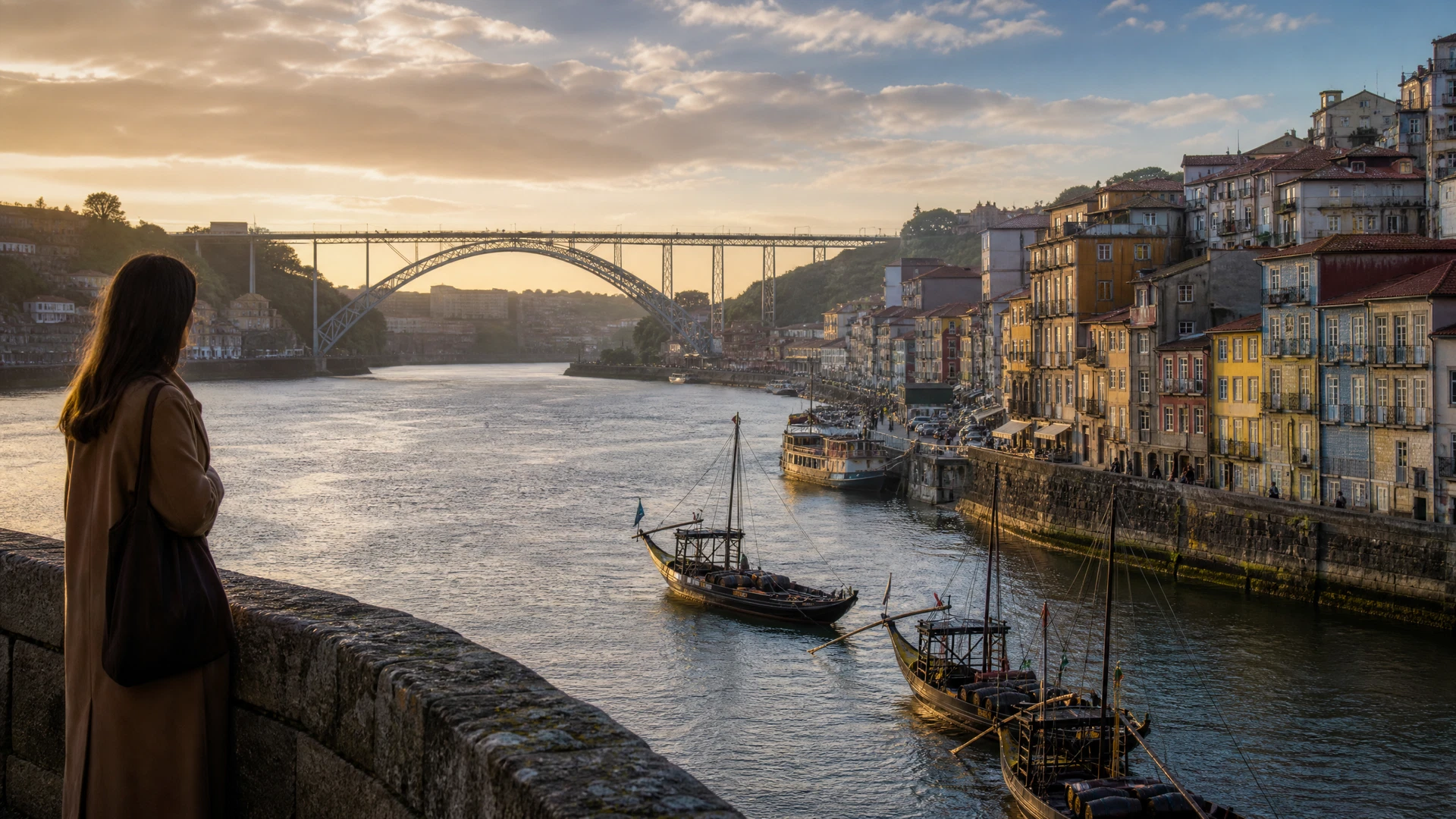
Porto is a city of verticality, a granite labyrinth clinging to the steep banks of the Douro River. Arriving here means navigating a world where horizontal planes are rare, replaced by cascading medieval alleys and stairs leading toward the water. The deep, olive-green river acts as the city's artery, a witness to centuries of maritime trade that built this rugged outpost. As the morning mist lifts, Porto reveals itself in layers: the rusted iron Dom Luís I Bridge, the colorful Ribeira facades, and the granite spires crowning the hills. It is a place of atmospheric weight, where Atlantic salt air mingles with the sweet scent of aging wine from the Gaia lodges.
The Ribeira district, a UNESCO World Heritage site, is the city’s beating heart. Here, buildings are packed with desperate intimacy, their narrow fronts painted in faded ochre and oxblood, with laundry-draped balconies whispering across narrow streets. Walking these alleys is a lesson in endurance; cobblestones are polished by generations of footsteps, and granite walls remain cool even in summer. The district culminates at the riverfront, spanned by the Dom Luís I Bridge, a double-decked iron marvel. The bridge is a grand stage where Porto’s commercial bustle and the cellar-quiet of Vila Nova de Gaia gaze at each other. At dusk, the iron lattice turns purple against the setting sun, providing a backdrop for locals watching rabelo boats bobbing in the current.
To understand Porto, one must grasp the Tripeiro spirit, a term of pride dating to the 15th century. Legend says that when Prince Henry the Navigator prepared his fleet, citizens gave up all prime meat for the sailors, leaving themselves only with offal. From this sacrifice came the signature Tripas a Moda do Porto and a reputation for gritty resilience. This ruggedness is reflected in the architecture, where stern granite provides a skeleton for the urban landscape's delicate flourishes. There is a palpable sense of saudade—a wistful longing—manifested in how the city embraces its decay. Porto does not hide its cracked plaster; it wears it as a badge of honor, proof of a history that refused to be paved over by modern artifice.
Visually, the city is defined by its Blue City aesthetic, derived from the ubiquitous azulejos cloaking its buildings. These hand-painted ceramic tiles are the city’s public diary, depicting everything from the lives of saints to the naval battles of the Age of Discovery. The São Bento Railway Station is a monumental gallery, its hall transformed by over 20,000 tiles into a frozen narrative of Portuguese identity. Even small chapels, like the Capela das Almas, are wrapped in these ceramic skins, their vibrant blues standing out against grey granite like a sudden burst of summer sky. The tiles protect buildings from humid Atlantic air, but their true value lies in how they soften the city’s hard edges, turning every street corner into a potential masterpiece.
While Ribeira represents the past, the Cedofeita district anchors the contemporary pulse. Centered on Rua de Miguel Bombarda, this neighborhood is the epicenter of Porto’s creative class, home to independent galleries, concept stores, and experimental cafes. Here, traditional granite facades are enlivened by sophisticated street art, and the air is filled with jazz rather than the calls of fishmongers. Nearby lies the Livraria Lello, one of the world's most beautiful bookstores. With its neo-Gothic facade and swirling crimson staircase, the shop feels like a portal to another dimension. It is said that J.K. Rowling drew inspiration from these shelves, and the bookstore remains a pilgrimage site for those who believe the city’s magic resides not just in its stones, but in its stories.
Moving westward, the city’s density unravels into the upscale elegance of Foz do Douro. Here, the river surrenders to the Atlantic, and the atmosphere shifts from old-town charm to salt-sprayed freedom. Foz is defined by oceanfront promenades and iconic pergolas, where crashing waves provide a soundtrack to the daily passeio. The light here is sharper, reflected off the vast ocean expanse. It is a favorite retreat for locals seeking respite from the summer heat, watching the sun dip below the horizon while sipping chilled Vinho Verde. The transition from rugged granite to sandy beaches reminds visitors of Porto’s dual nature: a city of the river and the sea, caught between the safety of the harbor and the call of the open horizon.
No visit is complete without immersing in Porto’s culinary and viticultural traditions. Across the river in Gaia, grand Port wine lodges stand like cathedrals to the grape. Inside these cool cellars, oak barrels sleep for decades, transforming the Douro Valley’s produce into the sophisticated fortified wine bearing the city’s name. Tasting a 20-year-old Tawny while looking back at the sun-drenched Ribeira is the quintessential Porto experience. On the plate, the city is equally bold. The Francesinha, a sandwich of steak, ham, and sausage drenched in melted cheese and spicy sauce, is the ultimate comfort food. These traditions are not performed for tourists; they are the building blocks of social life, shared in crowded tascas and grand dining rooms alike.
The culmination of Porto’s spirit occurs every June 23rd during the Festa de São João, a joyous street celebration. It is a festival of the senses, where the smell of grilled sardines fills the air and streets are crowded with people wielding soft plastic hammers to playfully bop strangers for luck. As midnight fireworks illuminate the Dom Luís I Bridge and paper lanterns are released into the sky, the city’s melancholy is replaced by collective euphoria. Yet, even then, there is a sense of the ephemeral, a reminder that the night will end and the city will return to its quiet, tiled contemplation. Porto lingers in the mind, a place of enduring beauty that ages with grace, where the past is always present and the river always flows toward the sea.