World city
The Living Labyrinth of Fes el Bali
Stepping through the cobalt tiles of Bab Bou Jeloud is more than a change of scenery; it is a profound descent into a medieval urbanism where time is measured by the call to prayer and the rhythmic clatter of donkey hooves against ancient stone.
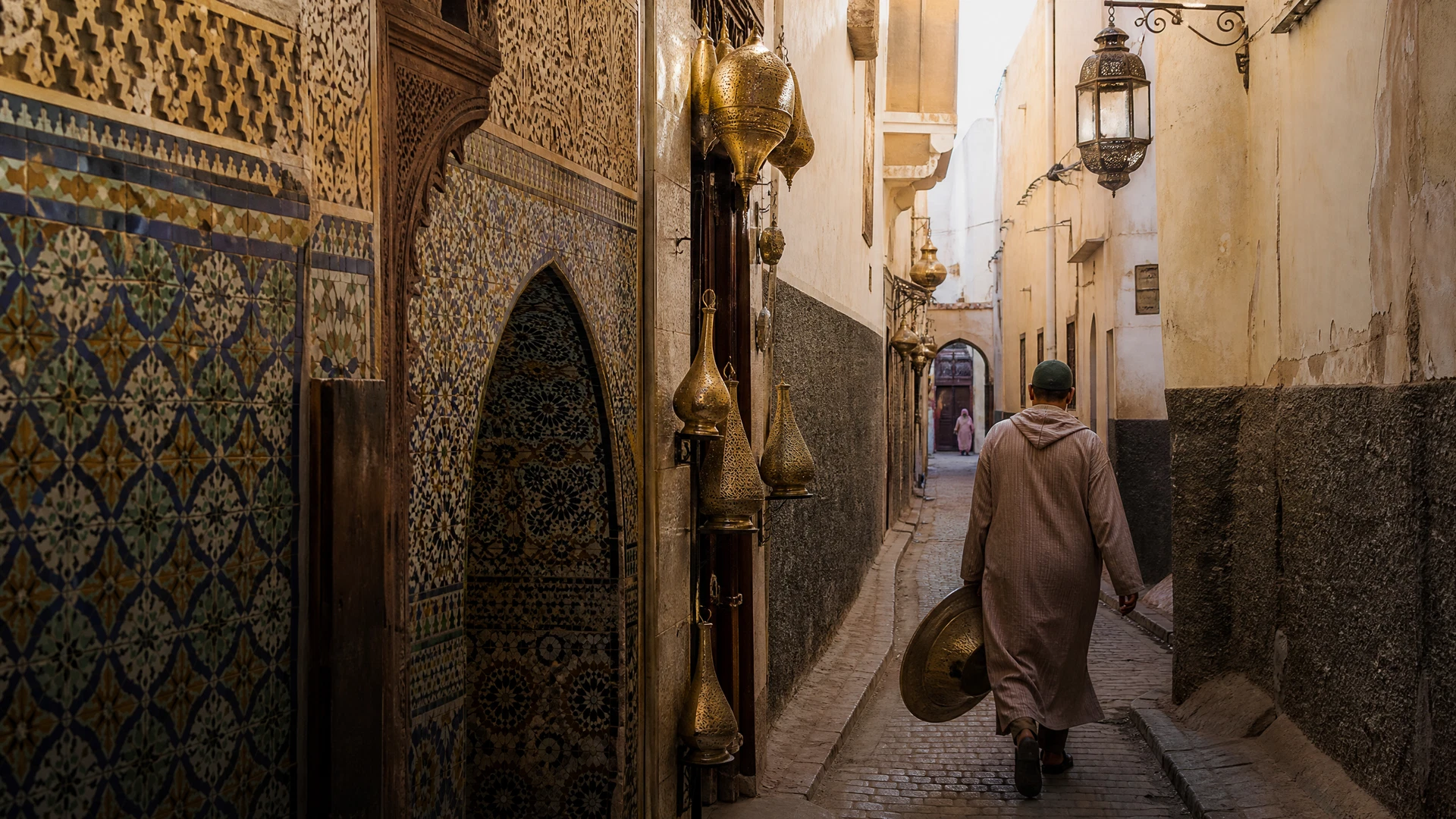
To pass through Bab Bou Jeloud, the iconic Blue Gate of Fez, is to witness the sudden evaporation of the twenty-first century. On one side, the rumble of motorbikes defines the modern Ville Nouvelle; on the other, the world contracts into a dense, vertical tapestry of sandstone and cedar that has remained largely unchanged since the Marinid dynasty. Fes el Bali, the city’s oldest district, is a functioning medieval metropolis—a UNESCO-listed labyrinth of over nine thousand winding alleyways where motorized vehicles are physically impossible. Here, the air is thick with the scent of cedarwood shavings, roasting cumin, and the sharp, metallic tang of hammered copper. It is a place where geography is dictated by the organic flow of human movement, a sensory immersion that demands a complete surrender of one’s internal compass to the whims of the winding path.
The economy of the medina is a human-scaled marvel, powered by the tireless labor of mules and the shouts of “Balak!”—a warning for pedestrians to flatten themselves against the walls to avoid a passing cart. Every turn reveals a new micro-economy: the Souk el Attarine, where mounds of saffron and paprika create a kaleidoscope of spice, and the Seffarine, where artisans beat massive copper vats into shape under the shade of ancient plane trees. This is sensory medievalism at its most visceral, a living preservation of pre-industrial life where every object has a maker and every maker has a lineage. The city’s identity is built upon these hereditary crafts, a social fabric where the apprentice still learns at the feet of the master, ensuring that the techniques of the eleventh century survive the pressures of global homogenization.
At the spiritual and intellectual heart of this labyrinth lies the University of Al-Qarawiyyin, a testament to the city’s enduring legacy as a center of enlightenment. Founded in 857 CE by Fatima al-Fihri, it is recognized as the oldest continuously operating educational institution in the world. While the interior remains a sacred space reserved for the faithful, a glimpse through its massive bronze doors reveals a sea of white arches and a courtyard of cool marble, a stark contrast to the chaotic heat of the surrounding streets. The university’s library, housing fourteenth-century manuscripts, serves as a silent guardian of the Islamic Golden Age. It is a reminder that Fez was once a beacon of science and philosophy, where the pursuit of knowledge was considered as essential to the city’s survival as the walls that protect it.
The architectural language of Fez is one of deliberate mystery, where opulent beauty is hidden behind anonymous, windowless walls. This is the world of the riad—traditional courtyard houses that function as private paradises. To enter a riad is to experience a sudden, breathtaking silence. The central courtyard, often anchored by a marble fountain and shaded by citrus trees, is a masterclass in Islamic geometry, with intricate zellij tilework climbing the walls. This internal focus reflects a culture that prizes privacy and domestic tranquility above public display. In these cool, shaded sanctuaries, the frantic energy of the medina feels like a distant memory, replaced by the soft gurgle of water and the aroma of orange blossoms, providing a necessary counterpoint to the city’s external intensity.
Nowhere is the city’s raw, industrial soul more evident than at the Chouara Tannery. Viewed from the surrounding balconies, the tannery resembles a giant, sun-baked watercolor palette, with hundreds of honeycomb-like stone vats filled with vibrant dyes. The process here is a grueling, all-natural ritual that has remained unchanged for a millennium. Hides are softened in a pungent mixture of water and pigeon droppings—the ammonia acting as a natural scouring agent—before being submerged in vats of indigo, poppy, and saffron. Tanners, standing waist-deep in the liquid, stomp the leather to ensure the pigment penetrates deep into the grain. The smell is overwhelming, a potent cocktail of raw hide and fermentation, but it is the smell of history itself. It is a visceral reminder that the soft leather sold in global boutiques begins its life in these ancient pits, forged by hand and heat.
As the sun begins to dip toward the horizon, the medina undergoes a subtle transformation. The golden hour casts long shadows across the rooftops, and the call to prayer begins to echo from the city’s thousand minarets, a polyphonic chorus that vibrates through the very stones. This is the time to find a terrace overlooking the city, where the dense, sandy-hued urban fabric stretches out like a frozen sea. From this vantage point, one can see the green-tiled roofs of the mosques and the crumbling Merenid Tombs on the hillside, silhouetted against a sky that turns from pale ochre to deep violet. The air cools, and the smoke from communal bread ovens begins to rise, carrying the smell of toasted flour and woodsmoke. It is a moment of profound peace, a temporary stillness in a city that has been in constant motion for over a thousand years.
The culinary landscape of Fez is as layered and complex as its geography, a fusion of Berber, Arab, and Andalusian influences. In the communal ovens, or farrans, neighborhood residents still bring their dough to be baked by the master baker, a practice that fosters a deep sense of community. The flavors here are a sophisticated balance of sweet and savory, exemplified by the pastilla—a delicate pigeon pie dusted with cinnamon—and the slow-cooked tagines that simmer in clay pots over charcoal fires. Dining in Fez is an act of hospitality, where a simple invitation for mint tea can lead to an afternoon of storytelling and connection. The food is not just sustenance; it is a narrative of the city’s history, a taste of the diverse cultures that have sought refuge and prosperity within its walls.
To visit Fez is to accept a temporary displacement in time, to walk through a city that refuses to be a museum. It is a place of grit and grace, where the weight of the past is not a burden but a foundation. While the modern world continues its relentless pace outside the walls, the medina of Fes el Bali remains a bastion of human-scaled living, a reminder of the power of tradition and the resilience of the human spirit. It is a city that requires patience, a willingness to get lost, and an open heart to hear the stories whispered by its ancient stones. As you eventually pass back through the Blue Gate, the sudden noise of the modern world feels jarring, a reminder that you have just returned from a place where the medieval heart of Morocco still beats with a vibrant, unyielding pulse.