World city
Colombo: The Indigo Hour and the Palimpsest of Empires
Between the salt-spray of the Indian Ocean and the neon bloom of the Lotus Tower, Sri Lanka’s capital breathes through a layered history of colonial ghosts and high-tech dreams.
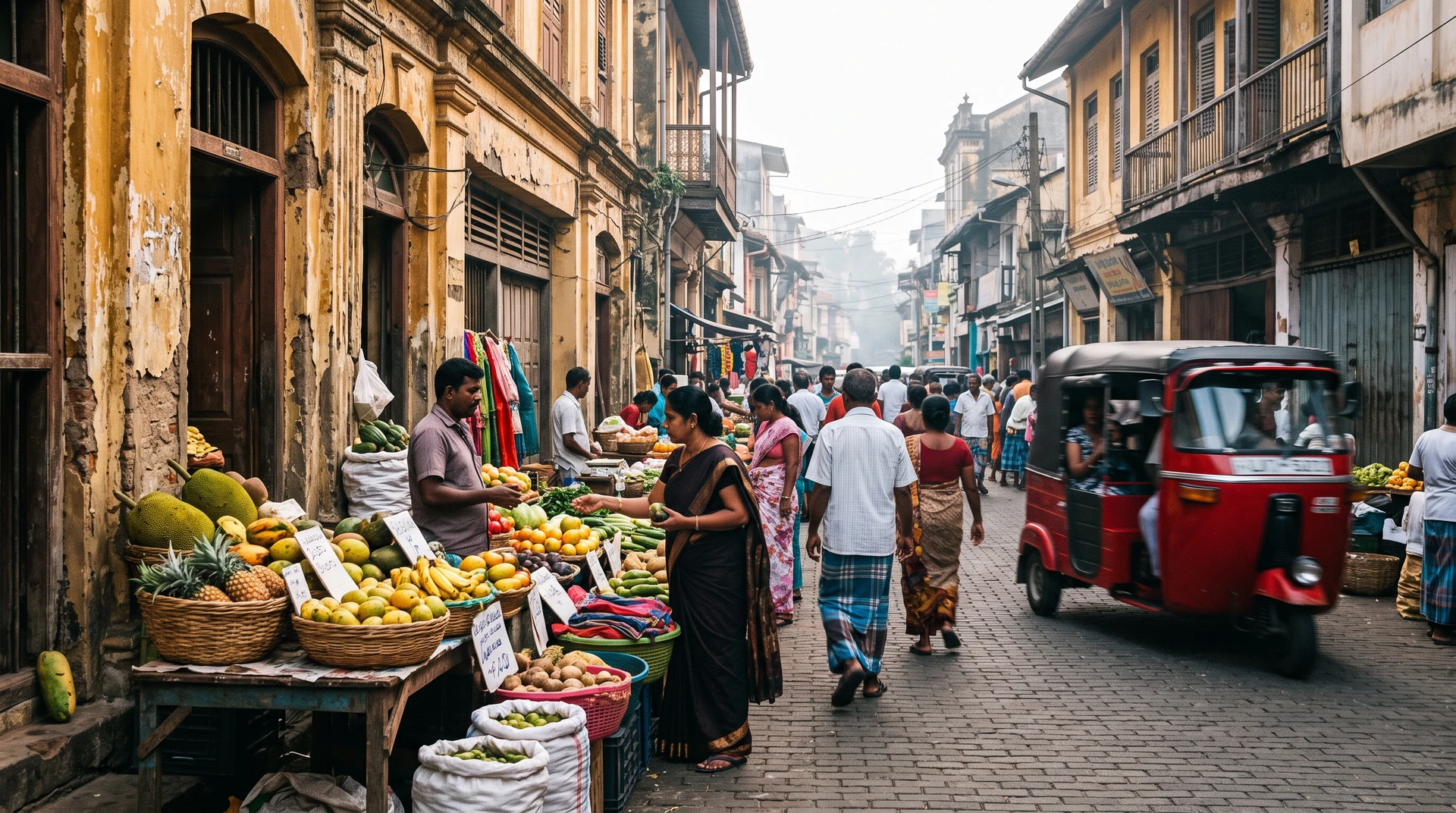
To arrive in Colombo is to step into a humid embrace where the scent of the Indian Ocean competes with the persistent thrum of a city in a state of perpetual reinvention. The air is a heavy, tactile thing, carrying the salt-spray of the Laccadive Sea and the faint, sweet ghost of cinnamon that once drew empires to these shores. As you move through the city center, the landscape shifts from lush, palm-fringed pockets to a jagged skyline that changes every time you blink. There is a specific, wistful energy here—a sense that the city is constantly mourning its past while racing toward a future it hasn't quite finished building. It is a place of sensory friction, where the rusted iron of the old railway tracks at Fort station runs parallel to the gleaming, air-conditioned corridors of luxury hotels that rise like glass monoliths from the dust.
The heart of this friction beats most violently in Pettah, the city’s chaotic commercial lung. Here, the streets are less like thoroughfares and more like a series of interconnected veins, pulsing with the movement of hand-pulled carts, vintage yellow tuk-tuks, and porters balancing impossible loads. The air in Pettah is thick with the wholesale aroma of dried chilies, turmeric, and peppercorns, a sensory map of the island’s agricultural wealth. Amidst this frenetic commerce stands the Jami Ul-Alfar Mosque, a striking architectural anomaly known as the Red Mosque. Its red-and-white candy-striped masonry, built in the Indo-Saracenic style, rises above the grit of the market like a surrealist dream. During the "blue hour" of twilight, the mosque’s intricate minarets are softly lit, casting a warm, pomegranate glow over the surrounding alleys. It is a moment of profound beauty that feels disconnected from the bartering and shouting just a few feet below.
A short distance from the roar of Pettah lies the Fort district, where the city’s "palimpsest of empires" is most visible. The name itself is a ghost, referring to a fortification that no longer exists, yet the colonial bones remain. The Dutch Hospital Shopping Precinct, a low-slung building with thick walls and red-tiled roofs, was once a 17th-century medical facility for the Dutch East India Company. Today, it has been meticulously restored, its open courtyards now housing high-end boutiques and world-class dining. At the Ministry of Crab, diners sit beneath heavy wooden beams, cracking into giant lagoon crabs while looking out at the nearby skyscrapers. The transition is jarring; the 1600s architecture stands in the literal shadow of the 350-meter Lotus Tower, a futuristic purple blossom of steel and glass that serves as a constant reminder of the city’s modern, Chinese-backed ambitions.
For a moment of reprieve, one must head to the glassy, dark waters of Beira Lake. In the center of this urban reservoir sits the Seema Malaka, a Buddhist temple that functions as a minimalist sanctuary. Redesigned in the 1970s by the legendary architect Geoffrey Bawa, the temple is a masterpiece of "Tropical Modernism." It consists of three floating pavilions connected by wooden walkways, their design reflecting a seamless integration of traditional motifs and modern lines. The bronze Buddha statues that line the perimeter sit in eternal meditation, their calm faces reflected in the water even as the city’s traffic roars in the distance. The Seema Malaka is a silent witness to Colombo’s identity—a place where the ancient spiritualism of the island is given a contemporary, light-filled form. It is particularly evocative at dawn, when the morning mist blurs the edges of the nearby towers.
The city’s transformation reaches its zenith at the new Port City, a vast expanse of reclaimed land being groomed as a high-tech financial hub. Standing on the edge of the old coast, you can see the massive dredging ships and the skeletons of new buildings rising from the sand. This is the latest layer of the palimpsest, a multibillion-dollar bet on a maritime future that feels light-years away from the spice-scented alleys of Pettah. The contrast is the defining characteristic of the Colombo experience. You might spend your morning in a 19th-century railway carriage on a slow train to Mount Lavinia, only to spend your evening sipping cocktails on a rooftop bar overlooking a landscape of cranes and neon. There is a certain melancholy in this rapid change, a feeling that the old, lived-in charm of the city is being paved over by a sterile, globalized aesthetic.
Nowhere is this resilience more evident than at Galle Face Green, the city’s communal living room. This oceanfront promenade, a legacy of the British era, remains the most democratic space in Colombo. As the sun begins its descent into the Indian Ocean, the green fills with families, students, and lovers. Kites of all shapes and sizes dance in the stiff sea breeze, their strings humming against the wind. The air here smells of salt and frying oil, specifically the scent of isso vade—prawn crackers topped with whole, spicy shrimp, served with a squeeze of lime and chopped onions. Eating these crunchy, fiery snacks while watching the sky turn a bruised purple is a ritual that transcends class and creed. Even as the skyline behind the green grows taller, the simple joy of a sunset walk along the water remains the city’s most enduring tradition.
Navigating this sprawling metropolis requires a combination of patience and local technology. While the quintessential mode of transport is the three-wheeled tuk-tuk, the experience has been modernized by ride-hailing apps like PickMe and Uber, which ensure that negotiating fares is a thing of the past. These nimble vehicles are the only way to truly see the city, darting through narrow shortcuts and navigating the labyrinthine backstreets of Slave Island. For those looking to escape the city, the Colombo Fort Railway Station serves as the gateway to the rest of the island, its colonial-era platforms still serving as the starting point for the iconic coastal and highland train routes. The best time to visit is between January and March, when the humidity yields to a manageable heat and the skies remain a clear, brilliant blue.
Ultimately, Colombo is a city that refuses to be defined by a single era or influence. It is a place of profound contradictions, where the call to prayer from a mosque mingles with the chime of a temple bell and the bass-thump of a modern nightclub. It is a city that has survived civil war, colonial rule, and natural disasters, emerging each time with a new layer of identity. To walk its streets is to participate in a grand, ongoing experiment in urban living, a journey through a landscape where the past is never truly gone and the future is always just a crane-swing away. It is a wistful, vibrant, and utterly distinctive destination, a city that invites you to look past the construction dust and find the soul that lingers in the spice-scented air and the salt-spray of the sea.