World city
The Luminous Waters of the White City: A Journey Through Udaipur’s Royal Heart.
Nestled within the rugged folds of the Aravalli Range, Udaipur reveals itself as a shimmering mirage of pearly marble and lime-washed stone, where centuries of hydraulic ingenuity have transformed a semi-arid landscape into a floating kingdom of lakes and palaces.
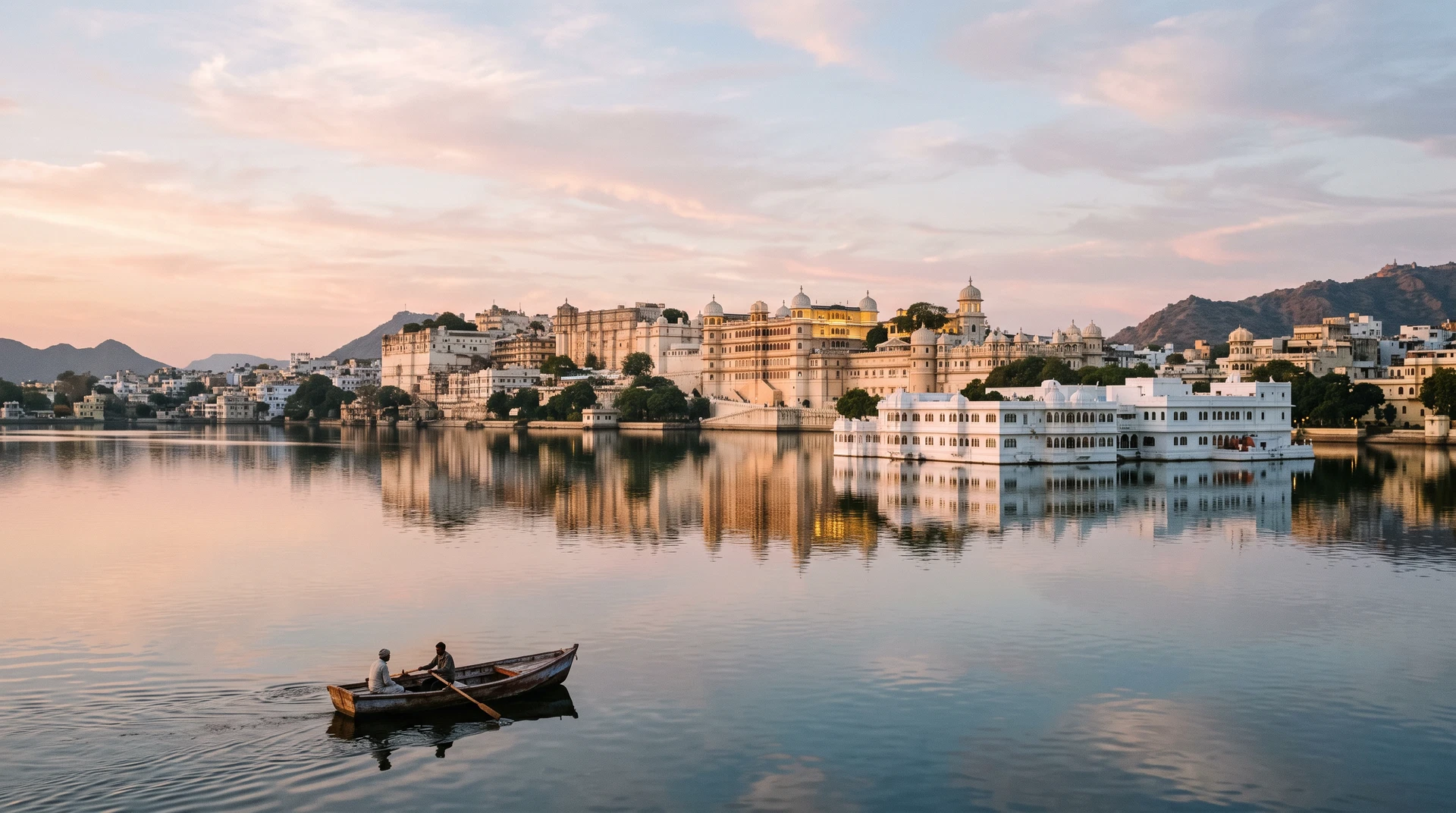
To arrive in Udaipur is to witness a profound dialogue between the stark crags of the Aravalli Range and the luminous, lime-washed architecture of a city that seems to float upon the water. Known as the "White City," Udaipur stands in elegant contrast to the vibrant pinks of Jaipur and the deep indigos of Jodhpur. Here, the Rajasthani sun reflects off pearly marble facades and whitewashed havelis, creating a pervasive glow that softens the rugged edges of the surrounding desert. The air feels cooler here, tempered by vast man-made lakes that have sustained the Mewar capital since the sixteenth century. As one moves through the city, the sense of being in an oasis is inescapable, a feeling grounded in the intentional harmony between the natural topography and the ambitious urban vision of Maharana Udai Singh II.
The architectural soul of the city is the City Palace, a monumental complex of eleven interconnected palaces rising majestically from the eastern banks of Lake Pichola. It is a fortress of white granite and marble, yet its interior reveals a delicate beauty that belies its imposing exterior. Within its labyrinthine corridors, one finds the Mor Chowk, where walls are adorned with three magnificent peacocks crafted from thousands of pieces of colored glass. These mosaics, shimmering in shades of emerald and sapphire, capture the light in a way that feels almost supernatural. Nearby, the Sheesh Mahal offers a display of reflective artistry, where a single candle can illuminate a thousand surfaces. Each courtyard tells a story of royal refinement, where the transition from one era to another is marked by subtle shifts in carving and the increasing intricacy of the jharokhas that overlook the water.
The lifeblood of Udaipur is its water, defined by a sophisticated 16th-century hydraulic system that remains a marvel of engineering. Lake Pichola, the most famous of these reservoirs, was designed for survival in a semi-arid region. The engineering required to capture monsoon rains and channel them through interconnected lakes—including Fateh Sagar and Swaroop Sagar—dictates the city's unique, Venice-like layout. To experience Udaipur fully, one must take to the water. A boat circuit on Lake Pichola at sunset offers a perspective that no land-based vantage point can match. From the lake's center, the City Palace appears as a continuous, glowing wall of light, while the Aravalli hills form a dark, jagged silhouette against a sky that transitions from pale gold to deep violet.
Floating amidst the azure waters of Pichola is Jag Mandir, a seventeenth-century island palace that served as a royal summer retreat. Built of sandstone and marble, the palace is guarded by life-sized stone elephants standing sentinel at the water’s edge. There is a historical whisper that the marble aesthetics and serene setting of Jag Mandir deeply influenced the young Prince Khurram, who would later commission the Taj Mahal as Emperor Shah Jahan. Walking through the quiet gardens and marble pavilions, it is easy to see how this sanctuary could inspire a vision of eternal beauty. The stillness of the lake, broken only by the soft lap of waves against stone steps, creates an atmosphere of profound tranquility that feels centuries removed from the bustling markets of the mainland.
Returning to the shore, the transition into the historic core is immediate and sensory. The narrow, winding streets of the old town are a dense thicket of havelis, artisanal shops, and small shrines. Navigating these alleys on foot is the only way to truly appreciate the textures of Udaipur. The walls are often painted with vibrant murals of elephants and horses, traditional motifs signifying celebration. The scent of woodsmoke, marigolds, and frying kachoris hangs in the air, mingling with temple bells and the hum of auto-rickshaws. Here, the "White City" motif is most intimate; every doorway and balcony seems a study in lime-washed geometry. In these hidden corners, one finds the workshops of miniature painters and silversmiths whose families have practiced their crafts for generations, preserving a cultural continuity that is the city’s true heritage.
As the afternoon fades, the social heart of the city shifts toward the ghats. Gangaur Ghat, with its broad stone steps, serves as a communal gathering place where the sacred and the mundane coexist. It is here that one finds Bagore Ki Haveli, a massive 18th-century residence meticulously restored to showcase the traditional Rajasthani lifestyle. Every evening, the haveli’s courtyard comes alive with folk performances that are part of the city’s fabric. Dancers in vibrant, mirror-work costumes perform the Ghoomar and the Bhavai, the latter involving the balancing of multiple clay pots on the head while dancing on broken glass. The energy of the performance, fueled by the rhythmic beat of the dholak and the haunting wail of the kamaicha, provides a visceral counterpoint to the quiet elegance of the palace architecture.
Beyond the shadow of the City Palace, the northern lake of Fateh Sagar offers a more local, relaxed rhythm. Connected to Pichola by a small canal, Fateh Sagar is bordered by the Moti Magri hill and the lush Saheliyon-ki-Bari, or "Garden of the Maidens." This garden, with its marble elephants, lotus pools, and fountains that operate solely on water pressure, is a masterpiece of hydraulic leisure. On the promenade of Fateh Sagar, families gather to eat street food and watch the sun dip behind the Nehru Park island. While Pichola is the lake of royal dreams, Fateh Sagar is the lake of the people, where the modern pulse of Udaipur is most evident. It reminds us that while the city is a monument to the past, it is also a living community that continues to draw its spirit from the waters.
As night falls, reflections on the lakes transform Udaipur into a shimmering tapestry of light. The boundary between sky and water dissolves, leaving the palaces and havelis suspended in a dark, liquid void. The City Palace, illuminated by hundreds of floodlights, looks like a golden crown resting on the black velvet of the lake. This final view—a luminous, white mirage reflected in the deep azure—is what lingers longest. Udaipur does not just demand to be seen; it demands to be felt. It is a place where the weight of history is lightened by the presence of water, and where the enduring legacy of the Mewar kings is written in the shimmering, ever-changing surface of the lakes that define its existence.