World city
The Rose-Hued Geometry of Jaipur: A Symphony in Terra Cotta
In the heart of Rajasthan, the Pink City unfolds as a deliberate masterpiece of Vedic science and royal ambition, where 18th-century mathematical precision meets the vibrant, living pulse of India’s artisanal soul.
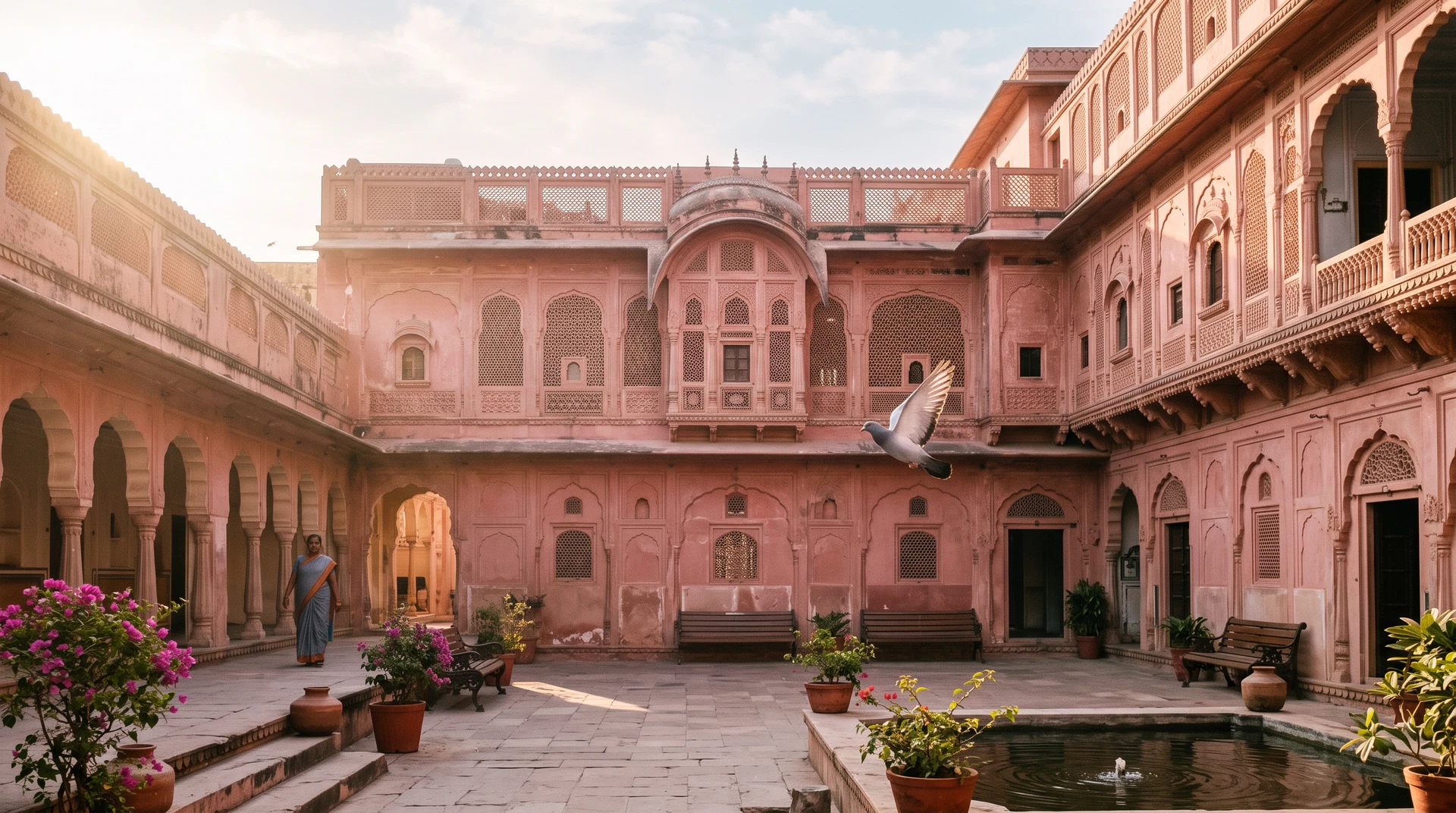
To enter the Walled City of Jaipur is to step into a vision of order that defies the organic, labyrinthine chaos typical of medieval Indian urban centers. Founded in 1727 by Maharaja Sawai Jai Singh II, the city was not merely built; it was calculated. Guided by the Prastara grid—a Vedic architectural concept that prioritizes mathematical symmetry and commercial flow—Jaipur was divided into nine blocks, reflecting the nine divisions of the universe. Today, this terra-cotta-hued grid remains the city’s skeleton, a rigid framework that somehow contains the fluid, neon-drenched energy of modern Rajasthan. The famous 'Pink City' moniker is actually a misnomer for the deep, earthy shade of terra-cotta that blankets the historic core, a color mandated by law since 1876 when the city was painted to welcome the Prince of Wales. This uniform wash serves as a unifying canvas, turning every street corner into a cinematic tableau of heritage and hospitality.
At the center of this geometric dream stands the Jantar Mantar, an 18th-century astronomical observatory that looks more like a collection of avant-garde sculptures than scientific instruments. Here, the Samrat Yantra, a sundial standing twenty-seven meters tall, can measure time to an accuracy of two seconds. It is a testament to Jai Singh II’s obsession with the stars and his desire to ground his new capital in the immutable laws of the cosmos. Walking among these massive stone structures, one feels the weight of an era where science and art were inseparable. The nearby City Palace continues this narrative of royal intellectualism, housing the Chandra Mahal where the royal family still resides. Within its courtyards, the four seasons are celebrated through the intricately decorated gates of the Pritam Niwas Chowk, each a masterpiece of enamel work and carving that captures the shifting moods of the Rajasthani landscape.
No structure captures the wistful elegance of Jaipur quite like the Hawa Mahal, or the Palace of Winds. Its iconic honeycomb facade, featuring 953 small windows known as jharokhas, was designed to allow royal women to observe the bustling street life below without being seen themselves. The architecture is a functional marvel; the lattice-work creates a Venturi effect, funneling cool breezes through the palace even during the searing heat of a desert summer. Standing inside the narrow corridors behind the screen, the sound of the city—the honking of horns, the cry of street vendors, and the tinkling of temple bells—rises up in a muffled, rhythmic hum. It is a poignant reminder of a cloistered past, where the world was viewed through a screen of carved sandstone, turning the vibrant life of the bazaar into a silent, distant theater for the elite.
Beyond the grand monuments, the true heart of Jaipur beats in its 'chattis karkhanas' or thirty-six industries. This system of artisanal guilds, established by the Maharaja to ensure the city’s economic self-sufficiency, continues to thrive in the narrow lanes of the Johari and Bapu Bazaars. In the gemstone quarters, the rhythmic tapping of hammers against silver and the whirring of polishing wheels fill the air as craftsmen cut emeralds and rubies with techniques passed down through generations. Jaipur remains the world’s largest center for gemstone cutting, a place where a dusty storefront might hide millions of dollars in raw stones. In the textile districts, the smell of fresh indigo and the rhythmic thud of wooden blocks against cotton reveal the art of hand-block printing. Each pattern is a story of local flora and geometric precision, a living heritage that refuses to be relegated to a museum.
As the midday sun peaks, the sensory experience of Jaipur shifts from the visual to the culinary. A visit to the original Lassiwala on MI Road is a rite of passage, where thick, creamy yogurt is served in disposable clay pots called kulhads. The earthy scent of the clay mingles with the sweetness of the lassi, providing a cooling sanctuary from the dust and heat. For a more substantial encounter with Rajasthani culture, one must seek out Dal Baati Churma. This quintessential desert meal—comprising hard wheat rolls baked over charcoal, spicy lentils, and a sweet crumble of wheat and ghee—originated as a wartime ration for Rajput soldiers. Eating it today, preferably in a local dhaba where the ghee is poured with a heavy hand, is an exercise in grounding oneself in the rugged, resilient spirit of the Thar Desert.
Venturing just outside the city walls, the landscape transforms into the rugged Aravalli Hills, where the Amer Fort stands as a formidable sentinel. The fort’s transition from a rugged exterior to the delicate opulence of the Sheesh Mahal, or Mirror Palace, is breathtaking. Thousands of tiny mirrors are embedded into the walls and ceilings, designed so that a single candle flame could illuminate the entire hall like a star-filled sky. It is a masterpiece of Rajput aesthetics, blending Mughal influence with local craftsmanship. Nearby, the Panna Meena Ka Kund stepwell offers a different kind of beauty. Its symmetrical, crisscrossing stairways were designed for water collection and social gathering, a geometric marvel that turns a functional utility into a work of art. The play of light and shadow on the yellow-painted steps creates a hypnotic pattern that draws the eye downward toward the emerald-green water at its base.
As evening approaches, the city’s energy softens, and the best vantage point is the Nahargarh Fort, perched on the edge of the hills. From here, the rigid grid of the Walled City is laid bare, a sea of terra-cotta roofs stretching toward the horizon. As the sun dips below the Aravallis, the city lights begin to flicker on, turning the pink sandstone into a glowing ember. In the distance, the Jal Mahal appears to float on the calm waters of Man Sagar Lake, its lower floors submerged, leaving only the top pavilions to catch the final rays of light. It is in these quiet moments that the 'Wistful Ink' of Jaipur is most legible—a city that was built on a foundation of rigid mathematics but has grown into a vibrant, breathing organism of color, craft, and enduring royal grace.
The enduring appeal of Jaipur lies in this delicate balance between the planned and the spontaneous. While the Maharaja’s grid provides the structure, it is the people—the gemstone cutters, the spice merchants, and the e-rickshaw drivers—who provide the soul. The city does not hide its history; it wears it like a vibrant lehenga, layered and heavy with meaning. To visit Jaipur is to participate in a 300-year-old experiment in urban living that continues to yield surprising results. It is a place where the ancient science of the stars still dictates the rhythm of the streets, and where a simple wash of terra-cotta paint can turn a bustling metropolis into a rose-hued sanctuary of the imagination. In the end, Jaipur is not just a destination; it is a reminder that even in the most calculated of worlds, there is always room for the unexpected beauty of a desert sunset.