World city
The Painted Courtyards and Sulfur Springs of Tbilisi.
A journey through Georgia's capital reveals a city where ancient thermal baths, crumbling Art Nouveau mansions, and repurposed Soviet factories coexist in a vibrant, wine-soaked tapestry of Silk Road history.
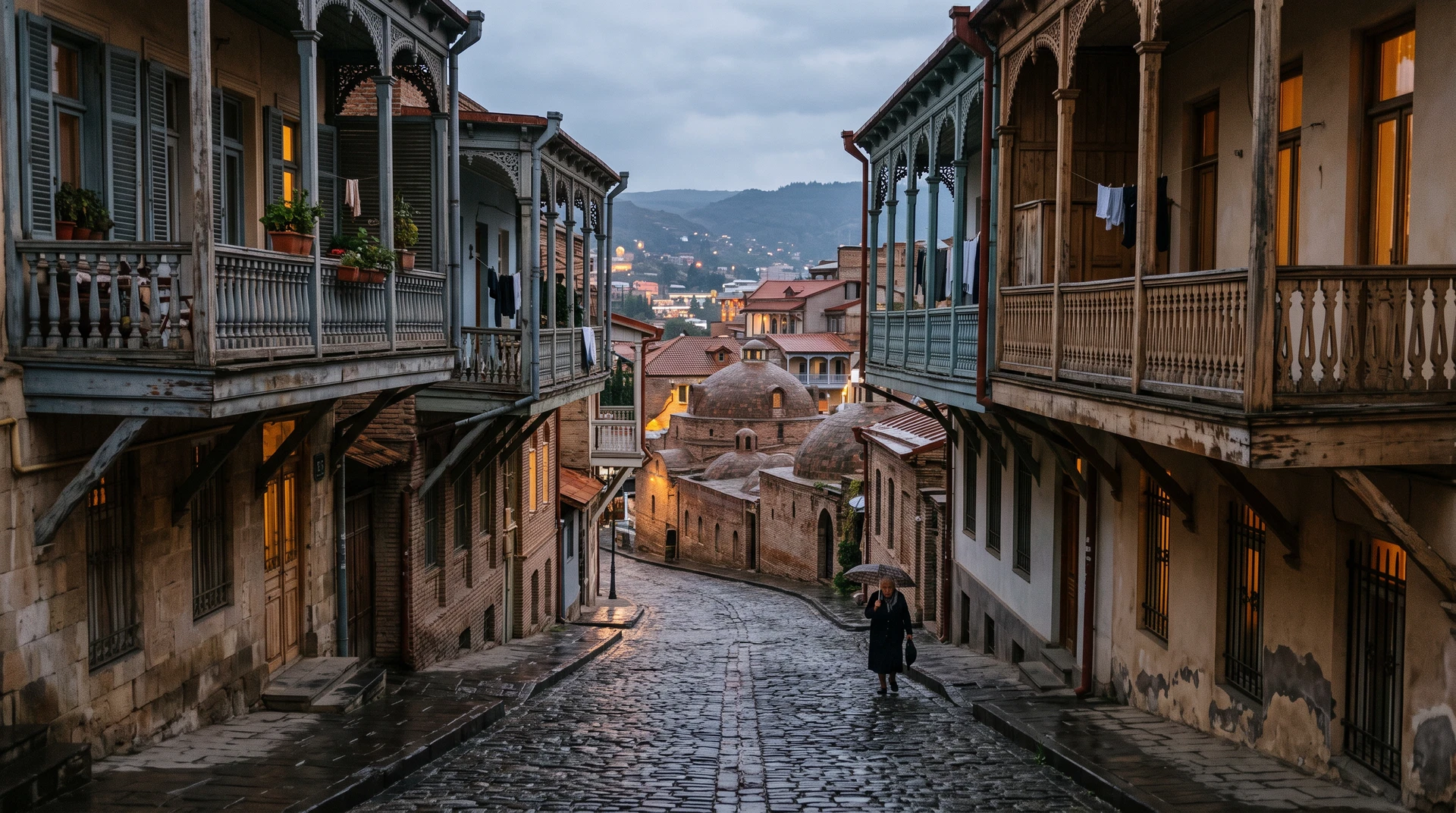
To arrive in Tbilisi is to step into a sensory landscape where the air is thick with the scent of woodsmoke, roasting meat, and the faint, persistent tang of sulfur. The city clings to the steep banks of the Mtkvari River, its skyline a jagged testament to centuries of conquest and resilience. Here, the suave, chaotic harmony of the urban fabric is immediately apparent. One's gaze might travel from the ancient, sun-bleached stones of the Narikala Fortress to the hyper-modern, undulating glass canopy of the Bridge of Peace, only to rest on a row of delicate, Persian-style wooden balconies that seem to defy gravity as they lean over the river's edge. This layered eclecticism reflects a city that has served as a crossroads between East and West for over a millennium, absorbing the aesthetics of empires while stubbornly maintaining its own distinct Georgian soul.
The story of Tbilisi begins at the water's edge in the Abanotubani district, where the city's very name - derived from the Georgian word for warm - was born. Legend tells of King Vakhtang Gorgasali, who, while hunting in the 5th century, discovered his falcon and a pheasant had fallen into a natural thermal spring and been boiled. Impressed by the healing waters, he ordered a city to be built upon the site. Today, the district is defined by a cluster of low-slung, beehive-like brick domes that rise from the ground like subterranean bubbles. These are the roofs of the ancient sulfur baths, where for centuries, travelers and locals alike have descended into steam-filled chambers to soak in the mineral-rich waters. The Orbeliani Bathhouse, with its blue-tiled facade and stained-glass windows, stands as a sentinel over the district, offering a glimpse into a time when these bathhouses were the primary social hubs of the Silk Road.
Stepping away from the steam of Abanotubani, one enters the Sololaki district, a neighborhood that captures the wistful elegance of a bygone era. Once the residence of the city's 19th-century merchant class, Sololaki is a labyrinth of crumbling Art Nouveau mansions, their facades adorned with intricate stone carvings and wrought-iron flourishes. The true magic of the district, however, lies behind its heavy, carved wooden doors. Here, one finds the famous painted entryways - hallways decorated with faded murals of landscapes, birds, and flowers that have survived decades of neglect and Soviet-era whitewashing. These passages lead to hidden Italian courtyards, communal living rooms where laundry hangs like prayer flags between balconies and neighbors share coffee and gossip under the shade of ancient grapevines. It is in these courtyards that the city's enduring spirit of community is most palpable, a resistance to the fast-paced modernization occurring just blocks away.
Tbilisi's architectural narrative is a restless dialogue between the past and a determinedly futuristic present. The city's identity is rooted in its history as a Silk Road crossroads, a fact visible in the juxtaposition of Soviet brutalist structures - like the former Ministry of Highway Construction, which looks like a stack of concrete blocks - against the sleek, metallic curves of the Rike Park Concert Hall. This layered eclecticism creates a visual rhythm that is both jarring and beautiful. Walking through the city, one might encounter a medieval church standing beside a glass-and-steel government building, all framed by the jagged ridges of the Caucasus foothills. This willingness to embrace contradiction is what gives Tbilisi its unique energy, a sense that the city is constantly reinventing itself without ever truly letting go of the layers that came before.
No exploration of Tbilisi is complete without immersing oneself in the city's deep-seated culture of hospitality and its 8,000-year-old wine tradition. In Georgia, a guest is considered a gift from God, a philosophy that transforms a simple meal into a sacred ritual. The city's many traditional taverns, or dukani, serve as subterranean sanctuaries where the sound of clinking glasses and polyphonic singing fills the air. Here, wine is often made using the ancient qvevri method - fermented in large clay jars buried underground - resulting in amber-hued wines with complex, earthy profiles. A dinner in Tbilisi is rarely just a meal; it is a supra, a feast presided over by a tamada or toastmaster, whose eloquent speeches weave together themes of family, history, and friendship. This spirit of generosity is the true lifeblood of the city, ensuring that no traveler ever feels like a stranger for long.
Across the river in the Chugureti district, a different kind of energy is taking hold. Fabrika, a former Soviet sewing factory, has been transformed into a sprawling creative hub that anchors the city's alternative scene. With its graffiti-covered walls, open-air courtyards, and industrial-chic aesthetic, Fabrika is a microcosm of the new Tbilisi. It houses artist studios, independent boutiques, and a hostel, serving as a magnet for the city's youth and international digital nomads. The resurgence of this district is a testament to the city's ability to breathe new life into its industrial past, repurposing the cold structures of the Soviet era into vibrant spaces for art and collaboration. It is a place where the history of labor meets the future of creativity, providing a stark but complementary contrast to the faded grandeur of Sololaki.
Navigating this complex city requires an appreciation for its various modes of transit, each offering a different perspective on urban life. The deep, Soviet-era Metro system is a marvel in itself, featuring rapid escalators that plunge commuters into stations adorned with mid-century mosaics and marble. For a more direct route, ride-sharing apps provide affordable and efficient transit through the city's winding streets. For those looking to venture beyond the city limits toward the Caucasus mountains, the marshrutka - a ubiquitous network of minibuses - offers a rugged and authentically Georgian travel experience. To truly enjoy the city's vibrant outdoor life, visitors should time their arrival for late spring, when the parks are in full bloom, or early autumn, when the harvest season brings a festive atmosphere to the streets and the summer heat has finally broken.
As the sun sets over Tbilisi, the city takes on a cinematic quality. The Narikala Fortress glows on its ridge, the Mtkvari River reflects the neon lights of the modern skyline, and the sound of bells from ancient churches mingles with the pulse of electronic music from hidden basement clubs. Tbilisi is a city that refuses to be defined by a single era or identity. It is a place of layered history and creative resurgence, of ancient traditions and bold futures. Whether soaking in the sulfur baths, wandering through a painted entryway, or sharing a glass of wine in a crowded tavern, the visitor is constantly reminded that they are in a place where time is both precious and irrelevant. It is this enduring spirit of the Silk Road crossroads that makes Tbilisi not just a destination, but a feeling that lingers long after the journey has ended.