World city
The Verdant Sanctuary of Ubud: Where Ancient Medicine Meets Modern Grace.
Nestled in the emerald highlands of Bali, Ubud remains a profound testament to the island’s spiritual resilience, offering a sensory journey through terraced landscapes, sacred forests, and a cultural legacy that prioritizes harmony above all else.
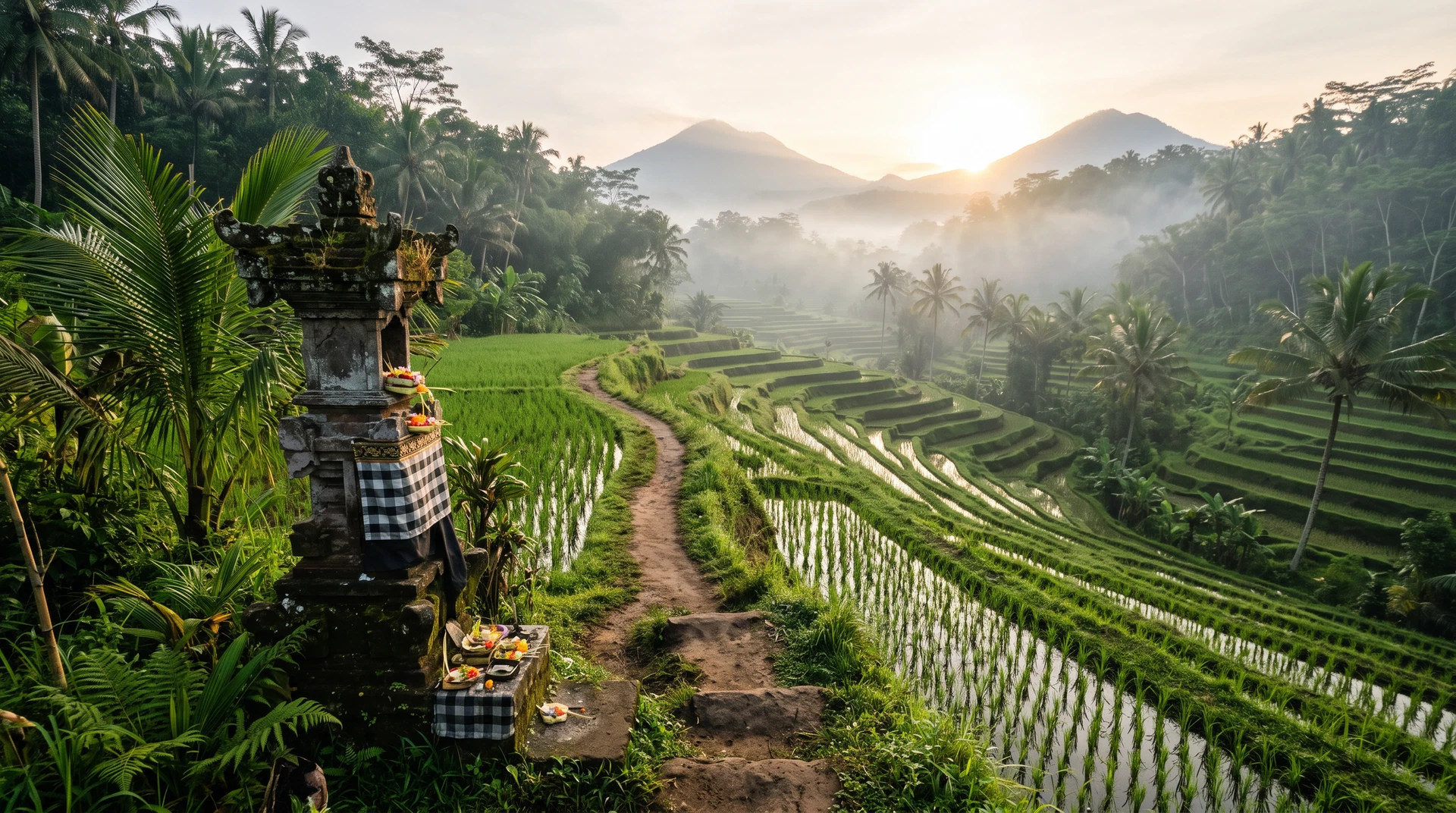
Ubud’s identity is rooted in its name, derived from the Balinese word ubad, meaning medicine. This etymological origin marks the town’s history as a sanctuary for healing herbs, discovered by the 8th-century sage Rsi Markandeya at the campuhan, or confluence, of the Wos and Cerik rivers. This sacred meeting point, home to the Pura Gunung Lebah temple, remains the town’s spiritual heart. Today, the Campuhan Ridge Walk offers a sensory immersion into this landscape, following a paved trail along a hill crest between two lush river valleys. As morning mist clings to the elephant grass and the sound of rushing water rises from the jungle floor, it is clear why this site was chosen as the source of the island’s medicinal energy. For the visitor, the ridge walk is a gentle introduction to Ubud’s dual nature: a place of profound natural beauty and deep historical significance.
Life in Ubud is governed by the Tri Hita Karana philosophy, which mandates harmony between the human, natural, and spiritual realms. This worldview is physically manifested in the daily ritual of Canang Sari. Each morning, the air fills with the scent of incense as locals place hand-woven palm-leaf baskets at every threshold. These offerings, filled with vibrant flower petals and small tokens of food, are intended to maintain cosmic balance. This spiritual grounding is reinforced by the active presence of the Ubud Royal Family, who continue to host traditional Balinese dance and gamelan performances within the weathered stone courtyards of the Ubud Palace. For the traveler, witnessing these daily acts of devotion provides a poignant contrast to the town’s modern tourism, reminding one that Ubud’s soul remains anchored in a duty to the unseen world.
Artistic expression in Ubud reflects a unique blend of isolation and global influence. While the town center is synonymous with the fluid Ubud style, the nearby Batuan Village preserves a starkly different tradition. Originating in the 1930s, the Batuan style is characterized by dense, monochromatic compositions depicting complex mythological scenes. These works are packed with intricate details, where every inch of the canvas is occupied by spirits and village life. This creative depth ensures that Ubud remains Bali’s cultural capital, a place where art is viewed as a form of worship rather than mere decoration. The sound of the gamelan percussion orchestra resonating from the palace each night further solidifies this connection. Within these ancient stone walls, the preservation of high art ensures that Balinese culture is not just performed for visitors, but lived as a continuous, sacred tradition.
Beyond the town gates lie the Tegalalang Rice Terraces, a living monument to the Subak system. This UNESCO-recognized cooperative water management framework has governed the landscape since the 9th century. The Subak system is a democratic method of irrigation that connects farmers through a network of water temples, ensuring every field receives its fair share of the mountain springs. This ancient engineering feat reflects the Tri Hita Karana philosophy by integrating spiritual, social, and natural elements. Walking through the narrow ridges of the terraces, one sees the sun reflecting off the flooded paddies, creating a shimmering staircase that seems to ascend into the tropical sky. It is a testament to a thousand years of sustainable co-existence, where the landscape is not merely exploited for resources but carefully tended as a sacred trust between generations.
In the southern reaches of town, the Sacred Monkey Forest Sanctuary offers an immersion into the natural world. This 12.5-hectare forest is home to over 1,200 long-tailed macaques and 186 species of trees, many of which are considered sacred. The forest is a site of significant religious importance, housing three 14th-century temples where the monkeys are viewed as spiritual guardians. As the macaques swing through giant banyan trees and lounge on moss-covered statues, the forest serves as a microcosm of the Balinese belief that nature is a sentient force. Visitors are encouraged to observe the animals with quiet reverence, acknowledging that in this shaded sanctuary, humans are the guests. The interaction between the playful monkeys and the ancient, vine-draped stone structures creates an atmosphere of timeless mystery, bridging the gap between the wild jungle and the civilized town.
Navigating modern Ubud requires understanding the local transport dynamics, defined by a tension between global technology and traditional structures. While ride-hailing apps like Grab and Gojek are widely used, they operate within no-go zones in central Ubud. These zones are enforced by local transport cooperatives to protect the livelihoods of traditional drivers from the lower prices of app-based services. Signs warning app drivers to stay away are common, and visitors may find their ride requests canceled if they are within a restricted area. To navigate this, travelers often walk to a neutral zone or hire a private driver for the day. Hiring a driver is often the best approach, as these locals serve as informal guides, sharing insights into village life and providing access to hidden waterfalls and temples that are otherwise inaccessible.
The sensory experience of Ubud culminates in the Pasar Seni Ubud, where the town’s creative and commercial pulses meet. In the early morning, the market is a local affair selling fresh produce and spices. As the sun rises, the stalls transform into a vibrant display of Balinese craftsmanship, featuring hand-woven rattan bags, wood carvings, and batik fabrics. The air is a heady mix of roasting coffee, tropical fruit, and the scent of frangipani. For the visitor, the market is a place of negotiation and discovery, where bargaining is conducted with a smile and mutual respect. Amidst the colorful chaos, one feels the true vitality of Ubud—a place that has invited the world in without losing its unique essence. It is the perfect location to witness the intersection of traditional artistry and the modern global marketplace.
Ultimately, Ubud is a destination of profound contradictions and wistful beauty. It has transitioned from a quiet medicinal outpost to a global hub for wellness, yet it holds onto its ancient soul with quiet determination. The sound of a distant gamelan, the sight of a priest blessing a new building, and the persistent green of the jungle all serve as reminders that Ubud is a living community, not a museum. For the visitor who looks beyond the trendy cafes, Ubud offers a glimpse into a way of life that values the invisible as much as the visible. It is a place where the past is a constant companion, guiding the town toward a future rooted in the sacred harmony of the Balinese highlands. This enduring balance ensures that Ubud remains a sanctuary for the spirit in an ever-changing world.