World city
The Painted Palimpsest of George Town: A Journey Through Penang’s Living History
Beyond the weathered pastel facades and the scent of sizzling wok hei lies a city where centuries of migration have woven a tapestry of faith, flavor, and fading murals into the very fabric of the tropical air.
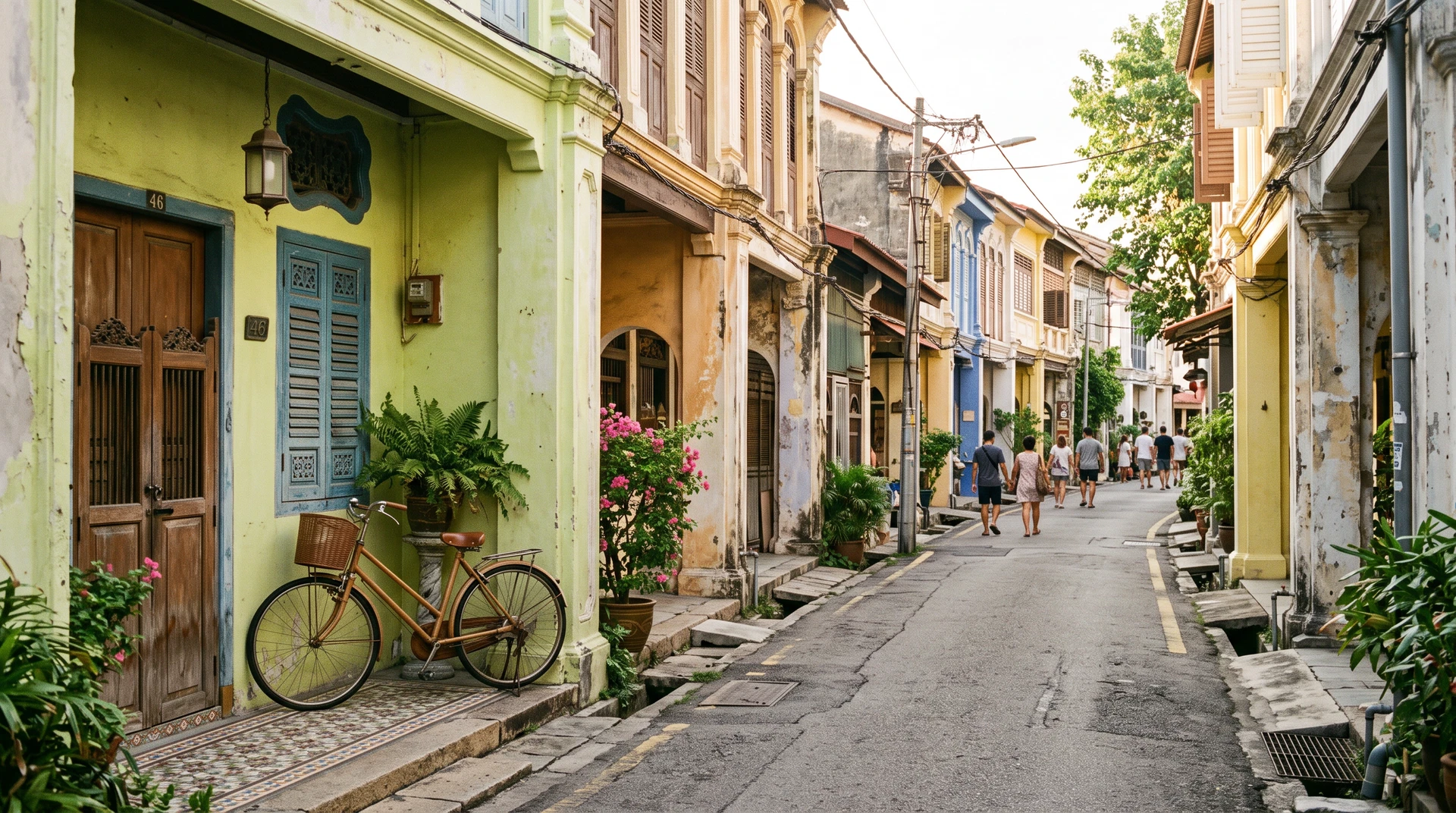
The 15-minute ferry crossing from Butterworth is the proper way to enter George Town, transitioning the traveler from the industrial mainland to the humid, salt-kissed air of Penang Island. As the ferry creaks toward the terminal, the skyline reveals a startling juxtaposition: modern glass towers standing over a dense labyrinth of terracotta roofs and colonial shophouses. Stepping off the boat, the heat hits like a physical weight, carrying the scent of diesel, sea spray, and jasmine. The streets of the UNESCO heritage zone are a sensory overload, where narrow lanes are choked with the vibrant chaos of trishaws, their riders pedaling slowly past crumbling walls that wear their history in layers of peeling pastel paint and tropical moss.
To understand George Town, one must step inside the indigo walls of the Cheong Fatt Tze Mansion, known as the Blue Mansion. This architectural marvel, with its Gothic windows and Chinese courtyards, serves as a monument to the Peranakan culture—a unique hybrid of Chinese and Malay traditions born from maritime trade. The mansion’s intricate wood carvings and Scottish ironwork tell the story of a merchant prince who sought to anchor his legacy in the jewel of the British Straits Settlements. Nearby, the Pinang Peranakan Mansion offers an opulent glimpse into this world, its rooms filled with thousands of antiques, from delicate beadwork slippers to massive teak sideboards, each piece a testament to a lifestyle that balanced Confucian values with tropical elegance.
While the mansions provide the historical backbone, street art has given George Town its modern heartbeat. In 2012, artist Ernest Zacharevic transformed the city’s weathered walls into an interactive gallery, most famously with his mural 'Little Children on a Bicycle' on Armenian Street. These artworks are not mere decorations; they are palimpsests that interact with the city’s physical decay, using real bicycles and chairs to bridge the gap between the painted image and the living street. As you wander down Lebuh Armenian, you encounter a whimsical parade of iron-wrought caricatures that narrate the city’s history with wit. This creative explosion has turned neglected alleys into thriving hubs of artisanal boutiques, proving that heritage is most vibrant when it is allowed to be playful.
Nowhere is the city’s multicultural spirit more evident than along Jalan Masjid Kapitan Keling, the Street of Harmony. In a single walk, one passes the stately St. George’s Church, the oldest Anglican church in Southeast Asia, followed by the ornate Goddess of Mercy Temple, where the air is thick with the smoke of giant incense coils. A few steps further, the rhythmic chanting from the Sri Mahamariamman Temple mingles with the call to prayer from the Kapitan Keling Mosque’s Mughal-style domes. This is not a manufactured coexistence for tourism, but a lived reality where the community navigates their diverse faiths with a casual intimacy that has endured for generations, anchored by the shared belief that every god deserves a place in the shade of the Penang sun.
At the edge of the heritage zone, the land gives way to the sea at the Clan Jetties, wooden stilt settlements that have survived modern development. The Chew Jetty is the most prominent, a narrow wooden walkway extending over the dark harbor, lined with humble homes that have belonged to the same families for over a century. These jetties were originally built by Chinese immigrants who worked as boatmen, creating a self-governed community that existed on the fringes of the colonial city. Walking along the creaking planks, you see laundry fluttering in the sea breeze and small altars glowing with red candles, offering a rustic contrast to the grand shophouses inland. It is a place where the tide dictates the rhythm of life, and the smell of salt remains unchanged by decades.
The true religion of George Town is its food, a fiery fusion that has earned the city a reputation as the culinary capital of Asia. The journey begins in Little India, where the air vibrates with Bollywood beats and the smell of roasting spices. As evening falls, hawker centers like Gurney Drive or New Lane become the centers of social life. Under the glow of fluorescent lights, vendors masterfully toss Char Kway Teow in soot-blackened woks, the 'wok hei' imparting a smoky depth to the noodles. A bowl of Penang Asam Laksa, with its sour tamarind broth and flakes of mackerel, is a culinary map of the region’s history, blending Chinese techniques with the bold, pungent flavors of the Malay Peninsula.
As the sun dips below the peaks of Penang Hill, George Town undergoes a magical transformation. The harsh glare of the afternoon softens into a golden hue that makes the ochre and turquoise walls of the shophouses glow with intensity. The sound of the city shifts from the clatter of commerce to the clink of ice and the murmur of diners gathering at plastic tables on the sidewalk. Lanterns begin to flicker in the doorways of clan houses, casting long shadows across the cobblestones of Love Lane. In this blue hour, the city feels most like itself—a place of transition where the ghosts of colonial officers and immigrant laborers seem to walk alongside modern travelers, all drawn to the same intoxicating blend of nostalgia and vitality.
There is a profound beauty in the way George Town refuses to be polished into a sterile theme park. The UNESCO status has brought protection, but it has not erased the grit; the city remains a place of damp walls, tangled wires, and the persistent humidity that slowly reclaims every surface. This is the 'wistful ink' of Penang—a story written in the cracks of the plaster and the fading colors of the murals. To visit George Town is to accept a slow pace, to get lost in the labyrinth of the heritage zone, and to recognize that the city’s value lies not in its perfection, but in its resilience. It is a reminder that culture is an evolving conversation between the people and the history they carry.
Leaving George Town feels like waking from a vivid, spice-scented dream. As you take the ferry back to the mainland, the island recedes into a silhouette of green hills and twinkling lights, leaving you with the lingering taste of chili and the memory of a sun-drenched alleyway. The city stays with you, a mental map of hidden temples and secret cafes that you promise yourself you will return to explore. It is a place that demands a return, because the city itself changes every time you look at it. George Town is a testament to the enduring power of the human spirit to create beauty in crowded spaces, a painted palimpsest that continues to add new layers to its storied walls, one brushstroke at a time.