World city
The Water-Borne Resilience of Bangkok’s Hidden Arteries.
Beyond the neon-drenched skyscrapers and the relentless hum of the Sukhumvit gridlock, the Thai capital breathes through a resilient network of historic canals and jungle-clad sanctuaries that preserve the city’s ancient water-borne soul.
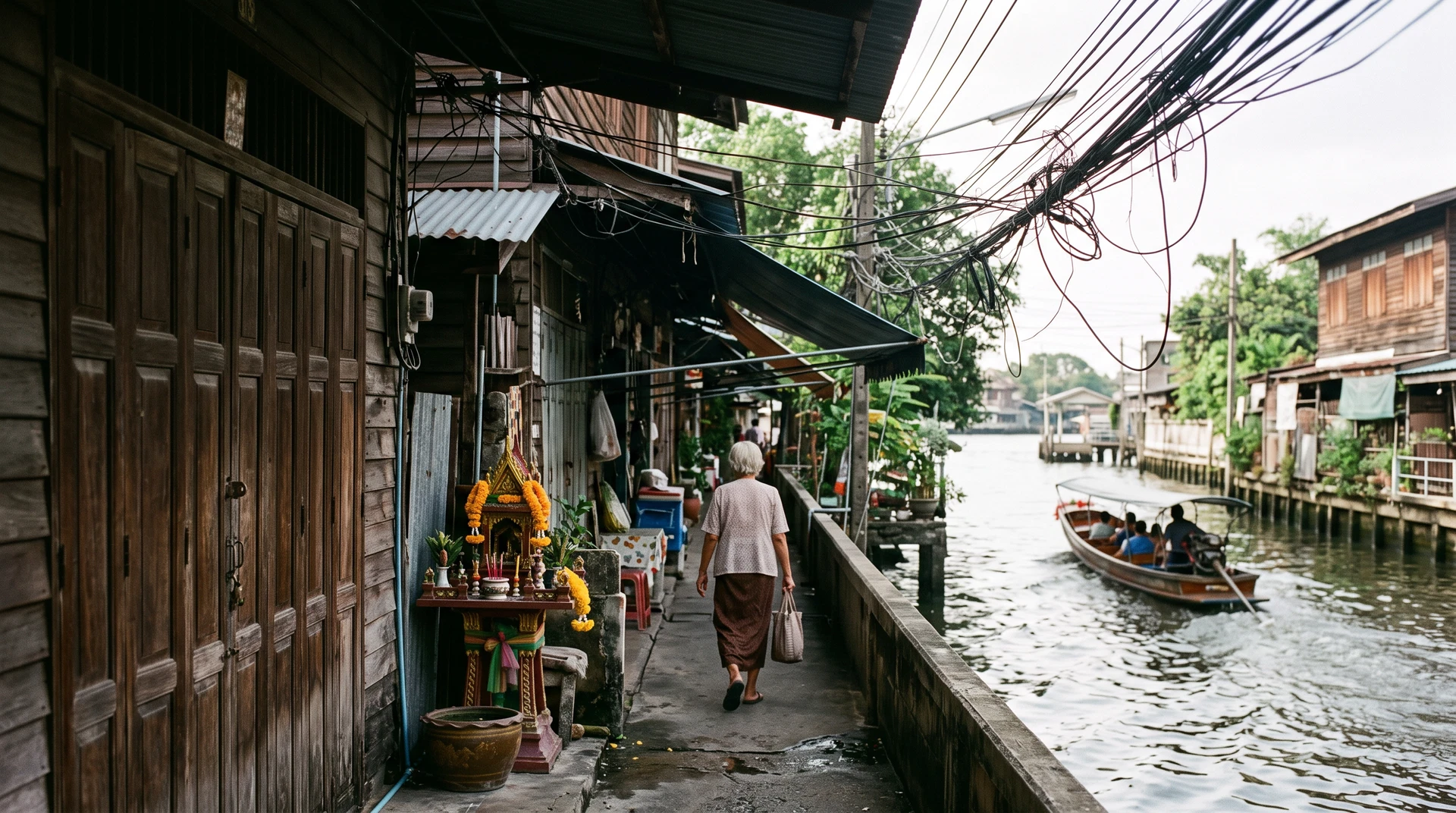
The humidity of Bangkok is a physical weight, a jasmine-scented curtain that falls the moment you leave the air-conditioned sanctuary of the airport. To the uninitiated, the city is a chaotic tapestry of neon skyscrapers, tangled power lines, and a relentless tide of motorbikes. Yet, beneath this hyper-modern veneer, the city breathes through ancient lungs of water. Once known as the 'Venice of the East,' Bangkok’s identity was forged in the silt of the Chao Phraya River, and that aquatic soul remains remarkably resilient. It is a place where the sacred and the profane are inextricably braided together, creating a wistful urban rhythm that rewards visitors willing to look for the seams between the eras.
To find the heart of this resilience, one must wander into Talat Noi, a historic neighborhood where the scent of incense from hidden Chinese shrines mingles with the metallic tang of engine oil. This is the Sieng Gong district, the legendary hub of scrap-metal recycling, where stacks of rusted engine blocks are piled high like industrial altars. In these narrow, winding alleys, the grit of manual labor is being reclaimed by a new generation of creative energy. Weathered brick walls, once silent witnesses to the trade of Portuguese and Chinese settlers, are now canvases for vibrant murals that tell the story of the neighborhood’s evolution. It is a sensory landscape where industrial decay and spiritual permanence exist in a constant, productive tension.
In the heart of Talat Noi, a vintage Fiat 500, its metal skin pitted by decades of tropical rain and partially reclaimed by creeping vines, sits as a silent monument to the city’s industrial past. Just a few feet away, sleek, minimalist cafes serve artisanal pour-overs to a crowd of young locals, illustrating the city’s characteristic collision of eras. This juxtaposition is not merely aesthetic; it is a lived reality where animist spirit houses and street food stalls anchor the community against the rapid vertical growth of the skyline. The constant interplay between the weathered textures of the past and the neon-lit ambitions of the future creates a unique urban pulse that defines the modern Thai capital.
Crossing the Chao Phraya River to the Thonburi side offers a starkly different tempo, a glimpse into a Bangkok that feels like a memory of a slower time. Here, the 'khlongs' or canals still serve as the primary arteries for local life, their dark waters reflecting the overhanging branches of mango and jackfruit trees. In the Khlong Bang Luang community, the pace of life is dictated by the gentle wake of passing long-tail boats rather than the frantic ticking of a digital clock. It is a water-centric lifestyle that has persisted despite the city’s modernization, offering a rare opportunity to see the traditional wooden architecture that once defined the entire metropolis before the concrete arrived.
The centerpiece of this riverside neighborhood is the Artist’s House, or Baan Silapin, a two-hundred-year-old wooden structure that leans gracefully over the water. Inside, the air is cool and still, smelling of old teak and acrylic paint. It is a sanctuary for traditional Thai arts, where visitors can watch a master puppeteer bring a wooden Hanuman to life or sit on the deck and feed the schools of fish that gather beneath the stilts. A centuries-old white chedi stands watch in the courtyard, a silent guardian of a culture that refuses to be eclipsed by the surrounding skyscrapers. This community remains a vital link to the city’s heritage, preserving the delicate balance between nature and urbanity.
For a true escape from the urban heat, one must travel further south to Bang Krachao, a jungle-clad peninsula known as Bangkok’s 'Green Lung.' Enclosed within a dramatic horseshoe bend of the river, this protected ecological haven feels worlds away from the concrete canyons of Sukhumvit. The only way to truly explore Bang Krachao is on two wheels, navigating the maze of elevated concrete cycling paths that wind through dense mangrove forests and coconut plantations. The air here is noticeably cooler, filtered through a canopy of green that has resisted the city’s relentless development. As you pedal past rustic wooden dwellings, the sound of the city fades into a symphony of cicadas and rustling palms.
The true genius of Bangkok lies in its 'sois'—the side streets that branch off the main thoroughfares like capillaries. These are the city’s permeable living rooms, where the boundaries between private and public space are blissfully blurred. In the early morning, residents offer alms to monks in saffron robes, their vibrant orange garments a striking contrast against the gray pavement. Every corner is anchored by a spirit house, a miniature temple adorned with fresh marigolds and bottles of red Fanta, intended to appease the guardians of the land. Amidst this spiritual landscape, the street food stalls provide the city’s communal fuel, where the intoxicating aroma of lemongrass and galangal is the constant background noise of daily life.
Navigating this layered geography requires a certain tactical flexibility, a willingness to embrace the city’s diverse modes of transit. While the BTS Skytrain offers a sleek, air-conditioned view of the skyline from above, the most authentic way to move through the city’s core is via the Khlong Saen Saep canal boats. It is a visceral, often chaotic experience—passengers must scramble onto moving vessels while conductors, balanced on the gunwales, collect fares with practiced ease. The water is dark and the air is thick with diesel, but as the boat slices through the heart of the city, bypassing the legendary gridlock, you realize that this is the true lifeblood of Bangkok, a functional relic of the past.
Ultimately, Bangkok is a city of endurance, a place that has learned to thrive in the tension between its historical grounding and its futuristic ambitions. It is a metropolis that does not ask you to choose between the old and the new, but rather invites you to inhabit the space where they collide. Whether you are watching the sunset reflect off the porcelain spires of Wat Arun or losing yourself in the neon-lit labyrinth of a night market, the city’s wistful urban rhythm is always present. It is found in the weathered texture of a Talat Noi wall, the cool shade of a Bang Krachao mangrove, and the resilient spirit of a city that remains grounded in its water-borne roots.