World city
The Ochre Echoes of Hoi An: A Silk-Woven Passage Through Time
Nestled along the banks of the Thu Bon River, Vietnam’s most evocative ancient port preserves a centuries-old tapestry of merchant history, where lantern-lit waterways and bespoke craftsmanship create a living museum of Southeast Asian heritage.
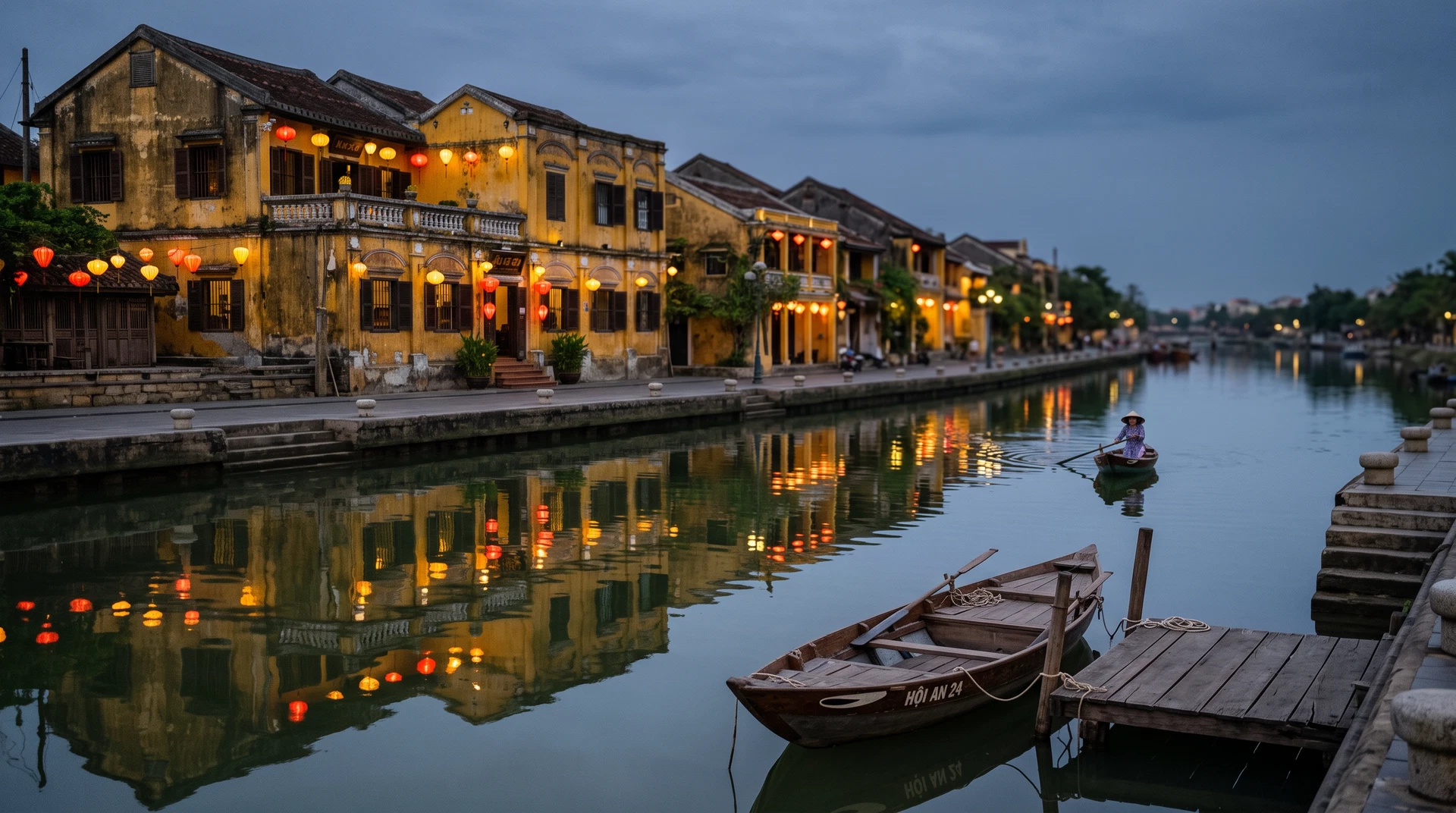
As the tropical sun begins its slow descent over the horizon, the city of Hoi An transforms into a radiant tableau of gold and shadow. Known to many as the 'Yellow City,' its streets are lined with buildings washed in a distinctive, sun-ripened ochre that seems to capture the very essence of the Vietnamese afternoon. Walking through the narrow arteries of the UNESCO-listed Ancient Town, one is immediately struck by the weight of history that hangs in the humid air, thick with the scent of incense and woodsmoke. This is a place where time does not so much pass as it does pool, collecting in the quiet courtyards of merchant houses and the weathered crevices of ancient timber. The atmosphere invites an abandonment of the frantic pace of the twenty-first century for a rhythm dictated by the tides and the moon.
The architectural soul of Hoi An is a testament to its storied past as a preeminent maritime hub in Southeast Asia. Between the 15th and 19th centuries, this small port was a vital intersection for traders from across the globe, serving as a primary link between the East and the West. The result is a unique 'melting pot' of cultural influences that remains remarkably intact today. Here, the sturdy, dark-timbered frames of traditional Vietnamese dwellings stand shoulder-to-shoulder with the ornate, tiled roofs of Chinese assembly halls and the delicate, curved lines of Japanese structures. French colonial aesthetics linger in the shuttered windows and grander facades along the riverfront. This synthesis of styles is not merely a historical curiosity but a living, breathing environment where families still reside in homes that have seen centuries of trade, typhoons, and transformation.
Perhaps no structure better encapsulates this cross-cultural legacy than the Japanese Covered Bridge, a 16th-century marvel that has become the iconic symbol of the city. Built by the Japanese merchant community to link them with the Chinese quarters across the canal, the bridge is a masterclass in functional elegance, featuring a small temple dedicated to the god of weather nestled within its wooden span. Nearby, the grand merchant houses, such as the Tan Ky or Phung Hung houses, offer a deeper look into the lives of those who built this port. Their interiors are cool sanctuaries of dark jackfruit wood and mother-of-pearl inlay, designed with open-air courtyards that allow the elements to breathe through the house. The walls, draped in vibrant cascades of pink bougainvillea, provide a sharp, beautiful contrast to the aged yellow masonry, creating a visual language that is synonymous with the Hoi An experience.
The Thu Bon River remains the lifeblood of the city, just as it was when the great merchant ships of the Dutch and Portuguese East India Companies anchored in its depths. Today, the scale of commerce has shifted to a more intimate level, yet the water’s importance is undiminished. Along the riverfront, traditional wooden sampan boats bob gently against the stone docks, their hulls painted with the watchful eyes that sailors have long believed protect them from the spirits of the deep. A slow-paced boat ride at twilight offers a perspective of Hoi An that is both tranquil and hauntingly beautiful. From the water, the city’s silhouette appears as a jagged line of ceramic tiles and overhanging eaves, reflected in the rippling surface of the river. It is here, amidst the soft lap of oars and the distant call of vendors, that one truly feels the wistful connection to the maritime ghosts of the past.
Beyond its static monuments, Hoi An is a city defined by the tactile and the artisanal. The district is world-renowned for its bespoke tailoring, a tradition rooted in the silk-weaving heritage of the surrounding central provinces. Walking through the streets, one is greeted by the rhythmic click-clack of sewing machines and the vibrant displays of raw silk in every conceivable hue. The level of craftsmanship is staggering; local tailors are famous for their ability to produce high-quality, custom-fitted garments in as little as twenty-four hours. This industry is a sensory feast, providing a modern echo of the luxury goods that once passed through these docks. For many travelers, the process of choosing a fabric and being measured for a suit or a dress is a rite of passage, a way to literally weave themselves into the city’s commercial fabric.
The sensory experience of Hoi An reaches its zenith during the monthly Lantern Festival, a tradition that honors the full moon and pays tribute to the city’s ancestors. On these nights, the modern world is intentionally pushed aside as electric streetlights are extinguished, leaving the Ancient Town to be illuminated solely by the soft, flickering glow of thousands of handcrafted silk lanterns. The effect is nothing short of magical. The river becomes a floating galaxy of light as visitors and locals alike release small paper lanterns with prayers for luck and prosperity. The air is filled with the sound of traditional music and the sight of people gathered on straw mats to play games or share stories. It is a moment of profound spiritual connection, where the boundary between the present and the past seems to dissolve entirely under the amber light of the lanterns.
Navigating this historical treasure is a uniquely peaceful endeavor thanks to the city’s commitment to preservation. The Old Town enforces a strict ban on motorized vehicles for much of the day, transforming the streets into a sanctuary for pedestrians and cyclists. This policy allows the sounds of the city to emerge—the tinkling of bicycle bells, the sweep of a broom on a stone threshold, and the animated chatter of the central market. Cycling through the surrounding countryside, where emerald rice paddies are dotted with water buffalo and white egrets, provides a necessary counterpoint to the density of the town center. The thirty-kilometer journey from the modern hub of Da Nang International Airport serves as a transition zone, preparing the traveler for the slower, more deliberate pace of life that Hoi An demands and deserves.
To visit Hoi An is to engage in a form of architectural and cultural pilgrimage. While the dry season from February to April offers the most temperate weather for exploration, there is a certain melancholic beauty to the city even during the rainy months, when the river rises to reclaim the lower streets and the yellow walls take on a deeper, saturated hue. It is a place that rewards the patient observer—the one who stops to notice the intricate carvings on a lintel or the way the morning light hits a steaming bowl of Cao Lau noodles. Hoi An remains a distinctive refuge that honors its complex history while remaining vibrantly alive. It is a story written in silk and stone, a wistful ink that continues to flow through the hearts of all who wander its ancient paths.