World city
The Ochre Pulse of a Thousand Autumns
In the labyrinthine streets of Hanoi, where French colonial decay meets a restless modern energy, the soul of Vietnam is found not in its monuments, but on the weathered plastic stools of its sidewalks.
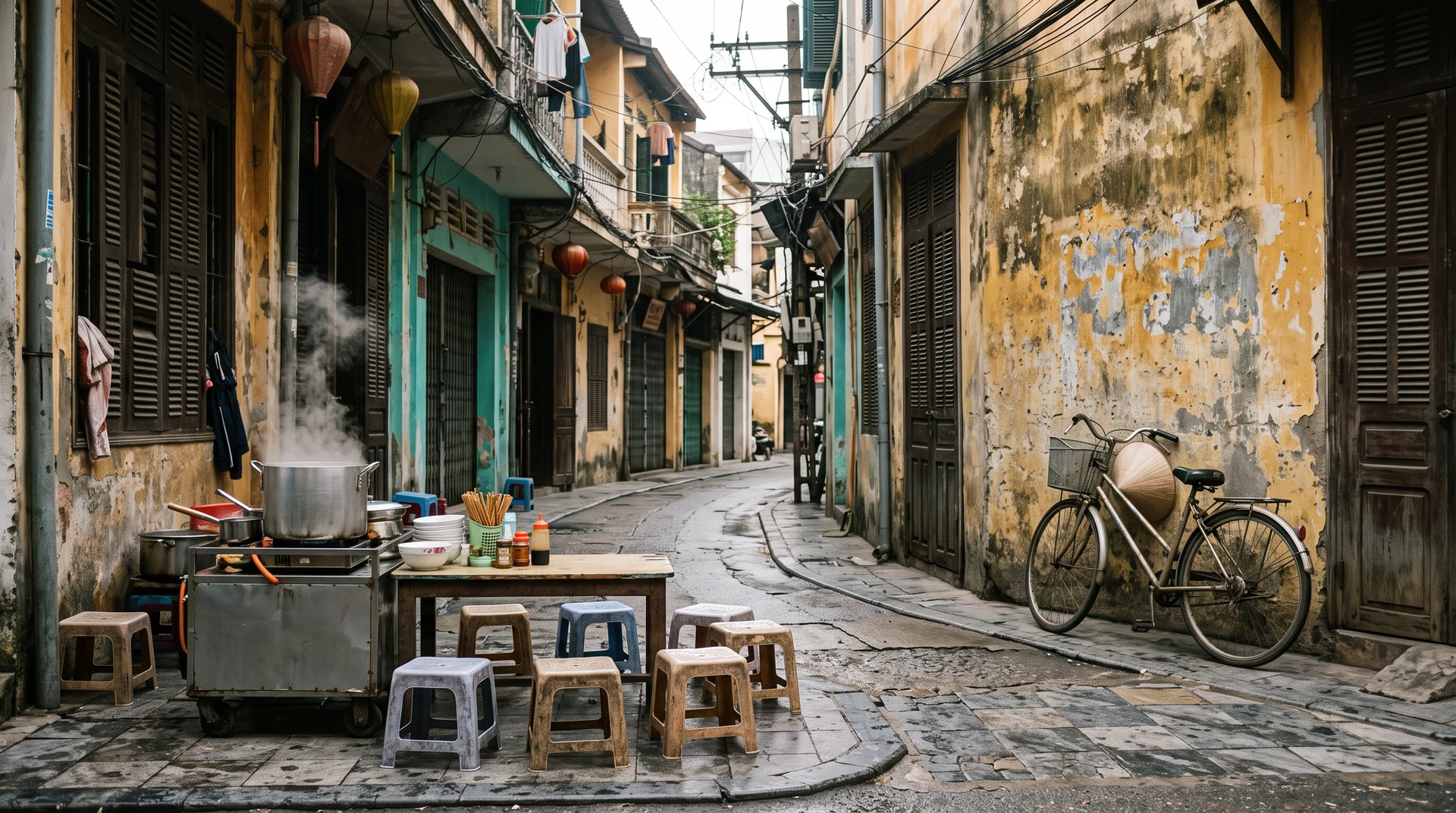
To arrive in Hanoi is to step into a living paradox where a thousand-year history is carried with restless levity. The air is a tapestry of motorbike exhaust, jasmine tea, and charcoal-grilled pork. This city is defined by its Patina and Pulse, a poetic coexistence of French colonial decay and a vibrant sidewalk life. Navigating the labyrinthine streets, you see weathered ochre-yellow facades, their peeling paint telling stories of monsoons and revolutions. It is a place where time swirls like the steam from a bowl of pho, blending ancient legends of the Red River with the modern aspirations of a generation that refuses to be slowed down.
The Old Quarter, a dense grid of thirty-six streets, has been the commercial engine of the city since the 11th century. When King Ly Thai To moved the capital to Thang Long in 1010, he created a hub for craft guilds. Today, streets still bear the names of their original specialties—Hang in Hang Bac or Hang Gai means merchandise, marking the territory of silversmiths and silk weavers. Walking these alleys is like leafing through a ledger of human industry. On Hang Ma, the air glows with scarlet paper offerings, while on Hang Bac, the rhythmic tapping of silver hammers continues a hereditary tradition that has survived empires.
The architecture of the Old Quarter reflects both ingenuity and historical taxation. Iconic tube houses—narrow buildings stretching deep into blocks—minimized street frontage to lower property taxes. These slender structures house multiple generations, their interiors featuring hidden courtyards that offer silent retreat from the street-level cacophony. Interspersed are elegant, crumbling remnants of the French colonial era. Stuccoed villas with emerald shutters stand as witnesses to a different century, their grandeur softened by creeping vines and persistent humidity. This collision creates a visual rhythm where European classicism is softened by the exuberant growth of a tropical metropolis.
Life in Hanoi is a public performance enacted on the sidewalk. The open-air culture of the city thrives on the low plastic stools populating every inch of pavement. Here, boundaries between private and public dissolve. Residents dine, socialize, and conduct business in full view, creating a communal intimacy rare in the West. To sit on one of these stools—inches off the ground—is to enter the flow of the city. You might find yourself elbow-to-elbow with a government official and a street vendor, both enjoying a glass of fresh beer. This sidewalk society prioritizes connection over seclusion, displaying the routines of millions with refreshing transparency.
Navigating this landscape requires an appreciation for choreographed chaos. The streets are a relentless sea of motorbikes, a fluid tide following unknown laws of physics. For the uninitiated, crossing the road is an act of faith; for the local, it is a subtle dance of motion and eye contact. The Grab app has integrated this chaos into a tool for travelers, allowing you to hop on a motorbike taxi and weave through gridlock. From this vantage, the city takes on a new dimension. You feel the temperature drop under the ancient trees of the French Quarter and the surge of heat in the dense northern markets.
As the blue hour settles, the ritual of Bia Hoi begins. This fresh lager is brewed daily and delivered in steel kegs via motorbike. Often the cheapest beer in the world, its value lies in the social fabric it supports. At Ta Hien Corner, the energy is infectious. The air is thick with the sound of Mot, Hai, Ba, Yo! as crowds spill into the intersection. The beer is crisp, served in recycled glasses that have seen a thousand such nights. This is a social leveling mechanism, where daily stresses are washed away by the collective joy of the crowd and the simple pleasure of a shared table.
When central intensity becomes too much, the Truc Bach neighborhood offers a quieter rhythm. This district is a sanctuary for the storied coffee culture of Hanoi, home to the original egg coffee—a decadent whisked yolk and condensed milk creation. Sipping this velvety brew in a vine-draped courtyard, far from the honking horns, you feel the slower heartbeat of the city. These coffee houses, often in former mansions or industrial spaces, are filled with the scent of dark-roasted beans and the murmur of students. It is a reminder that Hanoi is a city of contrasts, capable of both overwhelming noise and profound, cedar-scented silence.
To understand the industrial soul of the city, one must walk the Long Bien Bridge. Designed by the firm of Gustave Eiffel and completed in 1902, this rusted iron giant spans the Red River like an essential skeletal remain. It survived heavy bombings, its repairs serving as a physical manifestation of resilience. Today, it remains a vital artery for trains and motorbikes, its cantilevered spans providing a windswept path above verdant banana plantations. Walking its pedestrian lane at sunset, you see the city from a distance—modern skyscrapers rising like glass shards against the soft-focus silhouette of the old town, while the Red River flows silently beneath.
The journey inevitably leads back to Hoan Kiem Lake, the spiritual anchor of the city. In the early morning mist, shores are alive with residents practicing Tai Chi under weeping willows, while the red Huc Bridge leads to Ngoc Son Temple. As autumn light clarifies the legendary atmosphere of the city, the fading ochre of the walls glows with renewed intensity. Hanoi does not hide its scars; it wears them with a quiet dignity. It stays with you long after you leave, a wistful memory of incense smoke, the taste of salt and lime, and the image of a vendor walking through golden light, carrying the weight of a thousand years.