World city
The Garden City’s Quiet Pulse: Finding the Soul of Singapore Amidst the Neon and Greenery.
Beyond the shimmering steel of the Marina Bay skyline lies a city of deep-rooted nostalgia, where the steam of a hawker center and the pastel tiles of a Peranakan shophouse tell the story of a nation that refuses to forget its past while racing toward the future.
To arrive in Singapore is to step into a thick, fragrant embrace of humidity and the scent of damp earth. It is a place where the concept of a "City in Nature" is a visceral reality. As you move from the hyper-modern corridors of Changi Airport, greenery asserts itself, climbing concrete pillars and spilling from high-rise balconies. This metropolis has mastered the vertical forest, yet beneath the canopy of steel and leaves, there exists a quieter, more wistful narrative. It is a story told in the curves of old buildings and the rhythmic clatter of communal dining halls, a side of the island that feels distant from the sterile efficiency often attributed to this Southeast Asian hub.
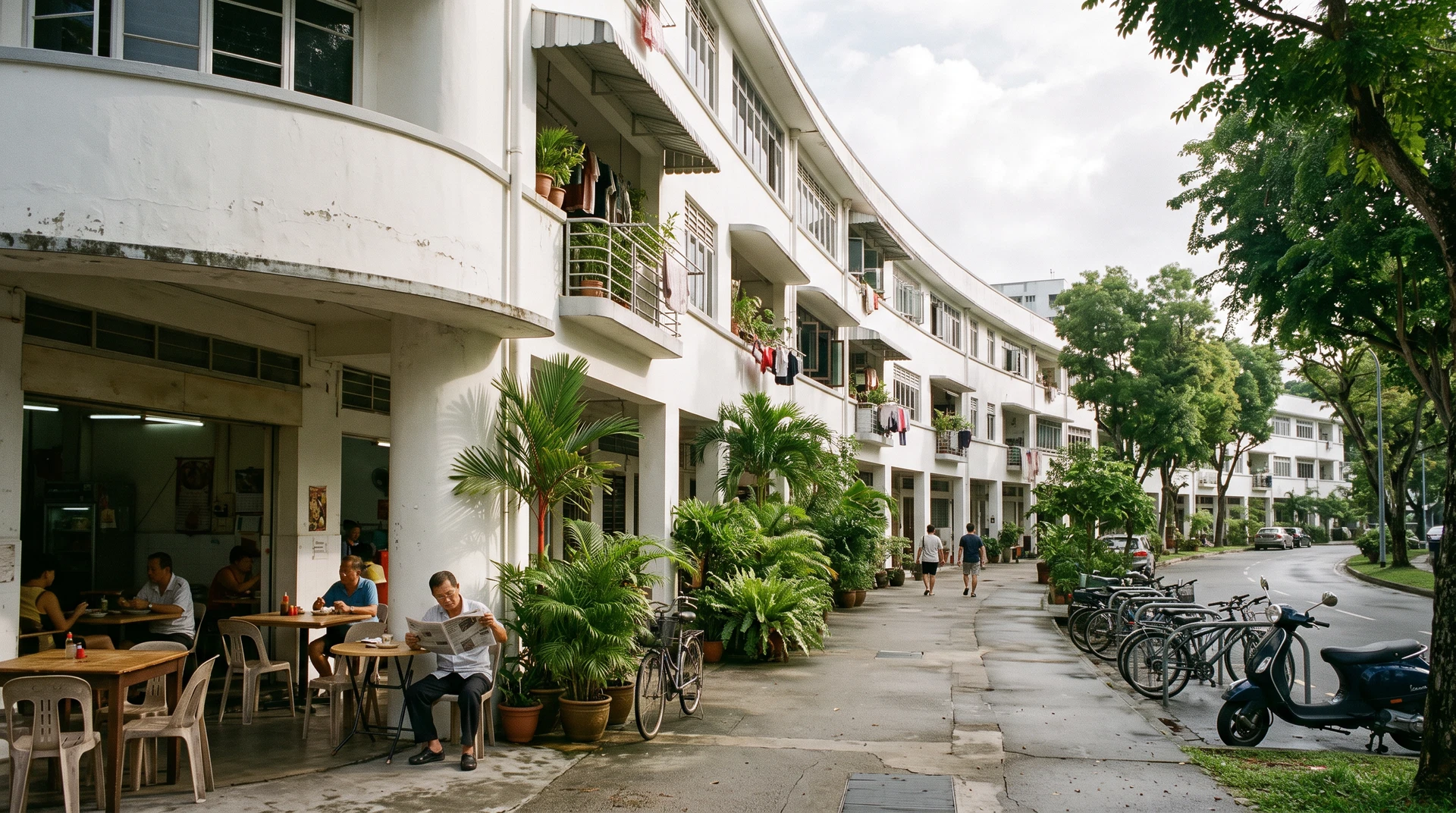
One such sanctuary is Tiong Bahru, a residential estate serving as a living museum of the 1930s. Here, the architecture is defined by Streamline Moderne, a style reflecting the era’s fascination with the elegance of ocean liners. Walking through the estate, you encounter low-slung blocks characterized by nautical porthole windows, cantilevered sunshades, and rounded corners that guide the tropical breeze through narrow streets. There is a specific stillness here, especially in the early morning when the only sound is the distant chirping of birds and the soft scraping of a broom. The estate was the first public housing project in Singapore, and its endurance is a testament to the city’s ability to preserve its modernist roots. In quiet courtyards, elderly residents sit on stone benches, their presence a bridge to a pre-war era that feels both ancient and intimately present.
From the streamlined curves of Tiong Bahru, the journey leads eastward to the sensory explosion of Joo Chiat and Katong. This is the heart of Peranakan culture, a unique heritage born from the blending of Chinese, Malay, and Indonesian influences. Along Koon Seng Road, shophouses stand like jewel-toned boxes, their facades adorned with intricate floral ceramic tiles and ornate plasterwork. The colors are unapologetically bold—mint greens, pale pinks, and deep ceruleans—reflecting a legacy of trade and cultural exchange that predates the modern state. To walk these streets is to witness the resilient beauty of a community that has meticulously maintained its ancestral identity. The air smells of coconut milk and spicy rempah, drifting from eateries that have served the same recipes for generations. It is a neighborhood that demands you slow down, inviting you to run your fingers over cool, patterned tiles and imagine the lives lived behind shuttered windows.
Yet, if the shophouses are the city’s ornate exterior, the hawker centers are its beating heart. Recognized by UNESCO as an intangible cultural heritage, Singapore’s hawker culture is the great equalizer of the nation. These sprawling, open-air dining rooms are the "living rooms" of the community, where office workers in crisp shirts sit alongside retirees in singlets, all united by a shared devotion to the perfect plate. The atmosphere is a symphony of controlled chaos: the hiss of woks, the rhythmic chopping of cleavers, and the humid, savory steam rising from a hundred stalls. At dusk, fluorescent signs flicker to life, casting a warm, neon glow over stainless-steel tables. A bowl of laksa, its rich coconut broth shimmering with spicy oil, becomes more than just a meal; it is a culinary map of the region’s history. In the shared heat of these centers, the boundaries of class and culture dissolve, revealing the true, unvarnished spirit of the Singaporean people.
For those seeking a departure from the urban grind, a short ferry ride across the water leads to Pulau Ubin. This offshore island is a portal to the past, preserving the last remaining kampong, or village, life in Singapore. On Ubin, paved roads give way to dirt tracks, and towering skyscrapers are replaced by rustic wooden dwellings tucked away in the jungle. It is a place of rugged beauty, where the Chek Jawa Wetlands offer a glimpse into the biodiversity that once covered the entire island. Cycling through the island’s interior, you encounter granite quarries reclaimed by nature, their deep blue waters reflecting towering palms. The pace of life on Pulau Ubin is dictated by the tides and the sun, a stark contrast to the precision of the mainland’s MRT system. It is a reminder of the island’s humble beginnings as a fishing and farming community, a wistful echo of a simpler time that the city-state has fought hard to keep within reach.
This tension between progress and preservation is the defining theme of the Singaporean experience. The city operates with legendary efficiency, anchored by the Mass Rapid Transit (MRT) system that weaves the island together with air-conditioned seamlessness. To travel during quiet hours, avoiding the frantic rush of morning and evening peaks, is to see the city as a masterpiece of urban planning. You glide from the glass-and-steel canyons of the central business district to the lush, green fringes of the heartlands in minutes. Yet, even within this high-tech framework, there is a constant effort to ground the future in the soil of the past. The "City in Nature" ethos is not just about planting trees; it is about creating a habitat where technology and ecology coexist.
As the sun sets, the transition from day to night brings a new layer of atmospheric depth. The blue hour transforms the skyline into a silhouette of shimmering lights, while heritage districts retreat into soft, amber-lit nostalgia. The humidity remains, a constant companion that blurs the edges of the city and lends a cinematic quality to every street corner. Whether sitting at a damp table in a hawker center or wandering the quiet alleys of Tiong Bahru, there is a sense that Singapore is a city that is always becoming, yet never quite leaving itself behind. It is a place where the futuristic and the ancient are not in conflict, but are instead two halves of a single, complex identity. The wistful ink of its history is written in the shadows of its skyscrapers, a reminder that even in the most modern of metropolises, the soul of a place is found in the things that remain unchanged.
In the end, the true magic of Singapore lies in these quiet intersections. It is found in the elderly man practicing tai chi in a park surrounded by glass towers, or in the young couple sharing a plate of satay under the watchful eye of a centuries-old shrine. It is a city that has managed to build a future without discarding its memories, creating a landscape that is as much about the people who inhabit it as the structures they have built. The island remains a rare testament to the possibility of growth without the loss of character, a place where the humid air is thick with both the promise of tomorrow and the gentle, persistent echoes of yesterday.