World city
The Silent Echoes of the Thousand-Year Capital.
In the heart of Japan, Kyoto stands as a living testament to the beauty of transience, where the weathered wood of ancient machiya and the hushed moss of temple gardens offer a timeless sanctuary against the relentless pulse of modernity.
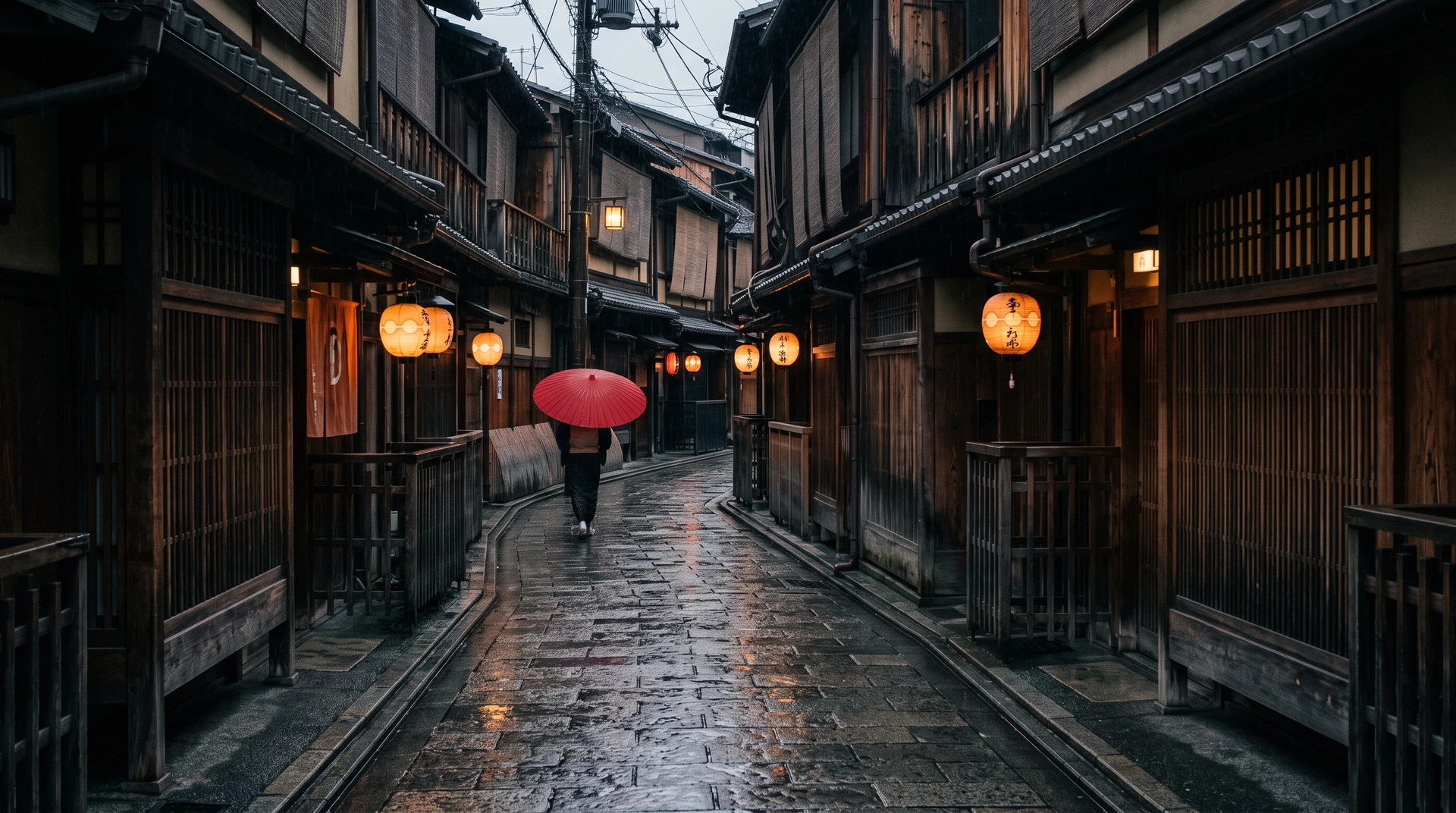
Kyoto is not merely a city; it is a repository of Japan’s collective memory, where twelve centuries of history are etched into every weathered beam and moss-covered stone. Spared the devastation of the Second World War, its intricate tapestry of temples, shrines, and traditional neighborhoods remains largely intact, creating a living dialogue between the past and the present. Walking through its streets, one is reminded that the ground beneath has supported emperors and pilgrims for over a millennium. It is a city that demands a slower pace, inviting visitors to look beyond the neon lights into the quiet, cedar-scented shadows of its hidden alleys. Here, the weight of history is a gentle presence, providing continuity in an ever-changing world.
The Gion district serves as the evocative heart of Kyoto’s traditional culture, particularly as twilight descends and the city glows with the soft, amber light of paper lanterns. Known as the geisha district, Gion is a labyrinth of narrow streets lined with machiya, the traditional wooden townhouses. Along the Shirakawa canal, the atmosphere is one of profound tranquility, where the sound of water flowing over stones provides a rhythmic backdrop to willow trees. While the commercial Hanami-koji draws crowds, the quieter corners offer a glimpse into a world fiercely protective of its traditions. It is here that one might catch a fleeting glimpse of a maiko, her vibrant kimono a striking contrast to the dark wood of the buildings. These moments perfectly encapsulate the city’s elusive charm and its commitment to preserving the artistry of a bygone era.
To the east, the Higashiyama district rises in stone-paved slopes that have served as a primary artery for pilgrims for centuries. The streets of Sannenzaka and Ninenzaka, with their steep stairs and traditional shops, lead toward the monumental wooden terrace of Kiyomizu-dera. This area is a sensory feast, where the smell of incense mingles with the aroma of roasted green tea. The architecture is a masterclass in traditional design, with low-slung roofs creating a sense of human-scaled intimacy. As you ascend, the city reveals itself in fragments, with the distant silhouette of modern skyscrapers framed by ancient eaves. Reaching the terrace of Kiyomizu-dera, one is treated to a panoramic view of Kyoto, a sight that serves as a powerful reminder of the city’s enduring spiritual significance as a bridge between the earthly and the divine.
Crossing to the west, Arashiyama provides a sensory transition rooted in the raw beauty of the natural world. The towering bamboo groves create a cathedral-like canopy that filters sunlight into a soft, verdant green. The sound of wind rustling through the bamboo is a melody that has inspired countless artists. Nearby, Tenryuji Temple offers a structured encounter with nature through its Zen gardens, designed to be viewed from wooden verandas. These gardens offer space for contemplation where every rock is placed with intentionality. The transition from the wild energy of the bamboo forest to the disciplined stillness of the Zen garden reflects the Japanese ideal of finding harmony between the untamed and the refined.
At the core of Kyoto’s identity is wabi-sabi, a worldview finding beauty in the transient and the imperfect. This is manifested in the minimalist rock garden of Ryoan-ji, where fifteen stones in a sea of white gravel defy complete observation from any single vantage point. It invites the visitor to sit in silence and confront the nature of perception. Similarly, the moss-covered grounds of Gio-ji celebrate the quiet decay of autumn and the lush growth of summer. In these spaces, the natural cycle of life and death is elevated to an art form. The deep greens of the moss and the grey of weathered stones create a palette that is both somber and moving, grounding the visitor in the present moment.
Despite its roots, Kyoto is not frozen in time. The tension between its ancient soul and modern ambitions is apparent at Kyoto Station. A futuristic hub of glass and steel, the station is a marvel of contemporary architecture standing in contrast to the low-slung wooden structures elsewhere. Inside, the hyper-modern transit network facilitates the movement of thousands, connecting Kyoto to the high-speed pulse of Tokyo. Yet, even here, there are nods to heritage, with views looking out over the tiled roofs of nearby temples. This juxtaposition creates a wistful tension, a reminder that while Kyoto is a guardian of the past, it is also a participant in the future, acting as a bridge between the 21st century and the silent interiors of its sacred spaces.
Navigating Kyoto requires strategy, as popularity leads to congestion during the peak seasons of spring and autumn. The cherry blossoms of April and the fiery maples of November draw visitors from around the world. To experience the city’s contemplative side, travelers should visit during early morning hours, when the air is crisp and the only sounds are the sweeping of temple brooms. The shoulder months of May and September also offer a temperate climate and fewer crowds. Transport is best handled via the Kyoto City Bus network and walking, as the subway is limited. Utilizing a rechargeable IC card like Suica makes these transitions seamless, allowing the visitor to focus on the journey rather than the logistics.
As the sun sets and the modern city flickers with neon, the ancient heart of Kyoto remains a place of profound, melancholic beauty. It teaches us that nothing is permanent, yet the things that endure are those cared for with intention. Whether it is the curve of a ceramic tile, the scent of incense, or a single maple leaf falling onto a mossy path, Kyoto offers endless opportunities for reflection. It is a destination that stays with the traveler long after they have left, a wistful ink drawing of a place where time folds in on itself. The true magic of Kyoto lies in the quiet moments of stillness found in between, a reminder that in a world of constant movement, there is still a place where the soul can find a home.