Migration ecology
A butterfly-sized tag is revealing a continent in motion.
A microscopic tag and a unique identification code are all that connect a single insect to a global research network, revealing the silent, intergenerational choreography of a continent in motion.
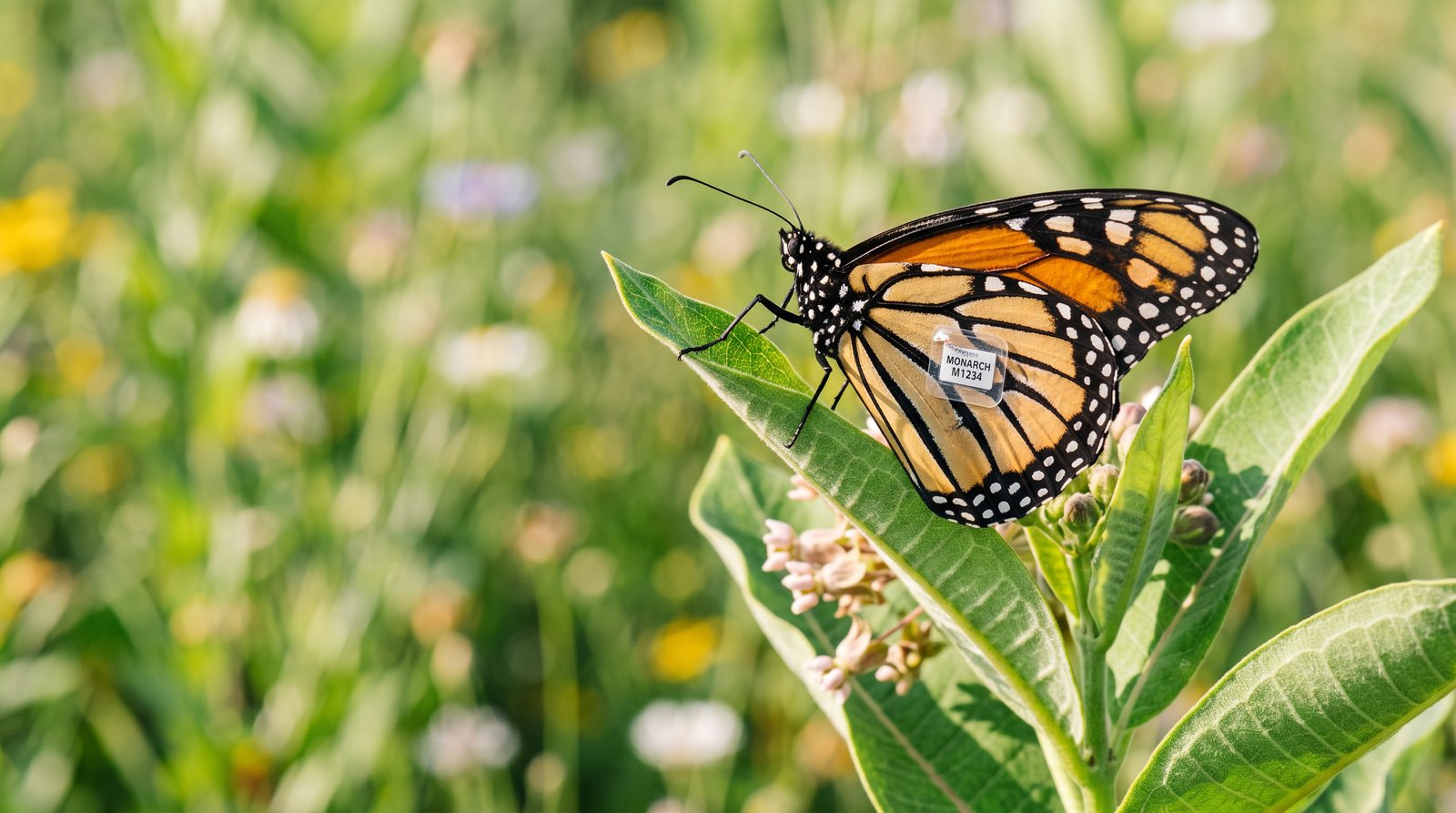
The migration of the Monarch butterfly is one of the most remarkable events in the natural world, a seasonal movement that transforms North America into a vast corridor of life. Every year, millions of these insects embark on a journey spanning thousands of miles, traveling from the northern United States and Canada to specific mountain forests in central Mexico. It is a journey that defies the apparent fragility of the individual traveler, a "continent in motion" that requires a resilience far beyond what its half-gram weight might suggest. The scale of this movement creates a sense of wonder that has captivated scientists for decades, prompting a search for the mechanisms that allow such a small creature to achieve such an immense feat.
To understand the intricacies of this movement, researchers have developed specialized tools that match the scale and delicacy of their subjects. The "butterfly-sized tag" is a masterpiece of miniaturization. These tags, often no larger than a small sticker, are engineered to be light enough that they do not interfere with the butterfly's flight or its ability to navigate through complex weather systems. Typically made of a thin, weather-resistant material, the tags are carefully attached to the underside of the hindwing to minimize aerodynamic drag. This tiny piece of technology serves as a silent witness to a journey that no human could follow on foot, capturing the trajectory of a life in flight.
The process of tagging is a meticulous endeavor that relies on a unique collaboration between professional researchers and a vast network of citizen scientists. Throughout the late summer and early autumn, thousands of volunteers across the continent catch, tag, and release Monarchs as they move southward. Each tag carries a unique identification code and a contact address, turning every tagged butterfly into a data point in a much larger narrative. This "Wild Signal" allows scientists to map the precise routes and timing of the migration, providing a level of detail that would be impossible to achieve through satellite tracking alone. It is a collaborative effort that bridges geographical and political boundaries.
How a creature with a brain the size of a pinhead can navigate across a continent remains a profound mystery of biology. Monarchs are known to use a sophisticated suite of navigational tools, including a sun compass that compensates for the time of day and a sensitivity to the Earth's magnetic field. They are not merely drifting on the wind; they are active navigators, capable of making precise corrections for wind drift and responding to subtle changes in atmospheric pressure. The journey is fraught with peril—unpredictable storms, predators, and the loss of critical habitat—yet the instinct to move is so powerful that drives them onward across thousands of miles of unfamiliar terrain. The tag on the wing is the only record of how an individual butterfly negotiates these challenges.
The data collected from these tags has revealed that the migration is not a single, uniform stream but a complex web of routes. While many butterflies follow a central path through the American Midwest, others travel along the Atlantic coast or through the mountain passes of the West. They converge in the American Southwest before crossing the border into Mexico, funneling into the high-altitude forests where they will spend the winter. The "Wild Signal" also provides a temporal map, showing how the timing of the migration is shifting in response to environmental changes. This information is crucial for conservation efforts, as it highlights the specific areas where the butterflies are most vulnerable and allows for the targeted protection of the landscapes they rely on for survival.
The success of the migration depends on a continuous chain of healthy habitats. Milkweed, the only plant that Monarch larvae can eat, is the essential foundation of this system, but the availability of nectar-rich flowers for adult butterflies is equally important. These flowers provide the fuel—the lipids and sugars—that the butterflies need to power their flight and to survive the long winter months. The tags have helped identify critical stopover points where the butterflies rest and refuel, revealing the importance of even small gardens in the larger migratory network. The loss of these habitats, whether through urban expansion or industrial agriculture, is a direct threat to the "continent in motion."
The final destination of this epic journey is a small area of oyamel fir forests in the mountains of Michoacán and the State of Mexico. Here, the butterflies cluster together in such density that they can actually change the color of the trees, turning the needles into a shimmering mosaic of orange and black. The microclimate of these forests provides the perfect conditions for the butterflies to survive the winter—cool enough to slow their metabolism and conserve their energy, but warm enough to prevent them from freezing. The discovery of these specific overwintering sites in the 1970s was made possible by the patient work of taggers and local residents, and they remain the most critical link in the butterfly's entire life cycle.
Perhaps the most incredible aspect of the Monarch migration is that it is an intergenerational journey. The butterflies that arrive in Mexico are the great-great-grandchildren of those that left the previous year; no single individual completes the entire round trip. Yet, despite having never seen the destination before, they return to the same specific trees year after year, guided by an inherited map etched into their genetic code. Scientists are still trying to fully decode how this information is passed down through the generations, but the tag on a single wing is a small piece of this much larger puzzle. It connects the life of an individual insect to the collective memory of a species, showing how a tiny creature can hold the history of an entire continent.
In the end, the "butterfly-sized tag" is more than just a tracking device; it is a symbol of our desire to understand and protect the natural world. In an era of massive environmental change, the "continent in motion" serves as a reminder of the interconnectedness of all living things and the delicate balance that sustains life on Earth. By listening to the "Wild Signal" and following the path of these delicate travelers, we gain a more precise sense of the world's rhythms and our place within them. The story of the butterfly is a story of resilience and endurance, a testament to the fact that even the smallest among us can carry a message of global importance, reminding us that the preservation of nature is a task that requires both scientific precision and a sense of wonder.