Arts
The Woman Who Repairs Neon After Midnight
After midnight, a neon restorer climbs above silent streets to revive a failing pharmacy sign—and remembers that a city’s lights are not souvenirs, but directions.
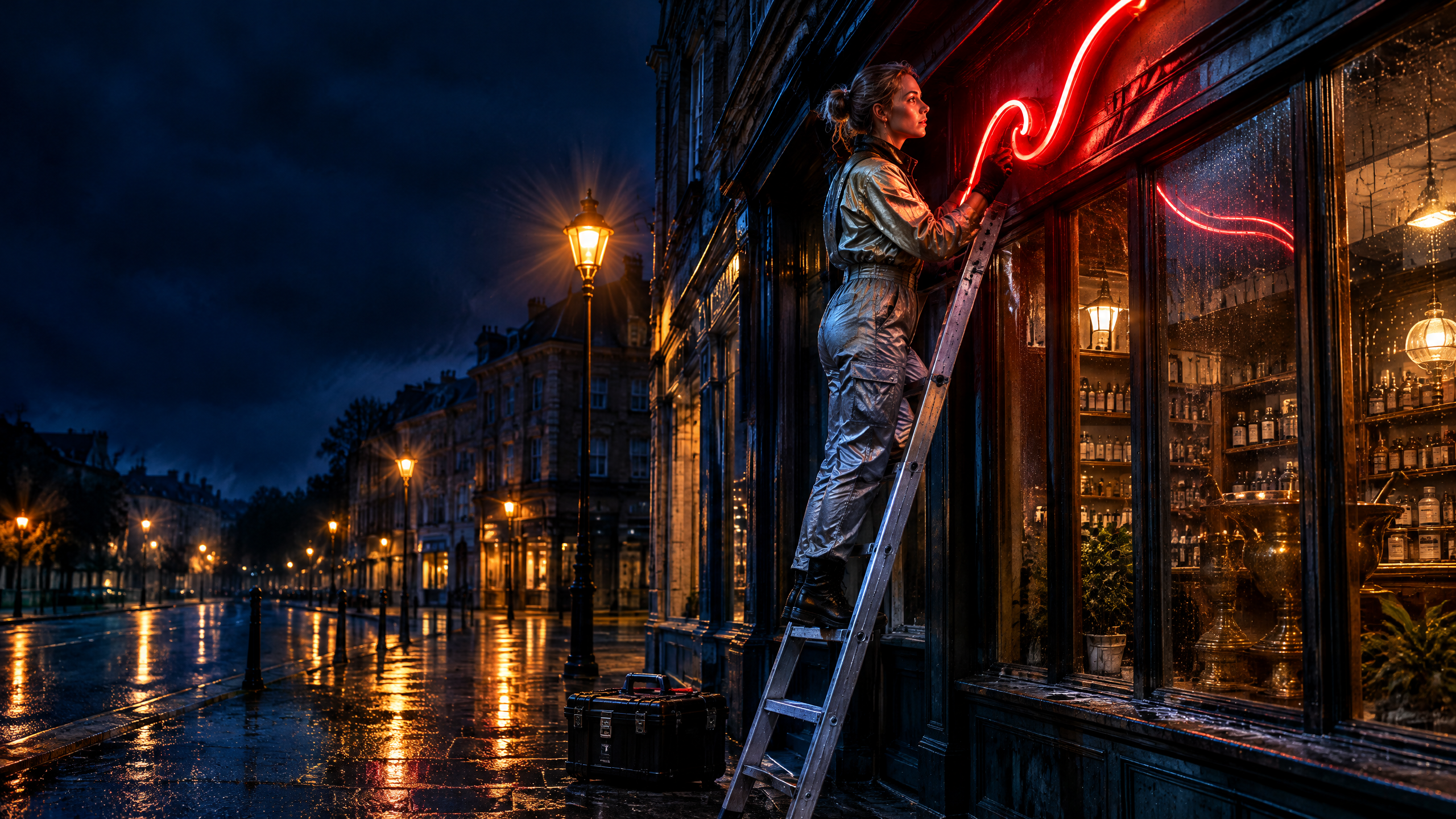
At 12:43 a.m., the sign above the Rialto Pharmacy began blinking the wrong color: three tired blue pulses, then a red apology. I was already in my silver boiler suit, lipstick still sharp enough to survive a ladder, so I took the call. People imagine neon repair is all romance—rainy pavement, humming glass, an elegant woman floating above an empty avenue. It is mostly a loose transformer, a damp junction box, and somebody downstairs asking whether I can make it “more vintage.” No. I can make it work. That is more useful.
The city sounds different once the kitchen crews have stacked their chairs and the buses have emptied. Refrigeration units breathe behind metal grilles. Delivery trucks tick as they cool. From the top rung, I can hear the small electric insistence of every sign still awake: an off-license green cross, a motel vacancy arrow, a laundromat window promising OPEN to nobody in particular. I carry my tester in a black hard case, my replacement tubing in foam sleeves, and a thermos of coffee that tastes faintly of solder because apparently I enjoy consequences.
The Rialto’s script R is the issue tonight. Its glass loop has not died; it has merely lost conviction. Inside the old cabinet, dust has knitted itself around the ballast, and a previous repairer has wrapped a wire in electrician’s tape the color of nicotine. The pharmacy owner, Mr. Bassi, watches from the doorway in his slippers. He says the sign was put up when his mother opened the place, and he says it as though I have been called to revive her. I tell him the sign is not his mother. Then, because I am not a monster, I ask what color it was when she first switched it on.
“Red,” he says. “Not this pinky nonsense.” He is right. The modern red tube we installed ten years ago burns a little too clean, a little too eager to flatter a smartphone. The original had a deeper ruby cast, almost wine-dark at the edges. I rummage through my van and find a length of old-stock glass I have been saving for a job that deserved it. Nostalgia is not a restoration plan; it is a very expensive impulse. But sometimes the correct shade is not sentiment. Sometimes it is the only color that makes a façade sit still.
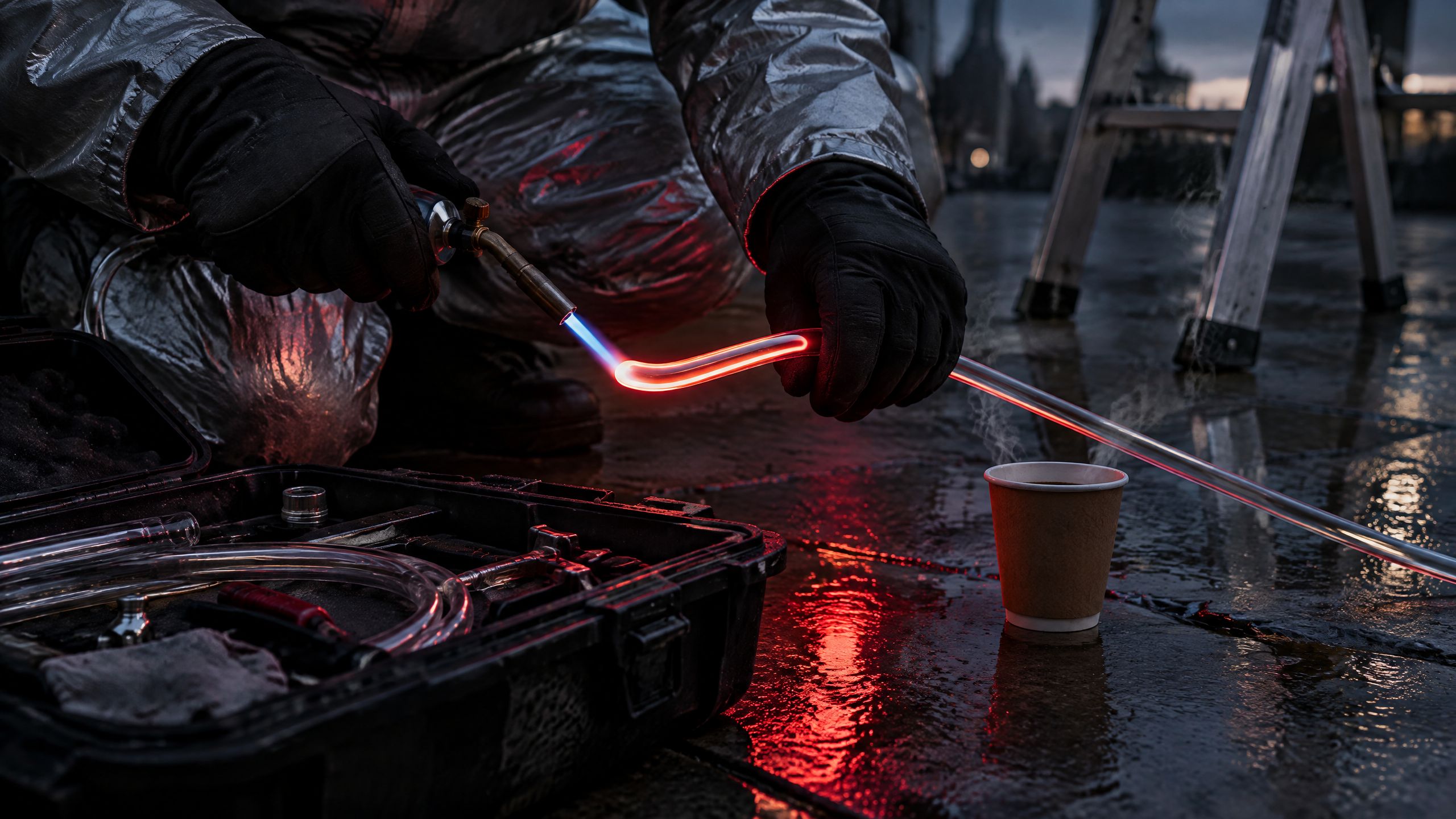
I heat the tube in the portable flame, turning it slowly until the glass gives way like warm sugar. The work requires patience, which is inconvenient because I am excellent at haste. A bend cannot be bullied. Too much heat makes the line sag; too little makes it crack with a sound like a tiny bell. I wear gloves, but not while shaping the curve—the fingertips need to feel the resistance. Below me, Mr. Bassi has brought out two paper cups of espresso. Steam rises toward the loose letters, and for a minute the street smells of coffee, wet stone, and hot metal: the perfume of a city refusing bedtime.
I have repaired signs that deserved the eulogy more than the invoice. A bowling alley where the letters were so sun-bleached they read BOWL NG. A nightclub crown with half its bulbs replaced by LED tape, its former swagger reduced to a computer’s idea of purple. I am not here to preserve every crooked tube simply because somebody kissed beneath it in 1987. Buildings change. Shops close. A sign is not a trapped insect in amber. But the best ones do more than advertise. They lend the dark a scale. They tell a person walking home alone that another human being has bothered to keep one small promise of light.
That is why I hate the phrase “iconic,” though clients use it whenever they want a discount. An icon is something you look at from a safe distance. Neon is closer to a pulse. It stutters, warms, argues with mist; it paints a stranger’s face without asking permission. On certain blocks, people navigate by it more faithfully than by street numbers. Meet me under the yellow horseshoe. Turn left at the blue fish. Wait beneath the red hand. The signs enter our bodies as directions before they become memories.
Near two, the new R is sealed, charged, and ready. I switch on the transformer. First there is the faint mosquito whine, then the letter fills from the bottom with that stubborn ruby light. The word RIALTO stops looking like a relic and starts looking like a place where medicine is available after a bad night. Mr. Bassi does not clap—thank God—but he puts one hand over his heart, briefly, as if checking an answer. Across the street, a woman carrying a sleeping child glances up, takes the correct corner, and keeps moving.
I pack my tools before anyone can make a speech. The street has begun to pale behind the rooftops, and the glamorous part of the job is over: my mascara has surrendered, my boots are filthy, and there is glass dust in my hair. Still, as I drive toward the next call, the pharmacy’s red R holds in my mirror for three blocks. Cities do not refuse to lose lights because the past was prettier. They keep them because the dark is always making new claims. My job is to answer, one bright, practical letter at a time.