Fiction
A Karaoke Bar on the Moon Has One Rule
At the Moon’s loneliest bar, every song may be sung only once. Then a woman asks the bartender to play the first one ever erased.
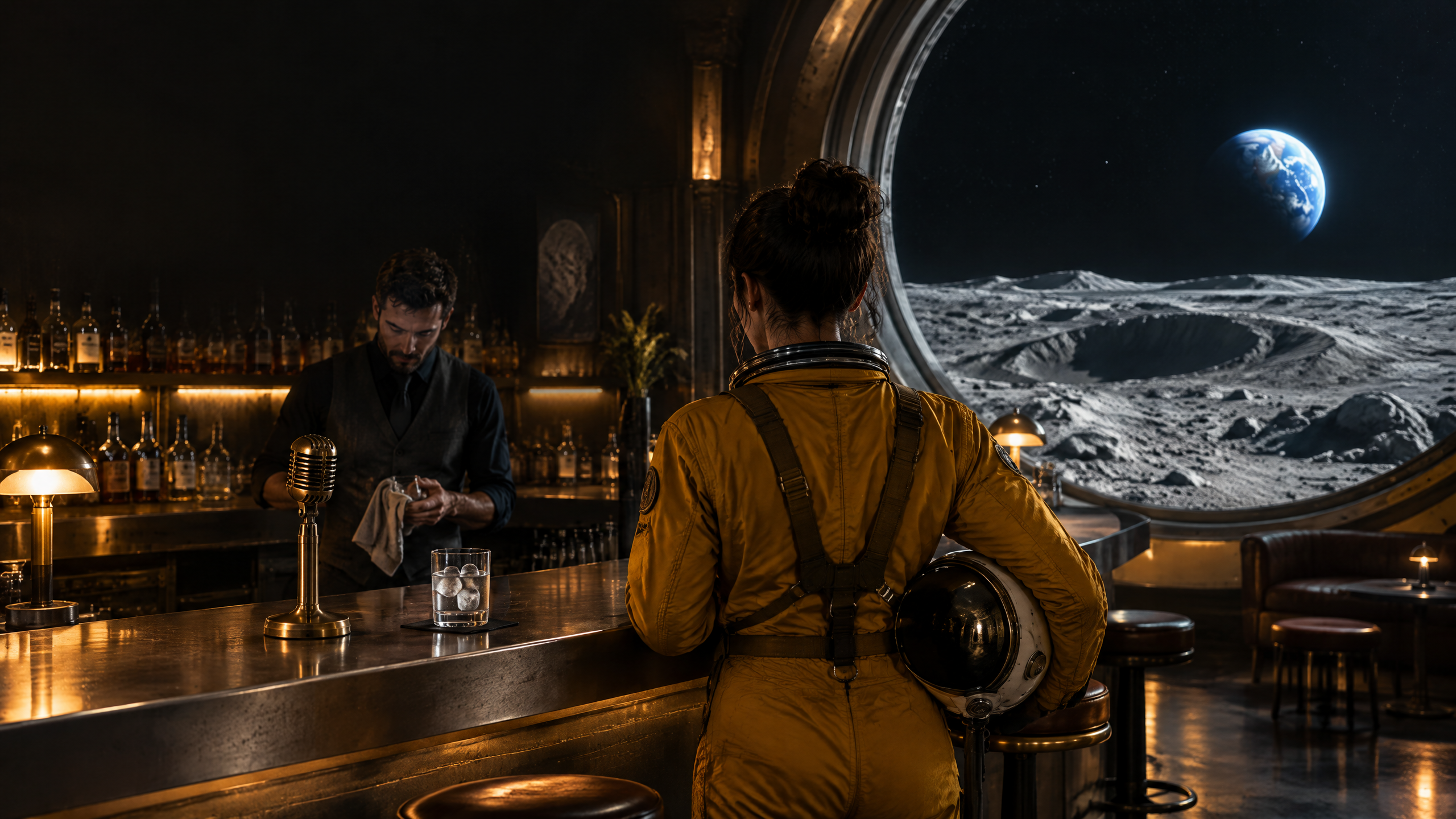
The first rule at Lunar Bluebird is printed nowhere, because printing costs money and rules work better when people learn them drunk: nobody sings the same song twice. Not in one night, not in one lifetime, not even by accident while vomiting into the airlock fern. The jukebox knows. It has a cruel little ear. It hears four notes of repetition, locks its brass throat, and plays a polite funeral chime. I am Miro, bartender, referee, witness to what loneliness does when you give it a microphone and one-sixth gravity.
The room sits three levels beneath Mare Imbrium’s freight docks, where the ceiling sweats silver condensation and the windows show nothing but the black side of an old crater. We keep the lights amber so everyone looks as if they have recently been forgiven. Pilots sing about their exes; miners sing about dust; diplomats sing songs with so many verses they need oxygen breaks. Each performance goes into the house archive for exactly one breath, then the program scours the accompaniment and melody clean. A tune is a match here: strike it once, watch it become useless, warm your hands anyway.
People think the rule is a gimmick. It began as a repair bill. The first owner bought a cheap terrestrial karaoke system, and a crew of twelve sang the same breakup ballad for forty-three shifts until an engineer drove a fork through the console. The owner replaced it with an adaptive machine that deletes whatever has already been offered. Soon people were arriving with songs they had written in sleep, songs from villages drowned under seawalls, songs their grandmothers hummed while folding shirts. No repeats made us brave. It also made us monsters. You have not heard cruelty until someone realizes the only song that ever made them feel loved is now unavailable by law.
At 02:17 station time, a woman in a yellow pressure suit came in alone and asked for a glass of water with three ice cubes. Extravagant order. The cubes clacked like tiny bells against the glass. Her helmet hung under one arm, her hair electrified in soft dark threads, and a white crescent scar ran through one eyebrow. She watched the stage empty after a freight captain sang an ode to his left knee. Then she said, ‘I need track zero-seven-nine-one. The one called “For Nika, When the Doors Open.”’
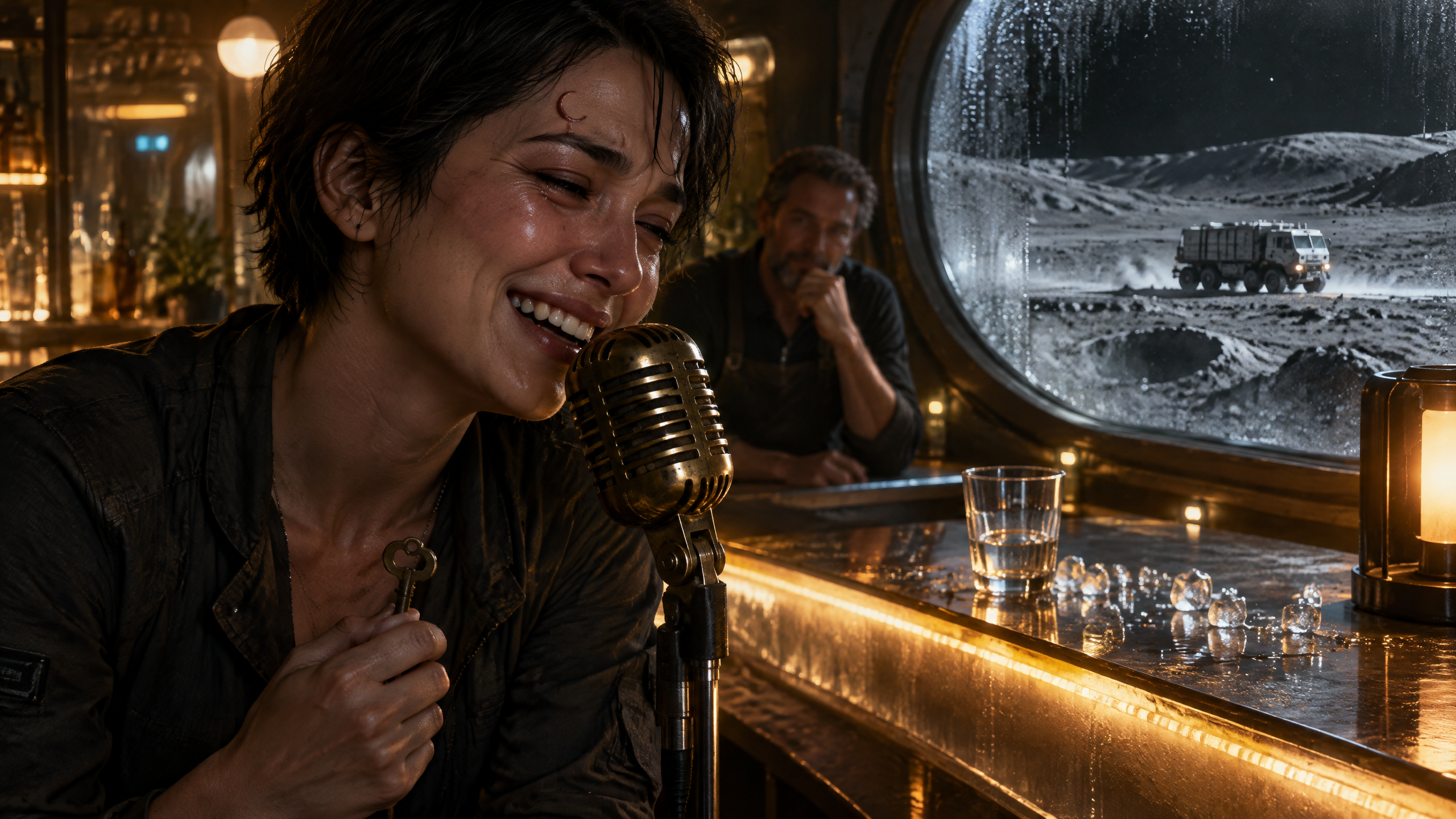
Every glass in my hand became suddenly expensive. Track zero-seven-nine-one was the first song ever performed at Lunar Bluebird. I knew because I had been here, polishing a counter no one could afford, while a young surveyor sang it to a camera pointed at Earth. Her daughter Nika had been born during the launch delay, and the surveyor promised she would come home before the child learned to walk. She never did. The song had only seven lines, none of them clever. On the final line, she laughed because the high note escaped her. The machine erased it before the applause stopped. The woman in the yellow suit was Nika, forty-one now, looking older than a person should under a moon with no weather.
‘I’m sorry,’ I said. Bartenders say that before they pour, before they refuse, before they lie. ‘The house doesn’t retain it.’ She placed a small tin on the counter. Inside was a screw, a strip of red fabric, and the kind of ordinary key people keep after the door is gone. ‘My mother’s return capsule used this key,’ she said. ‘They found it in the impact field. I don’t want a recording. I want to hear where she got the high note wrong.’ Her voice was steady, which is how you know somebody has carried a thing too far.
I told her the rule had eaten the song seventeen years earlier. I told her the archive was vapor, the original microphone had been melted into a plumbing bracket, and I was not a miracle worker, merely a man who could make beer foam form a respectable crescent. She nodded at every excuse. Then she pointed to the row of drinking glasses behind me. ‘You remember it.’ I made a joke about my memory being a union job with poor benefits. She did not smile. Outside the porthole, a cargo tractor crossed the crater rim, so slow it might have been dragging the entire Earth behind it.
Here is the embarrassing secret: I had remembered it. Not the words, which had been scrubbed from my head almost immediately, but the shape of the failure. The surveyor had reached for a note beyond her range and missed left, then laughed into the miss as if she had found a door there. For seventeen years I had carried that crooked leap because I was standing close enough to see the camera light turn green. I set a clean glass on the stage. I gave Nika no lyrics, no track, no promise of accuracy. ‘Sing anything you can,’ I said. ‘When you reach the place you don’t know, leave it empty.’
She sang a low line about a woman walking through a field of satellite dishes. She sang about a child who learned the word orbit before the word mother. The room went so still the ice machine sounded theatrical. At the empty place, she stopped. I tapped the bar twice with the old key, then made the wrong high note—not a song, not a replay, just the sound of someone failing to arrive on time and laughing because there was nothing else to do. Nika heard it and folded over the microphone, laughing once, angrily, then again for real. The jukebox did not chime. It had never heard that sound before. Nobody had. At closing, she left the key in the tip jar. I kept the glass. A rule can keep a song from coming back. It cannot stop a person from making room for what it left behind.