Learn
The Pigeon With a Train Timetable
A commuter tracks a pigeon that arrives before every delayed train, then discovers the city has been speaking in signals all along.
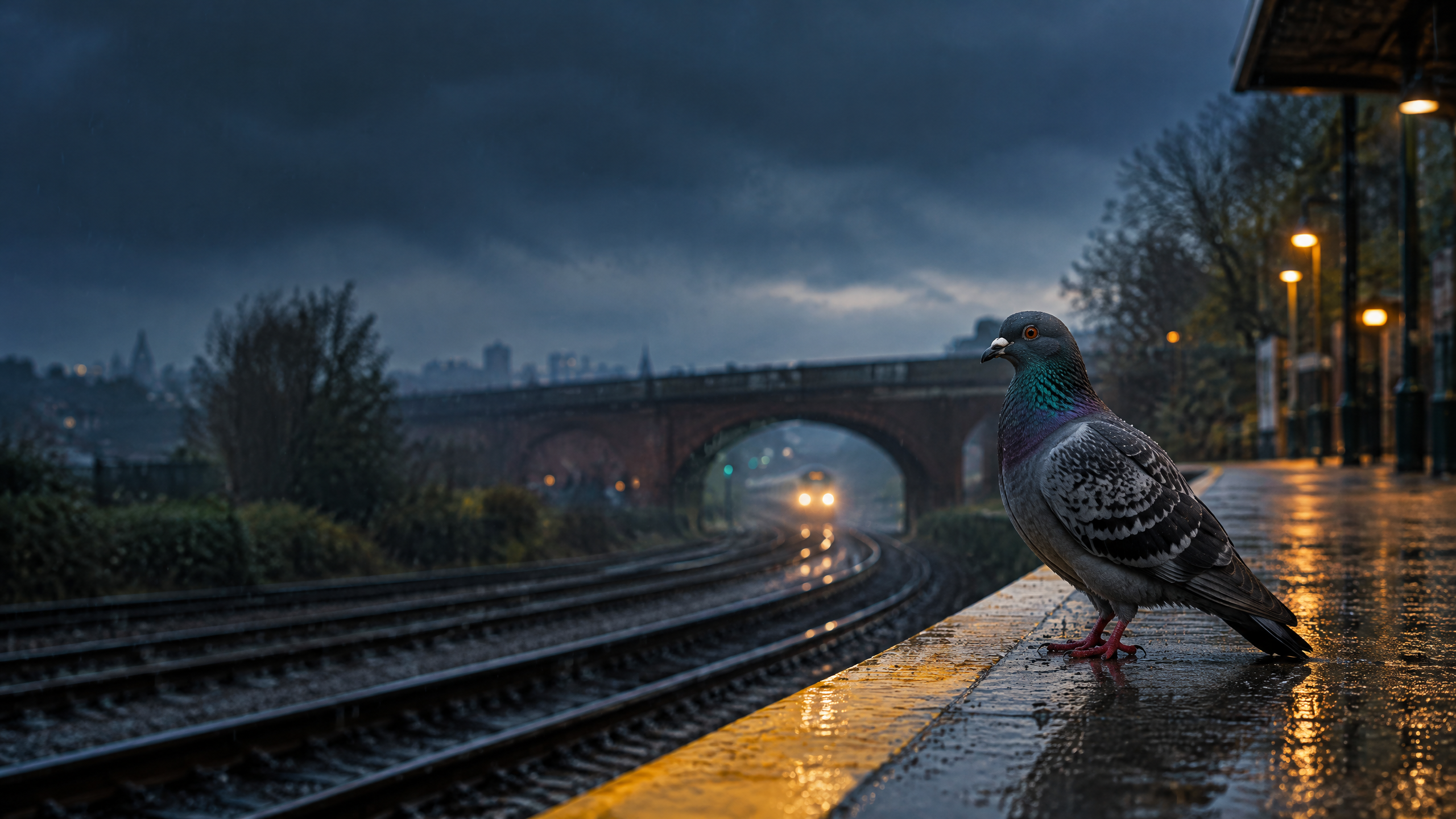
At 7:43 on a wet Tuesday, the pigeon was already waiting at Platform Four, toes spread wide on the yellow edge as if it had bought a ticket. The departure board said 7:52. Everybody knew it was fiction. The 7:52 had been stalled somewhere beyond the allotments for weeks, arriving late with the dependable creativity of a bad apology. Still, nine minutes before the train huffed into view, the bird would appear: slate neck flashing green, one pale feather stuck out like a loose thread. Mara Bell, who had recently decided commuters were furniture with phones, began timing it.
Mara worked in municipal payroll, which is not a profession that encourages mystical thinking. Her mornings were a tunnel of platform announcements, lukewarm coffee, and correcting other people’s decimal places. But the pigeon made a nuisance of itself. It came on Monday at 7:51, Tuesday at 8:02, Thursday at 7:47. Each time, the train followed within minutes. Mara tried to ignore the pattern until the bird beat a service update by fourteen minutes. She named it Schedule, which was less cute than it sounded and more respectful than calling it Gary.
At first she suspected crumbs. Platform Four had a bakery kiosk at the top of the stairs, and late trains collect impatient breakfast eaters. Yet Schedule ignored a dropped croissant one morning, watching instead toward the bend where the rails disappeared behind a brick viaduct. Mara tested this by carrying a bag of sesame seeds for three days. The pigeon accepted none. When the delayed train arrived, however, it flew neatly onto the roof of the rear carriage, where the warm air rose, and rode two stops east.
I met Mara while sketching birds outside the station for a community map, the sort of project people call charming when they mean unfunded. She showed me her notebook: arrival times in blue ink, pigeon appearances in red, little furious arrows when both coincided. ‘It isn’t predicting the train,’ she said, almost offended by her own conclusion. ‘It’s detecting it.’ Her theory was a gentle avalanche of overlooked signals: a vibration through the steel, a change in the wind that funnels along the cutting, a particular metallic shiver in the overhead wires.
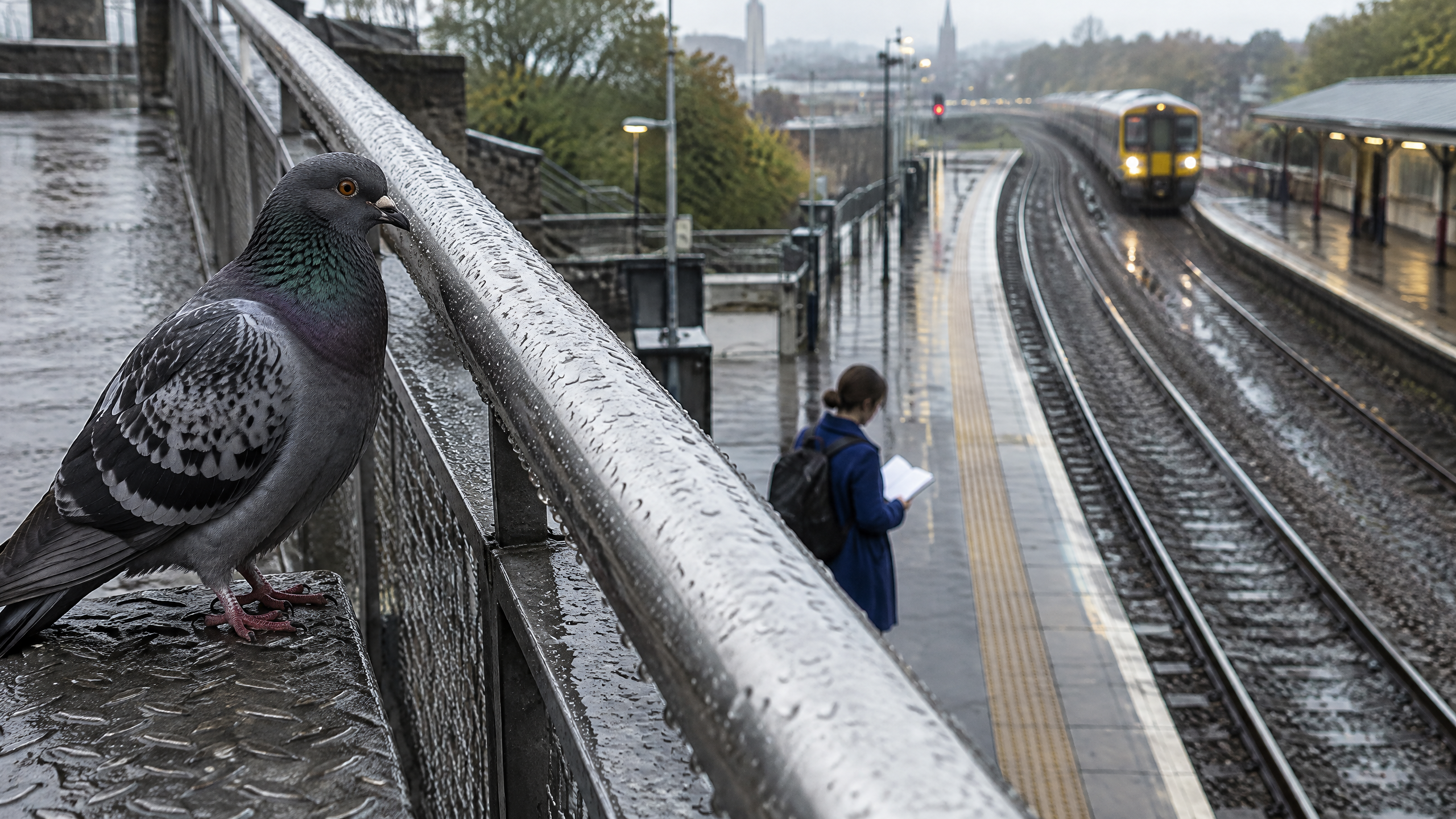
The station manager gave us the look reserved for anyone asking a reasonable question before 8 a.m., then allowed us onto the footbridge during a signal fault. No train was visible. Schedule landed on a cable box and went rigid. Twenty seconds later, I felt it too: not a sound exactly, but a faint granulated tremor through the railings, like a spoon dragged around the bottom of a faraway cup. The driver later said he had been braking a mile and a half away. The pigeon had received the news through its feet.
That discovery would have been satisfying if it had not made Mara sad. ‘So it’s not magic,’ she said, standing under the footbridge while rain stitched the tracks. I thought of the word magic, which we often use for attention we do not want to learn. Schedule had not been given a timetable; it had spent enough mornings in one place to read a language built from pressure, heat, habit, and delay. The city was always broadcasting. We were the ones wearing headphones, glancing only at the loudest screen.
Mara changed after that, though not in the cinematic way. She did not quit payroll to become a bird oracle. She simply began arriving early without resenting it. She noticed which trolley wheels squealed before the 8:10 crowd, which cleaner left water for sparrows behind the vending machine, which regular passenger made room for a stroller before anyone asked. Her notebook grew stranger and kinder. Next to the train times appeared notes such as ‘man in cobalt coat hums when anxious’ and ‘pigeons choose the dry side of the station before rain.’
Then, in late October, the service became punctual. Schedule kept coming, but its grand entrance disappeared; it was already there most mornings, pecking at a seam in the concrete or bullying a crisp packet. Mara’s red marks dissolved into ordinary days. One Friday, the train pulled in exactly on time and the bird did not board. It stayed by the rail, chest lifted to the vibration. Mara laughed—not because the mystery had vanished, but because it had never promised to perform for her.
There is a temptation to make clever animals proof that nature is outsmarting us. Schedule offered something less flattering and more useful: intelligence may not be hidden in a brainier creature or a smarter device. It can be the patient accumulation of tiny evidence, held long enough for a pattern to become legible. The next time my train ran late, I did not refresh the app. I looked down the platform. Near the yellow line, a pigeon had turned its whole body toward the unseen bend, listening with the part of itself closest to the ground.