Fiction
The Bookshop at Low Tide
Returning to her coastal hometown to settle her late aunt’s bookshop, a meticulous archival conservator finds an unexpected future through shared grief, steady work, and a widowed boat-repairer’s quiet kindness.
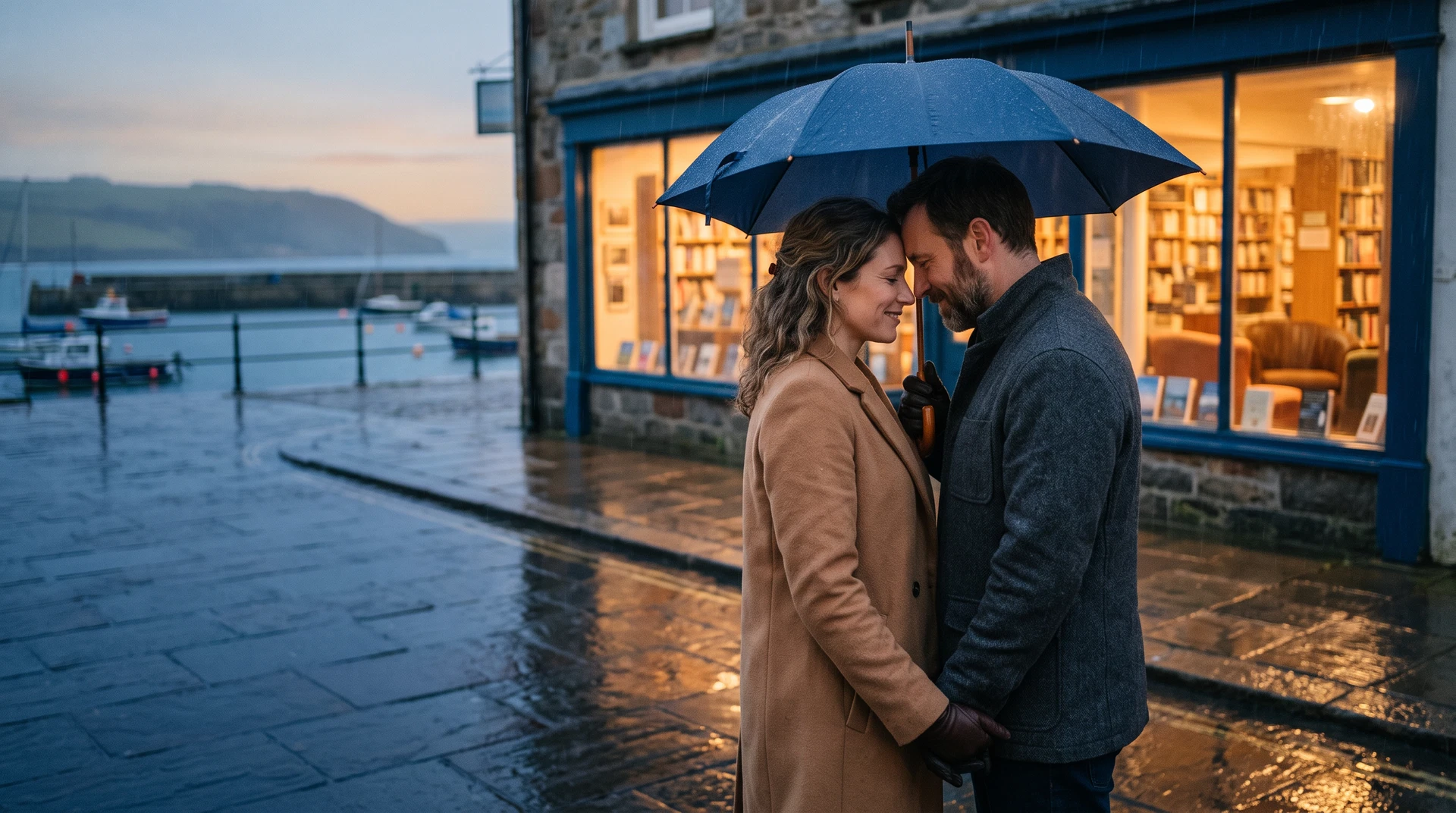
The road dipped toward the harbor as if the land had finally given in to its own long-leaning wish, the asphalt bowing in a gesture so patient it felt like penance, like a letter written late and sealed with the damp of a tongue that has learned not to hurry. Elara cracked the window; the salt reached in without asking, a sly guest, iodine and iron and something soft that pressed just behind the eyes the way a good memory does, as if salt knew doors were a human problem and not its own. Low tide slicked the mudflats into ribbed leather and turned the harbor to a book folded back on itself, spine agreeable, margins exposed; the intertidal zone read like a palimpsest where hermit crabs and found nails had left errata in fine sand script. Boats had settled patient at their lines, humility almost human, ribs accepting gravity’s slow hand, fenders squeaking like little concessions. The grasses leaned to listen to the water’s private talk. The hand-painted sign had been waiting: The Bookshop at Low Tide, its letterforms a little uneven where a brush had shaken from a laugh and a body had remembered to be mortal.
The key turned unwillingly, like a story begun too long ago in a different light. The bell above the door chimed a thin hello that startled her into breathing, into remembering she had a body that made steam in chill air. Paper and wood exhaled a life’s worth of stories, a damp-limbed chorus, and her skin—trained by years of careful rooms and cotton gloves, by air monitors and data sheets where she whispered to things that would outlive her—noticed first. The fine lick of damp in a hinge; foxing freckles where time argued quietly with cellulose and the slow autographs left by iron in water; the way old cloth turned the color of old leaves when the sun has had opinions for too long. Camphor, beeswax, dust, and an old citrus rubbed into dry wood, all threaded by the sea that never kept outdoors as well as people wished, because salt is a librarian, too, tucking itself into the grain of a counter, the interstices of a binding, the hair of a mop, cataloging itself into everything. In the corner a draft rehearsed a winter, while the floorboards remembered storms in their own unhurried language.
Maeve’s ledger lay open on the scarred counter, coffee rings making their constellation over prices and the names of neighbors paid in jam and herring, a sky where commerce and kindness shared the same astrological house. The loops of her aunt’s hand held a steadiness that made Elara’s throat ache—a steady woman; a steady shop; the certainty that there would be someone to nod at four in the afternoon—and a faded sign in Maeve’s dry hand pleaded: Please do not blow the dust from the books; it is older than you are. She loved the humor, loved the respect pretending not to be respect. Down the aisles she cataloged by reflex—vellum spines cracked fine as a river delta, cloth lifting at edges like birds testing air; headcaps blunted and tailcaps frayed; endpapers veined like maps where paste had developed temper, signatures misaligned where some binder had been distracted by grief or gin. She wrote nothing yet and knew already where to begin: stabilize, not beautify; arrest decay, not erase history; curatorial ethics as old and stern as tide charts.
There were things she had learned to notice that most people never knew they saw. In the cool under-shelf dimness, she could feel lignin softening its fists inside wood-pulp paper, the quiet fistfight of acids born long ago at the mill still going on; she could smell a book’s secrets—old smoke, a cat long dead who had slept on winter afternoons on a lap warmed by tea, a library’s HVAC set one degree too low for a summer. She ran a thumb along a fore edge, not to caress but to ask: do you shed me, do you powder, can I coax you into more years without lying about who you are? She thought about reversibility as if it were a kind of prayer: starch paste over PVA adhesive; Japanese tissue where Western had failed; the mercy of an eraser crumb rolled in the palm, turning history’s grime into little blessings you swept away, while always asking if cleanliness was a kindness or a theft. In a corner, a faded toddler’s drawing of a boat had been tucked behind a travelogue; she read the pencil grays as one reads weather: strong wind from left to right; hull stout; sun a necessary addition even if the day had been rain.
In the back room the enamel kettle sat in its old spot, enamel freckled by decades of steam, the chip at its lip the shape of a country she could not name but recognized as the place you end up when you go too fast with something hot in your hands. A cardigan hung from a peg, sleeves empty of arms but not of the motions they remembered; even without a body inside it held the grammar of Maeve’s shoulders, the syntax of someone who had lifted boxes and hugged arrivals in equal measure. The ache rose bright and sudden—an intake, a flare—and she let it pass through rather than split her, the way she had been taught to let wash cross her knees in a tide pool: don’t fight; feel; praise the pull and the give. The alley air was tar and salt and machine grease, a compound drawn by a child's careful hand with a blunt crayon. Next door, the boat shed’s doors yawned; sawdust rolled up small weather on the ground. Voices tumbled around the thud of persuasion; an electric sander sang its rough high note that got into jaw joints and old fillings, a bee that had chosen amplitude over charm.
The shared fence had stopped pretending to be whole. One slat leaned as if it had lost heart just shy of noon, a posture Elara recognized in certain spines whose owners had loved reading in bed too much. The little gate sagged and was held with a length of sunburnt twine polished by a hundred knots made with the distracted competence of people in conversation. The part of her that had learned to mitigate risk and reintroduce order reached automatically—latch what wants to wander; bind what would otherwise forget itself; a bias toward the controlled future that had given her something like belonging when rooms and cities had not. She assessed the screws: one stripped, one heroic, two merely young. She was thinking inventory and liability and the friendly ferocity of a sign-out sheet when a voice came around the shed’s corner the way a tide comes around pilings: suddenly, and like it had always been there.
“Hold up there.” He came into view with the unselfconscious balance of someone who lived in his body and trusted it without vanity, the way only people who worked with gravity and loss could. Rope slung over one shoulder, pencil behind his ear—a carpenter’s cigarette—and not young, not old; weather and laughter had written kindly at the corners of his eyes as if someone had stood there with a soft pencil in good light. His hands were sun and iron filings, a rosary of small cuts healed and healing. “We use that gate to bring skiffs through. Your aunt was fine with it.” His chin tipped at the twine as if it were a dozing pet. He wasn’t claiming; he was remembering the solutions people make when they have to share a narrow alley with lives in it.
“I’m Elara Thorne,” she said, aware of how her name sounded here as if tried on in old air, unfamiliar and too smooth in her own mouth. “Maeve’s niece. I just got in. I haven’t reset to town yet.” She looked at the gate, the delicate trail the sawdust had left in her air as if it were a moth’s path through lamplight. “I was thinking inventory and security. There’s a lot here that needs not to go walking.” She was thinking of first editions in flirting displays and the way a thin film of moisture could be both seduction and threat. He lifted only his eyebrows, which is a way of being gentle with other people’s worries.
“I’m sorry for your loss,” he said, and because he meant it, the words did their work, plumbing and electricity restored in one simple sentence. “Maeve kept half of us in books and the other half in good arguments.” He wiped his palms on his jeans to change subjects the way decent men do when their hands have too much to say. “Julian Vance,” he added, which fitted the shed and the rope and the skiff-shaped ghosts that moved behind his shoulder. “We try to keep the racket honest. I can soften the loud while you land. The gate—maybe a schedule, maybe a better tie. I’m not against latches.” His mouth did a small thing that might have been humor bowing to necessity.
“Fair,” she said, and took his careful, rough, steady hand. It told her more than introductions do—the temperature of his day, the grit ground into his lines, the way he did not squeeze to demonstrate strength but to demonstrate presence. “Thank you.” The gull above them laughed the way gulls laugh whenever humans attempt agreement, and it made her mouth want to answer with almost a smile. A ferryman crowed somewhere beyond the sheds, and the whole harbor seemed to look at them exactly long enough and then look away, decorous as a village that has learned both welcome and restraint.
Upstairs, her sea waited in boxes, cardboard grown soft at its seams like elderly knees. Postcards and menus, theater programs tied with tired ribbon; someone had once used a blue shoelace here, then given up and cut it. A jar of buttons rusted to a faint red map like a continent the brass had invented. A low sea chest leaned insolent, certain of its right to stay as if it had sprouted from the floorboards and the stairs would have to argue with it about any departure. She pried it open with a towel under the lid—conservators learn to pad every gesture. Salt and paper rose like a story laid aside, like breath left in a room where someone had finished talking but not yet left. Seaweed pressed between wax paper—Maeve’s labels exact, hand steady as a barometer’s needle: bladderwrack, knotted wrack, sea lettuce—each specimen a conversation between sea and sun stilled on a kitchen table. A loose stack of faces lit by a pier bonfire; on top, scold and affection entwined in Maeve’s dry humor: For Elara, when you’re ready to forgive me for not labeling these properly. Forgiveness is a kind of labeling, too.
She carried in her contraband dehumidifier and set it humming, a small white animal given a corner and a job. The sound she’d always loved—guarding the future—took hold, a throat clearing, a weather report improved. She had the comfort of list-making to keep her tethered to breathable air. On a clean page she mapped triage: stabilize environment; inventory by sections; pull the visibly distressed; isolate leather showing red rot; quarantine any mildew—never mold, never give it dignity with syllables—paste and patience; call the auction house about the first editions batting their lashes in glass, decide what to keep as anchor, what to release as wind. Medium term: consignment relationships, reconcile the cigar tin under the till with the ledger, set the barometer like it had once been more than a quaint thing pointing at rain coming. Long term made the pen hover. The long term wasn’t the shop; it was a life, and the ethics of conservation didn’t tell you how to catalog your own wanting or how to weigh the pH of longing against air light enough to live in.
She thought of Maeve’s rooms as bodies, the way she had been taught to think of books as breathing if you leaned close enough. Paper wants a certain humidity, not too much; hearts do, too. Fifty percent is ideal for rag paper; sixty with circulation acceptable for some clothbound casualties; but what of the human ledger, its entries in pencil and ink and crossing out? She could give the place silica gel and a discreet humidistat; could not promise herself steadiness, not yet. Preservation triage had taught her to distinguish between what can be mended and what must be mourned; she hoped, not for the first time, that she might one day be clever enough to do that for people. While she wrote, the dehumidifier’s steady gullets seemed to ease something in her own lungs, like a pact. When rain clicked softly against the upstairs sash, she imagined unwanted moisture as a talkative aunt at the wake, and she smiled without cruelty at the thought of shooing it toward the alley with a slice of good cake and a kindly lie.
The sander wound up, lower now, but the vibration found a tower of books and made a test of their towerhood. She caught them, an atlas thudding her ribs like a friend with enthusiasm—an atlas always did; it held other continents’ ribs and was generous with metaphor. In the back doorway she lifted a hand; he stilled the machine, a hand across a mouth that had been telling a loud version of itself. Silence had substance and grain. “Forgot that one telegraphs like a gossip,” he called, rue cheerful. “I’ll save the loud for when you break for dinner.” He took his cap off without noticing and put it back on again, an almost-bow full of apology and recognizing the habits of shared fences.
“Thank you,” she said, yielding honest words to a pause that invited them as a counter invites an elbow. “I found the ledger. It’s half shopping list, half poem. If you remember anyone I should look out for—people who came for one thing and left with another because I will want to hand them that other thing before they know they want it—” She meant Maeve’s knack for suggesting weather and not insisting on it; she meant community not as theater but as muscle memory. She liked the ledger’s small economies, the way jam was currency and time was never priced though always paid.
He paged a stained pocket notebook, the sander forgotten under his hand. “D. Parrish at the school. Rowan, who buys nautical charts even if they’re wrong—especially if they’re wrong, makes a face like the past is a practical joke only he hears. A boy who tied a knot in his shoelace and had to hop home, came back red-faced and proud with two dollars in dimes. My girl fell for anything with foxes. Maeve kept a secret rabble of badgers under the counter for late days.” He did not glance up to see if she would ask about the missing mother he had not named; he had learned where his life’s doors were and how much to open them for a neighbor.
“I’ll keep an eye out for foxes,” Elara said, and did not ask about the missing mother implied by my girl. The line between yards and lives sat where it should. It would move when it ought to, as tides do when rocks have had their say. She made a note: foxes, badgers, wrong charts, small boys who need their shoe unknotted by a patient adult. She thought of the small museum gift shops that she had known, not unkind places but curated to a point; Maeve’s place had been curated by appetite and argument, by tea temperature and what the day did to a person, and the ledger felt like a field guide.
Evening came and pronounced everything a little kinder, as if light had decided to dress the town in flattering tones. Julian reappeared with a handful of screws and a question he didn’t need to speak; it traveled in the angle of his neck and the deference to thresholds he always showed. He glanced at the hinge holding on rust and grace and found his way to the bracket as if he had been requested by metal. “May I?” She gestured—go on; she liked when people treated permission as a ceremony even if small. The screwdriver made domestic music; a stripped screw got a soft swear and a private apology to the splintered wood, which seemed to stand up straighter beneath it. The gate caught and released with a click that pleased parts of her she didn’t have names for. “A compromise with the laws of physics,” he said, settling a last screw without triumph.
“I like compromises,” Elara said. “They’re where most of the living gets done.” He leaned on the post with the satisfaction of a small steadiness made in a world that needed many, and she watched his contentment because she wanted to learn from anyone who could feel that and not immediately ask the next question. In the failing light their breath made brief ghosts. A boat bell noted the hour with the tact of an old aunt; a dog barked the score of evening.
She swept the floor, little moons of dust and salt along the baseboards, and felt each small arc as a promise to a future breath. In the front window her reflection watched with skepticism born of failed plans remade and with a kindness that surprised her, the way an unplanned wave sometimes lifts you instead of knocking you. The dehumidifier hushed itself to sleep; fairy lights unspooled from a late mood Maeve had once had, a festive thought that had not been embarrassed by its own brightness. The cash drawer counted itself with the little shames and prides of a day: coins sticky with fruit; a note folded into a bird by someone waiting; a receipt that had decided to be an airplane. The envelope with her name in Maeve’s neat print waited without impatience, not a trap but a door. Not yet, she told it, tucking it into the cardigan pocket as if placing it in Maeve’s hand to be held for her until she had stopped wanting to be notified of every loss at once.
When she shut the back door, the new latch clicked with the precise sound of something choosing to stay, an audible spine straightening. Across the yard Julian lifted a hand—good luck, tomorrow, the speech of a small, decent salute that exists in towns that still know their verbs: lend, hold, pass, keep. He didn’t make it a performance; he simply let it be seen. The bell gave a last delicate sound as if the building were acknowledging her and the night and the necessary work that would pass between them like weather: sometimes loud, sometimes barely named, always, in the end, remembered by what it had done to the air.
Morning brought the shop’s other weather, the one paper makes when it thinks no one is watching. Maeve’s ledger had left, at the back, a crude tide chart annotated in a bland pencil that must have been near the till since before the last renovation nobody had ever gotten around to: Books and water have similar tempers; never believe either will stay where you put them. The plaster bloom in the front corner gathered itself toward a drop like a thought that had grown too heavy for the mind that held it. The first bead let go, a small coin, and fell into the pan of the silence where such first things are measured. She imagined a thousand such beads over years and considered the layer of salt they would make: a low-gloss varnish of habit.
She found the enamel basin that had always lived beneath the sink and set it under the drip, a ritual you can do with your eyes closed and your heart open. The smell under old smells sharpened—mineral, green-edged, rain with authority, not the polite mist of the city’s timed fountains. Through the rain-wobbled window she saw the ribs of a skiff on sawhorses, a body not hiding its bones, a study in how to hold tension lightly. A gull stalked the seam of road and harbor like a notary witnessing a day, officious in its white, its eye as severe as any judge in any court where the laws are of weather and wind. Farther off, the ferry made a low pronouncement nobody would disobey.
He arrived with a ladder that looked as if it wished to be a mast and a green tarp that had learned humility and pride in equal measure and bore its patches like tattoos that meant the opposite of fashion. “Ridge cap’s lifting,” he said, the diagnosis simple, a stroke of a pencil on a plan. “Maeve used to tap the wall.” He said Maeve’s name as if it could still hear him and consider coming for tea. He tested the ladder’s balance with the palm of his hand and climbed while she held, feeling the thud of his boot heels through aluminum, the transference of weight that made you a partner in someone else’s gravity. The tarp flapped, complained, settled under his tug and the weight of a brick that clearly kept a job in a corner for just this, the way old men keep suits for weddings and good hats for burials.
Inside, the shop smelled briefly different—tar and rain and a clean outside cutting through so the camphor and lemon of old oil rose truer, like voices warmed to pitch. “Tea?” she asked, because ritual saves people and rooms from being only their immediate crises. Relief unknotted his shoulders; he hadn’t asked but he had hoped. The pot’s hairline crack had outlived its panic, its panic had outlived its reason; the mugs kept their counsel, mismatched, the earthen one with the nick, the souvenir with a pelican faded into a myth. He warmed his hands around his as if steadying a rope on a heaving deck, and she did not look at the place where his wedding band was not.
“My boy learned to read on that step,” he said, half-laughing at memory’s audacity, at the way a step could become a whole school if you stood on it often enough with someone you loved. “Maps first, for the lines. Maeve let him trace ferry routes with a finger.” Elara felt grief braided with gratitude for everything the shop had kept doing without her; grief for every ferry she had not traced when she could have; gratitude for places that don’t hold it against you when you return late with a better kettle and a worse heart. He bent over the ledger and touched the looped G of his name above a note in Maeve’s small exact hand: Vance—planks for window seat—paid in halibut and a paperback. “She overpaid me three slices and a poet I didn’t understand,” he said, and she saw him trying at the poet again in that instant, not wanting to be unfair.
They didn’t barter losses in a market; there was no stall where you could lay down your dead and receive in change the absence of a certain ache. In the lull a truth came with the steadiness of a shoal everyone knows by the break and the care one takes to turn the right way across it. “My wife died two winters ago,” he said, watching the spot where the stain had stilled as if stains should have the courtesy to tell you what else they planned. “Slow. We had time to call things by name.” Elara offered something smaller than the fact and offered it anyway, because one can only hand another what one has at that hour. “I wasn’t here when Maeve went. She left me a message about the kettle that stands in for everything.” He rescued them both with work. “What do you do with paper after a soaking?” She told him: dry slow, press with patience, blot with unsized paper so you don’t share your chemicals, coax fibers back to themselves, let memory of shape do half the labor, let time do the rest. He nodded as if she’d described tending a hull; drive a nail in anger and you’ll split it where it’s thin.
Work announced itself as the kindest way to share a room, a set of tasks you could do side by side without peering too closely at one another’s named and unnamed griefs. He shrugged off his jacket and set it on the peg like a small local trust. He lifted without overbearing and set things down as if they might speak back if jolted, and there was grace in it, this listening to wood and paper to know where their bone was. In the gutter of a shelf they found the summer worker’s letter with a fennel sprig—a hope pressed between minutiae; a bus ticket X-marked at the solstice in a hand that did not yet know how to hurry; a coil of thread a color time had renamed from vermilion to something like rust and rose and secret. Beeswax pooled a faint honey as the counter warmed under their elbows, a domestic geologic time, shined in rings from years of cups set down in different moods.
Near last, because Maeve liked hiding gifts in plain sight, a shoebox spoke her name as clearly as any bell. For Elara. Inside, cotton gloves, the second neatly mended as if its forefinger had had a lively life; a bone folder polished by years until it kept the memory of all the spines it had persuaded into being themselves again; a ribbon the blue of harbor dawn; a pink-lipped shell taxonomically itself and useless in the kind way certain beauties are. A note: Don’t humor the chimney; it sulks in a sou’easter. Roofline prefers attention midspring. Tea should be smoky when the day is indecisive. I will not be needing the ribbon again; I like to think you will. The casual prospect of future use made her vision swim, kindness unspooling in the simple phrase I like to think.
Elara pressed her thumb to the loop of Maeve’s name and felt warmth travel up her arm as if names could be conductive. He looked away, granting privacy with the competence of a man who had delivered lumber through windows while couples argued about couch color. “She trusted paper to keep,” he said, which was permission and praise together, and also a warning: paper keeps lies, too, if you ask it to. “I’ve a skiff to shame into seam honesty,” he added to change both their airs. “Tomorrow, early, before a boy makes a case for pancakes.” She liked him for giving time its proper verbs: shame, make, case, learn.
When he’d gone, the room unfurled around her like sail cloth shaking out creases. She wrote because writing steadied: inventory of loss—air circulation; dehumidifier; isolate leather; call about flashing; thank Julian properly; mend the tear in her own steadiness with paste made of sleep and fresh socks; feed the kettle. Then, against her own superstition, she added in a smaller hand: The way she said my name like finding a mis-shelved book and pretending only to be pleased to have seen me. The hum the old cooler made in late August. The feeling of being expected at four. In the quiet she could hear paper returning to its usual tensions, somewhere a board easing itself back into alignment after a change in weather.
By late afternoon the wind changed tone, a bow along wire, and the alley made the sound of halyards telling on the weather, their old gossip brisk. The basement air went brackish and full. Salt etched a white ring on the stone walls like a tight necklace too honest to ever be called adornment. Water suggested itself as a gloss more dream than puddle, that stealth first-state you doubt and then you don’t. It smelled of ancient rope and tar, of mice with ideas and the faint herb of someone having once stored apples in a bin. She fetched tarps that sprang open like notions too late and buckets that remembered being other things first, paint and potatoes and the laughter that goes with both.
The bell admitted weather—and Julian. Jacket wet at the crown, hands bare in the cold, breath walking a little ahead of him as if hoping to be let in first. “Storm drain’s pushing up. You’ll want the pump,” he said, not urgent, true, the way midwives talk when everything is going as it must. He moved in the measured way of someone who had negotiated before with water and time and learned not to insult either with haste or optimism. He pointed; she saw. The old coal chute wept along its mortar seam like careful tears, more embarrassed than dramatic. He set the pump in the low spot and ran the hose where the air was still dry, the logic of out to away the same whether paper or river. She flicked the right breaker and then the other, and they learned the room’s circuits together by feel, by the small shiver that means yes to voltage and no to peril.
“Boats and books,” he said, easing a sandbag into the path the water had smugly chosen for itself. “You don’t own them. You court them.” The pump found its throat, stuttered, then sang—tinny and insistent, not pretty but convincing. Outside, up the alley, a hollow slap—water exiting into weather, leaving where it had come with a sound of reluctant good manners. The shop’s bell rang three startled notes and calmed as halyards fussed on a hundred masts, their complaints braided. “We’ll outrun it if this is as high as it goes,” he said, glancing at the wall like a doctor glancing at a monitor and pretending not to have opinions. “It isn’t.” He was proved right within the minute; the water did what it had already decided, a familiar arrogance.
They worked faster without panic. She lashed tarps with square ties meant to be kind to wet fingers; her hands remembered a semester when she had learned knots as metaphor and ended up keeping them for use. He slid directories into tubs and made jokes at their expense, old municipal boastings rendered flotation. The water rose regardless, pebble-smooth and sly, and it did what water always does: it touched every story it could with impartial intimacy. It tasted the step and her boot leather, and a small reasonable fear woke—the domestic kind, witnessing hurt you cannot forbid, not the melodramatic theater of loss but the quiet civic duty of showing up to mop even where it will not show. On the narrow landing they shouldered past each other; he said sorry with more breath than word; her elbow remembered his hand longer than it needed to, like a bruise choosing to be a blessing.
The corner cabinet had swollen stubborn, wood’s response to insult. Her bone folder made no sense of its jaw; he handed her his folding knife without speaking, the way you pass a psalm in church to someone whose lips have forgotten a line. The knife’s horn handle sat in her palm like other men’s things in other kitchens, not ache, exactly, but notice, a haptic sentence. The blade turned, the cabinet clicked because of pressure at the right edge and the soft words people save for bad luck. The newspapers slid onto a plank he balanced like a stretcher. The plank wobbled; his hand flashed to her elbow and steadied. After, warmth stayed under wool like a kept ember, not scandal but consent to a fact: another person exists next to you and wishes you no harm.
The pump learned the line between possible and impossible and chose possible often enough to feel like a personality you could praise at dinner. He leaned on the rail with the right to indulge himself a minute and unscrewed a battered thermos polished to a dull heroism. Coffee came out smelling like mornings before sun, like patience and fools, and he passed her the lid, this small ceremony with a grace most restaurants had misplaced. “My boy used to introduce himself to storms,” he said, half-facing her, the past a practical map as much as a memory. “Hi, I’m Tom. Had to teach him not to turn his back to a wave.” Elara imagined a small hand on the door, the storm obliged to be a guest by a child’s good manners; she loved and feared the world for how often it will obey such spells and how often it will not.
They won, which is to say the water tired and left of its own accord as if instructed by a better host elsewhere. The salt ring warned, as scars do, a white chalk line around a day that had behaved. “I’ll bring a dehumidifier down,” he said. “You don’t want bloom. It gets into paper, makes want.” She heard him speak of mold as she had learned to, with disloyalty to its romance and loyalty to its ruin. “I won’t let it,” she said, and the words meant whatever they chose to mean under their clothes; meant she would not permit a second wet to follow this one; meant also she would not let want go unexamined until it bloomed in corners she could have aired.
That night, she lay under a faded quilt that had done duty for cousins and visiting dogs and the odd houseguest who had cried into it, and she cataloged her own damp places. Damp collects in questions left unasked, in weeks between phone calls, in a person’s habit of delaying a yes until the wanting has grown stale and self-righteous. She tried to set a fan by each one in her mind; she pictured firm little tented card signs: keep off for now; drying; do not touch; someone will return. It was not quite sleep, that inventory, but it was a familiarity with darkness she counted as skill. When the morning came—with its gull insults and the broom rattle of shutters teaching themselves bravery again—she was ready to test edges for give, to tap the baseboards for hollows and hear not echoes this time but wood that had remembered its shape.
In the days after, the floors took a beeswax shine that made the halyards outside sound kinder as if they had admired themselves in reflection and decided to behave. The For Sale sign leaned by the postcards, a glossy certainty both brash and shy, like a child in a stiff dress at a Saturday wedding, and she could not yet bring herself to put it in the window. He came with two dented steel mugs ticking together like bells no one had tuned in years. He smelled of pitch and cold iron and something mineral that has to do with dawn. “Looks like a place that knows what it’s about,” he said, which she believed counted as benediction in this language. “Or else like a person got bossed by paper and won.” He eyed the sign with neighborly neutrality and practiced neglect, the way you look at a wasp when you share a porch in August.
“The agent says there’s a couple with gallery ideas,” she said, letting the words be as simple as they could and as undecided as they were. “And someone wants to sell artisanal salt.” His polite face failed at turquoise soap and she saved them both by admitting the joke. The city rose at her shoulder like a weather system—filtered air, lilies in the lobby, a lab light clean as winter, accession numbers in neat grids, the safety of provenances clean enough to eat from. That life had gravity, and a line of blue chips to count by, and a language she could conjugate with both hands. So did the counter under her hands; so did the place where money came through and gossip went out and exchanges were mostly of gratitude and recipes and pencil skeletons of old maps.
“I don’t want to be the reason you stay,” he said, surprising himself with his own care, the words standing awkwardly but with intention. “Or you, the reason I sell.” He rubbed his palm on his knee, the gesture of a man tempted to reach and choosing not to. “What I want is mornings not braced, a shed that keeps promises, a kid who knows names for wind. Some nights with laughter. Enough in me to be good to someone new without making them a harbor they didn’t ask to be.” He stared not at her, not via any theatrics, but at the space between them like a craftsman looking at a joint he hasn’t decided whether to glue yet.
“I don’t want a shrine,” she said, simple and grown, and felt the room hold still to hear. “I don’t want filtered air that feels like a résumé. I want a room that asks to be itself. But I can’t ask you to be other than you are. Practice asking something small.” It felt like unfastening a single button in a too-stiff collar, and the relief was immediate.
“Come down to the wharf tomorrow,” he said. “Slack water. I’ve a skiff with a catch in her oarlocks. Ten minutes. A splinter if the gods frown.” It was so practical it felt like a truce with desire, which had in her life usually worn an outfit too dramatic to work in. “All right,” she said, and the word held in her like a small hook, like iron smart enough to know which muscle to persuade.
“There’s a retired teacher,” he added, almost as if it had nothing to do with anything and had everything to do with everything. “Reads aloud at the center. She’s asked me twice if Maeve might ever sell to someone who’d keep it what it is. She keeps a list of who to call when a good book needs a person.” He offered it as he’d offered pallets—quietly, sized for a hand, an answer to a question she had not posed because she had not yet dared.
She opened the ledger and wrote small in a flyleaf beneath Maeve’s tide sketch: If the room asks to be itself, listen. It wasn’t a rule, exactly, more a buoy set to mark a rock for some other tide; something for a future self to look at and say: we knew this once, don’t let amnesia make a fool of you. The pencil’s graphite left a faint shine that light found when it angled itself just so, a metallic whisper against cream, and she touched it and got that clean shimmer on her finger and knew she had just made a mark that would trouble and soothe her in equal measure across several seasons.
Slack water found her in borrowed boots at the skiff’s hip, the river and the sea briefly in treaty, an accord that made the whole harbor seem to hold its breath in good humor. He passed her a dab of grease between thumb and forefinger and showed the patient way to turn metal until it remembered smooth; you remind rather than force, you coax rather than command. The oarlock stopped arguing, a small domestic triumph. He tied and untied a simple bend and named it with a voice that had taught a child other names and also the word no and also the word again. She earned the splinter—she always would when impatience chose her hand—and he tweezed it with the same calm he gave to old wood, waiting for the flesh to relax rather than make more injury of insistence, and in the pause before the point broke free she could hear the slap of kelp heads against pilings and the slow talk of live water thinking itself over.
Marjorie from the center came the next day in a red coat that had outlived its buttons, the replacements mismatched and therefore superb, like friends. She set her whole palm on the counter before she sat by the window as if greeting a creature, not a thing. “I haven’t money enough to match a gallery,” she said, plain and kind, with the clean pride of a woman who will not pretend to be richer to be invited to a different table. “But I have a pension and a list of people who would put in because they know what a ledger is for.” She looked at the light the way one listens. “The afternoons here make people gentler.” She named three names Elara already loved, four she didn’t, and a fifth that made Julian lift his head from the knot he was tying in thought.
Elara did not promise away Maeve’s walls in kindness alone; she had learned to keep sentiment from being a solvent. “I’ll take less rather than see it turned into something that doesn’t know where it has been,” she said. “And if I can’t find the person by the time the weather turns, I’ll come back in winter and learn what it is to keep a small room breathing when it’s all blue at four.” She thought of flannel soaking up drafts, of soup like rescue, of the way December has a sound in places where the wind knows everyone’s name. Marjorie nodded and left her number like a bookmark under the ledger, not dramatic, expectant only in the way paper expects: with faith in hands.
They found friction in the right places, which is to say alive. He promised gutters on a Saturday, then called from a shoulder with a seized hitch and a boy to fetch; had the decency to sound irritated at physics and the tenderness to apologize for letting down a woman whose life had had enough let-downs disguised as professionalism. Rain came at an angle and the old drip rehearsed itself and she had to practice not taking personally what water always plans. She snapped harder than the moment warranted, having spent too many years in rooms where punctuality felt like love because love had not. He apologized without theater and came with a lamp and an apology at dusk, and she accepted both because she needed both and because a person trying should not be punished for a world turning on its own business. She told him she couldn’t live with suspended fixes the way he could; he told her a day with a child moves like weather. They set a schedule neither of them pretended would be perfect and gave each other permissions to fail gracefully.
On a different evening, they sat, exhausted by nothing glamorous—a day of small commerce and smaller repairs—and the room itself seemed to lean closer, conspiratorial. He asked her a question so simple she had almost forgotten how to answer it. “What do you love most to fix?” She said: “Paper that has been written on by people who did not know anyone would read them. Margins where the grocery list meets the sonnet. The page a cook turned with a sugared finger. A child’s drawing kept in a grown book as if to keep the child. That, and maps split at the fold where someone has gone back and back to the place where their life broke and also mended.” He watched her like a man looking at weather he recognizes from a story, and he smiled not because he understood it entirely but because he wanted to.
She opened the cardigan’s envelope one quiet after, when the shop held her without asking for anything, when the gulls had gone to make their dirty jokes somewhere else and the light had begun to amber the jars. Elara, Maeve had written in her sensible hand, if you keep it, do not think you have to keep it as I kept it. If you sell, do not think you have failed me. Tea should be smoky when a choice is a cliff; choose with your back to a wall that knows your name. The key was to nothing practical—just a spare for the door she already had, but it lay heavy as blessing in the paper. A blessing disguised as hardware, and in the bottom fold a grocery list that made Elara laugh and then bite the inside of her cheek to keep from crying: lemons, soap, twine, courage.
On a wet Thursday at the senior center, she unfolded facsimiles of broadsides and let the old men lay their palms on poems as if checking a pulse. Someone whistled a bar of a song no one admitted to knowing. Marjorie read an essay about low tide that made the room sigh in four places out of eight, a good ratio for any truth in public. Elara spoke softly of rag content and wood pulp without making herself the person at the party hissing about acids, and watched faces change not because they had learned viscera of paper but because they had been invited to think of their own letters as deserving of the room they took in a drawer. Julian sat in back with June and listened with the particular intensity of those who have earned their quiet, his hands idling on a length of twine he would remember to bring home. The sea pressed its cheek to the windows and then let go, an affectionate cousin who knows when to leave.
Routine ripened, which is such a domesticated word for a thing that is an architecture. In the ledger she wrote her first on account and did not feel that she was playing at anyone’s game: had-dock from Conway, misspelled but proud; quince preserves from Lily in exchange for a county atlas with stains like clouds and three pencil X’s where somebody had tried to buy land with hope; a teenager in a thrift-store sweater paid in a promise to mow the back when spring could be believed. Satisfaction unfurled like canvas. She had a circuit now: sweep; hum the kettle to its small sermon; open a shutter that would prefer another hour; turn the dehumidifier’s dial as if negotiating with a nervous aunt; feed the rosemary a foolish hope at the window. There is grace in doing certain things so often that the day learns it can rely on you.
Julian brought a bench he’d coaxed from scrapped planks and held it up to the window as if he were aligning a ship with a dock. He planed; curls of pale wood fell on beeswax like shavings of butter, the shop briefly smelling like a kitchen fooling itself into carpentry. “Bindery corner,” he said without selling anything, and she did not correct him to say conservation; she liked the way bindery sounded like hands. Rosemary rooted in the enamel basin where stormwork had rung itself thin, its green rude and healthful, a living exclamation by the cracked sink. “Keep the sign leaned where it is,” he said. “No one’s going to steal your way out.” She liked that he understood threat as much a posture as a thing.
June slipped in one tawny afternoon with her braid crooked and a backpack that had learned the heft of books, her shoesically scuffing the mat with an etiquette she had developed for places where people think with their hands. “We had to come past,” she said to the shells in the bowl more than to any person, the way children talk to magic without asking it to show off. The chalkboard on the counter promised tide times in a hand that had enjoyed the shaping, the sevens a little vain. “You smell like Aunt Maeve,” she told Elara with the bravery of children risking wrongsy truth, meaning citrus oil and paper and someone humming because the kettle is almost ready. Elara bit the inside of her lip to keep from making it a moment that would embarrass it by naming it too soon.
They made cocoa in the back, the kettle behaving as if it had always been destined for this, the enamel making that small modest rattle that means a language is about to be spoken. June perched on the rag rug and copied tide times like scripture, tongue at the corner of her mouth, pencil attempting serious adulthood and succeeding at something better. “Do you get to fix all the broken spines?” she asked, frowning at her own careful numerals. “Some of them,” Elara said. “Some I can only make more comfortable to be broken.” June nodded as if receiving a grown truth. “That’s most things,” she said, and Elara did not overpraise her because truths survive better without applause. The rain gave up outside and the light discovered their cups, and for a moment the work of the world was to keep milk from scalding.
At day’s end he brought chowder in a reused tub that had once said yogurt, and they ate from the same counter, different spoons, hips leaned as if sitting were indulgent. The chowder tasted the way tidepools look when you are eight and your knees are wet while your mother yells to get up—shock and umami and a conversation with hunger that ends in laughter. “I like variables in tide,” he told her, after she confessed a life lived under perfect humidity and controlled environments where the climate is more trusted than a person. “Not every day. But enough I remember I’m a person in a place.” He spoke then of schedules that were not promises so much as weather—his son’s school, skiffs that needed launching before the first frost, a life with its own unshowy obligations that did not make less room but more. “I will be all right,” she said, meaning it in the modest way one means such a thing when one knows better than to argue with fate in a loud voice.
She made the call late, alone with the clock and the lemon smell in the wood. The institution where her competence had been a coin sound on the floor received the news without drama because institutions don’t do drama, they do procedure. I must go where I can be useful, she said, and usefulness has shifted its address; or maybe usefulness had always lived here and she had been at a long wrong house party with excellent hors d’oeuvres. She hung up and wrote the date at the bottom of Maeve’s tide chart because endings and beginnings like to be counted and numbered even when numbers are poor historians. The For Sale sign became, under the shed’s paintbrush in a child’s steady fist, a chalkboard whose blank was a generosity and not a threat; the smack of the brush on its own tin lip made a rhythm she recognized as a human-sized future.
In the steadiness of that decision, light through the glass seemed to find new motes to dignify. She wrote to her mother and did not apologize for the lack of grandchildren; she wrote to a colleague with the good kind of envy and said: take my projects, I will visit them like godchildren; she wrote to herself on a receipt that had nothing to do with a promise and said: there are more kinds of permanence than museums will admit. She left the receipt tucked beneath the cash drawer as if it were a charm-of-a-charm, a superstition in sensible clothes. That night, sleep found her as if it remembered a path from when she was small and had been taught not to fear what a house says to itself after the day is done.
She painted the door sea-glass with a cheap brush that made a magic wand of itself when she was unobserved, the green a deliberate not-blue, a not literal, a memory rather than an imitation. He did the edges with his gentle flip and his carpenter’s prayer to avoid drips that dry into shame. June pressed one thumb in the inside corner like a keystone and then drew it away in horror and was forgiven immediately and permanently. Under the old hand-lettered name she stenciled a second line without forethought: Bindery and Charts. The word rose to meet her like something that had been practicing in the next room, and he made a low pleased sound as if a good knot had landed and would hold through a night's worry.
On a soft-opening afternoon the harbor wore its best unassuming face and the sky made itself thin as kindness can sometimes be when it is trying not to make a spectacle. People came uncertain and left certain. Elara taught a woman to hinge leather with paste and a kindness to her own nerves, to allow for drying which is another word for patience. A man who had been all jaw and summer at fifteen bought a book of weather proverbs and made the same bad joke; it was less his fault than a law. June read a sea poem from a stool while a dog sneezed approval; the room’s laugh had good manners and did not make a child believe she had saved it. Someone cried a little at a line about a lightship and pretended it was wind in the eye; no one called them on it; the bell, entirely moved by drafts, knew when to be quiet.
Closing wasn’t a bell but a change of posture in the light, the way the spine of the day finds a chair. The kettle sighed. He looked as if he were deciding to ask for more than a person should have to ask for; she spared him, which is a form of courage. “Stay.” It was not a command, only the inverse of permission, the way you invite someone to dinner who has brought you onions three times because that is what they had in the garden. He set his mug down with his hands shaking almost imperceptibly from a day you would not trade for mystique. The kiss tasted of coffee and sun-warmed lemon peel and water that had learned its place. The bell chimed against their shoulders and he reached up and hushed it as if promising the harbor their discretion, an oath sworn and promptly broken in the best way by a gull laughing at their human seriousness.
It wasn’t cinematic. Keys did not exchange; drawers were not labeled; no one put down a plant as a claim. He left a sweater on M’s hook because Maeve would have laughed at anyone else’s initial trying that trick and because there is a dignity in admitting you are cold and also know where the heat is. She folded a dish towel the way he preferred because it made sense and because some preferences should be learned when offered. They had arguments grown people have. She asked him not to offer a fix unless it meant this week; he asked her not to move the anchor-shaped paperweight he reached for by muscle memory when his hands needed something to tell them where they were. Apologies lived where they were supposed to, not paraded in public but brewed in the back room and brought forward hot enough to make trouble dissolve.
Letters came from her other life, curious, not accusatory. One said: we are keeping a chair warm just in case a kind of stack calls you; the smaller hand added a postscript full of office rumour about someone’s scandalous shelving. She sent back a photograph of June’s chalkboard, the new line beneath the shop’s name, rosemary getting immodest, the bench wearing paper freckles, a page from the ledger where she had written months ago inventory of what is to be kept—and quietly underlined kept again as a private joke with herself that had, astonishingly, aged well. The chair stayed warm in a room an hour away and she learned that a thing can be held for you and not be yours anymore and that isn’t cruelty; it is another discipline.
On a winter morning when the bay made itself an iron plate and gulls looked aggrieved at the invention, they stood in the doorway in layers that had ancestors. “I can promise you this summer and the winter after,” he said, measured as a tide chart, not because he loved her less but because he respected the future more than to bully it into prophecy. “I can’t see ten years. I don’t want to lie. I’ll fix what breaks; I’ll fail to show up one Tuesday; I will come to every performance of whatever the girl tries to memorize if it is within an hour’s radius.” She, a woman who had cataloged lives by accession number, surprised herself with an ease she had not had when young because age had gifted her with a lighter ledger. “That is exactly what fits in my ledger,” she said. “Two years is generous. Beyond that, we will do the work of mending where the crease will be and leaving it where it must show.” It felt not like settling but like honesty finding a place to sit without pins.
Spring arrived with a shamelessness that made her want to laugh in church, green reckless in ditches, a rebellion that would not be redacted. Rosemary sent up thin blue blossoms that smelled like jokes and lamb; the ivy threatened and was trimmed before it thought itself a principle. The bench at the window smeared itself with paste and paper thread; June and a friend learned what a deckle is by making three messy mistakes and claiming them all with the seriousness of pastry chefs. The shed next door made a percussion fit for a hymn—hammer, plane, a string of small curses that sounded like prayers of a different denomination. Sometimes Julian came through the alley with a coat June had forgotten, her cheeks flush with reading, a story making its own blood in her.
On colder nights of that same spring, they would spread an old chart on the counter and put mugs down where offshore buoys marked hazard and wave. He would show her the names he had learned from men whose voices were rusty as anchors: cat’s paw, a small wind that reads like handwriting; moil, the shine over a shoal; slack, a rare politeness; neap, a word that sounds like sleep and means more rest than the moon will routinely give you. She would show him the paper’s watermark, how a certain mill in 1922 liked its initials faint and certain on a wove that could take an eraser without sulking. He liked learning the small persistences of her craft; she liked the way his body leaned when a thing surprised him, as if he could help it into the room.
At slack mornings the harbor held still long enough for a person to see themselves without fear—not as a hero, not as a failure, just as a living thing among other living things—and that made generosity easier. She went sometimes before opening, to walk the pier where rot and strength both showed their grain. Low tide laid the town bare with a mercy she had learned to admire; it showed what clung and what let go, what had chosen to root and what had learned to travel. It named what hungry does to wood and what winter gives back and did not make a talent of it. It just did it. Eelgrass made its lace in the shallows, green ribbons practicing being loose and being attached, not bothering to decide between. Periwinkles wrote cursive on the mud that would never ask to be read. Somewhere a boy threw a stone with the confidence of someone who has seen water give and thus has decided the world can, too.
Maeve’s margin note—books and water have similar tempers; never believe either will stay where you put them—read like blessing now, not warning. She touched the rough post of the pier, the wood’s patient old muscle, and the splinter she did not get because her hand had learned enough. “I am here,” she said to the present, to the absent, to a salt-stiff cardigan and a careful man and a girl who was not hers and was hers in some pages, to a ledger where her name had finally found its proper column. The wind took the sentence and made of it what wind always makes: weather. That was all right; it had never been meant to be a permanent inscription, only a truth spoken to teach her own ear what her mouth needed to learn.
When she turned the key, the bell made a sound like a new horizon in good light, and even the dehumidifier seemed to clear its throat with satisfaction. Across the alley Julian lifted two mugs from the shed door with an ease that meant he had learned the trick of mornings unbraced, and June, behind him, mimed a wave that was half-hello and half-practice for the way she would one day leave and come back and leave again, as is the decent rhythm of children. Elara lifted her hand back, breathed in salt and lemon and a paper whose pH would survive without her a day, went in, and began.