Arts
When the First Full Moon Glows: The Lantern Festival
At the first full moon of the lunar year, a lantern becomes more than a light: it becomes a small, shared signal that night can hold memory, craft, appetite, and company at once.
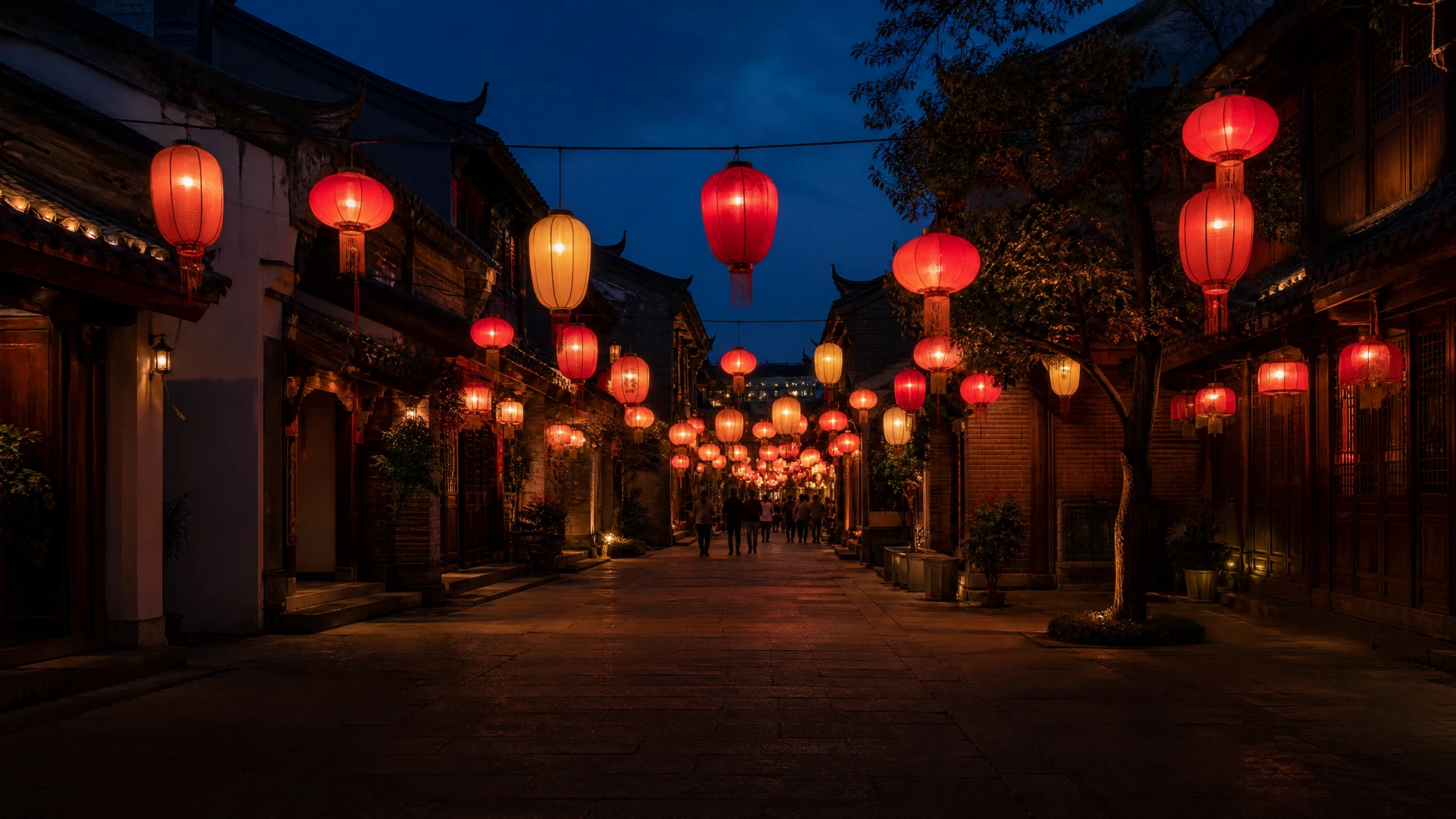
The Lantern Festival begins with a change in the quality of the evening. The day has ended, but the streets have not. A paper lantern gathers a small warm pool around itself; another answers from a doorway, then a line of them carries the eye farther than the daylight could. The festival, also known as Yuanxiao, arrives on the fifteenth day of the first lunar month, at the first full moon of the lunar year. It is often described as the closing celebration of the Lunar New Year period, but that description only gives its place on a calendar. The experience is less like an ending than a gathering of the threads of the preceding days: family visits, food, public performances, wishes for a generous year, and the patient work of making a neighbourhood luminous.
It is tempting to see the lantern only as decoration. Yet it is also a made object with a job to do. Its frame must hold a shape without becoming heavy. Its covering has to diffuse light rather than smother it. Its colour, pattern, scale, and hanging place can change the rhythm of a lane or a courtyard. A small lantern carried by hand produces one kind of intimacy; a large public installation makes a different kind of room. Across places and families, forms and customs vary. That variation matters. A festival is not a single fixed scene replayed everywhere, but a living collection of local choices, skills, stories, and people deciding how to welcome one another after dark.
The first full moon gives the night a second source of light. Lanterns do not compete with it so much as bring it down to street level. They make a route visible, mark a meeting point, and give children and elders a shared reason to look upward. The effect is practical as well as poetic. Evening streets are easier to move through when doors, thresholds, stalls, and paths are gently lit. The festival turns this ordinary need into an occasion for artistry. A lantern can be as spare as a round shade around a candle-like bulb or as elaborate as a sculptural figure assembled from many parts. What joins these forms is not spectacle alone but attention to how light travels through a material made by hand.
Riddles are one of the festival’s most playful ways of slowing a crowd down. A question fastened to a lantern invites a reader to stop, puzzle over a phrase, and ask someone nearby for help. The answer is not always the central point. The pause is. A riddle creates a small public conversation between strangers or relatives who might otherwise pass each other in silence. It asks for language, memory, and a willingness to be wrong in company. In an age when many screens reward an instant response, the lantern riddle feels quietly radical. It gives the mind a problem with no urgency and makes the solution more enjoyable when it is shared.
Food gives the celebration another shape. Tangyuan, the rounded glutinous rice balls often eaten during the festival, are associated with togetherness and family unity. Their form is part of their meaning: roundness is an image of completeness, and a bowl placed in the middle of a table encourages a pace of eating that is communal rather than hurried. Recipes, fillings, and names may differ across regions and households, which is one reason the dish resists becoming a single universal symbol. What remains recognisable is the gesture of serving something warm and round at a moment of reunion. The bowl is modest, but it holds a larger idea: that a new year is best met by making room for one another.
The craft behind a lantern can be almost invisible once the evening begins. A viewer notices the glow, then the colour, then the silhouette. The maker has already solved a series of quieter questions: where the joints should sit, how taut the covering should be, whether a hanging point can take the weight, and how a curve will read after the sun has gone down. Bamboo, wire, wood, paper, fabric, and modern lighting systems all ask for different kinds of knowledge. The best craft does not need to announce its difficulty. It lets the lantern appear easy, even while the maker has balanced strength, translucency, and proportion so carefully that the object seems to float.
Public festivals make this work visible at a larger scale. Streets, parks, temples, community halls, and cultural centres can become temporary galleries in which light is the medium. In some places, dragon and lion dances, music, processions, and performances draw people into the same moving field of attention. In others, the pleasure lies in a slower circuit of lanterns, food stalls, familiar faces, and small conversations. No single description can contain all these settings. The useful way to approach the festival is with curiosity rather than a checklist: notice what the local hosts have chosen to emphasise, learn the name of a form before assuming its meaning, and remember that visitors are stepping into a community practice rather than a stage set built only for them.
There is a particular generosity in a lantern-lit public space. Its light is not private like a bedside lamp, nor strictly functional like a streetlight. It belongs to whoever passes beneath it. That shared quality helps explain why lantern festivals travel so readily across cities and communities. Contemporary exhibitions may use steel frames, programmable LEDs, and monumental scale, while family celebrations may rely on paper, string, and a familiar table. These are not interchangeable experiences, but both depend on an old insight: light can organise a crowd without commanding it. It can invite movement, encourage looking, and make a public place feel briefly more hospitable.
For a visitor, the most respectful approach is also the simplest. Arrive with enough time to move slowly. Read event guidance from local organisers rather than assuming that every lantern display follows the same customs. Ask before photographing close-up performers, craftspeople, or families. Notice whether a place is being used for worship, ceremony, performance, or open public gathering, and follow the cues of the hosts. If food is offered, let the menu be a beginning for conversation rather than a prop. These small choices are not rules designed to drain pleasure from an evening. They are what allow pleasure to be reciprocal: the visitor receives a richer experience and the event remains welcoming for the people whose traditions make it possible.
The Lantern Festival also carries knowledge forward. Decorative skills, ballads, family recipes, stories, and performance practices are learned by watching, doing, and repeating. A child might first carry a simple lantern, then help attach a tassel, then learn why a riddle matters, then eventually teach someone else. That transmission is not always formal, and it does not need to be. It is often folded into the ordinary work of preparing for a celebration: clearing a table, testing a light, tying a knot, stirring a pot, greeting an aunt at the door. Culture survives most convincingly when it is not treated as distant display, but as a habit of making and sharing time.
At its centre, the festival asks people to pay attention to a night that could otherwise pass unnoticed. The full moon will rise whether or not anyone gathers beneath it. A lantern changes the terms of that rising. It says this light is worth meeting; this street is worth walking; this question is worth thinking about; this bowl is worth passing around. That is why the lantern’s glow continues to feel fresh even when the form is old. It does not preserve the past by freezing it. It preserves a way of being together: making a little light, carrying it carefully, and giving someone else a reason to stop beside you.
The most memorable lanterns are rarely the ones that merely look expensive. They are the ones that alter the scale of attention. A small red globe under an eave can make a threshold feel generous. A row of lanterns can turn an unfamiliar lane into a place one wants to explore. A complicated frame covered in silk can hold a crowd at a distance long enough for silence to become part of the event. In each case, the light is temporary. The lanterns will be lowered, the dishes cleared, the riddles solved or forgotten. Their impermanence is part of their power. They make the evening precious precisely because it cannot be kept.
When the night is over, the festival leaves a quieter kind of afterimage. It may be the memory of a bright answer arriving to a riddle, the scent of warm broth, a careful join in a paper frame, or the sight of a relative turning toward a lantern-lit path. None of these requires a grand interpretation. Together they suggest a simple measure of cultural life: a tradition remains alive when it gives people something to do with one another now. The Lantern Festival is not a distant picture of light. It is a practice of making a shared evening—one crafted object, one question, one bowl, and one full moon at a time.