Arts
The Line Begins in Bamboo: Making a Calligraphy Pen
A handmade bamboo pen turns the first mark into a small act of toolmaking: choose a straight hollow stem, give its tip a patient edge, and let the character of the line teach you what the tool can do.
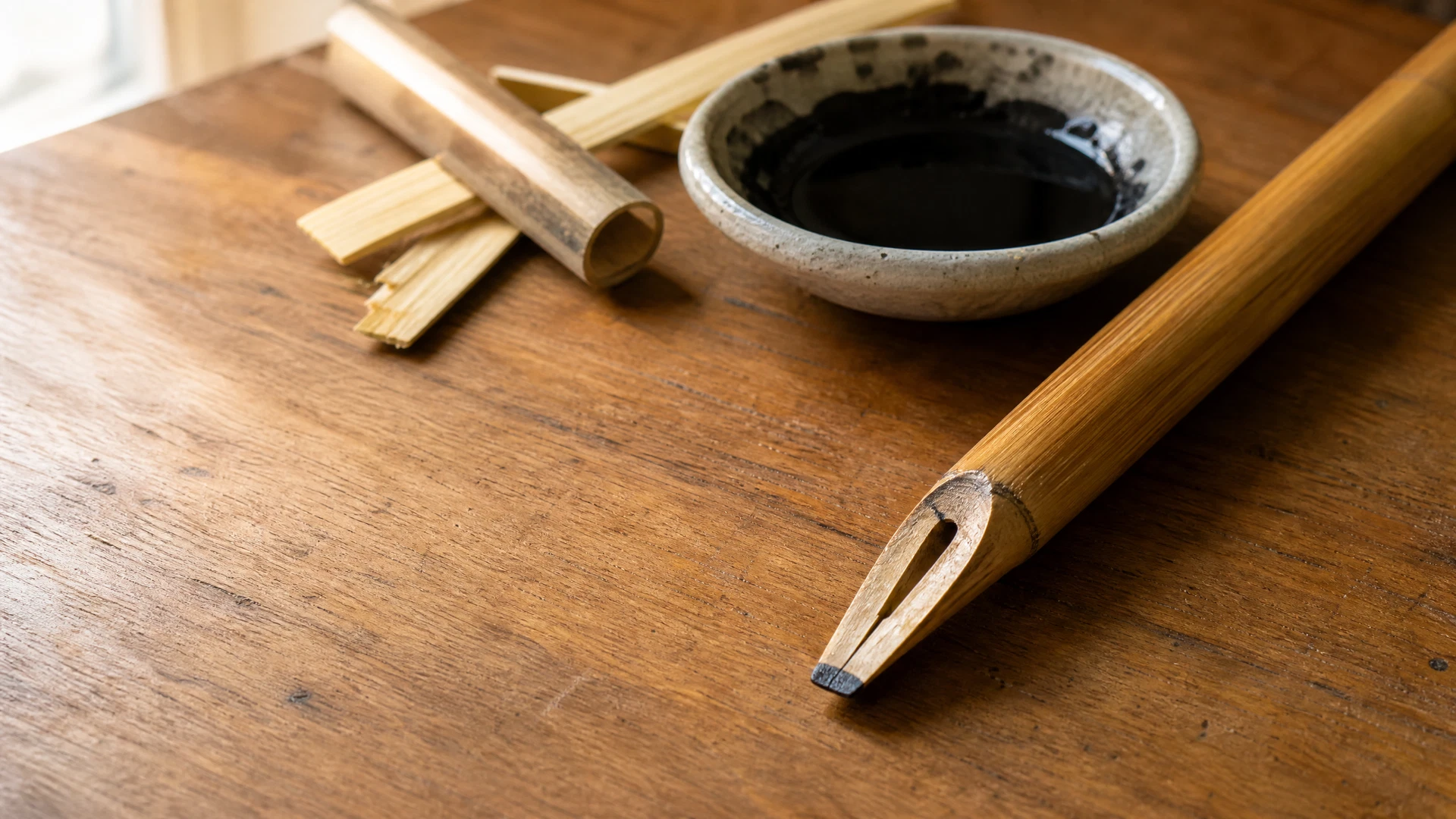
Before a handmade pen makes a word, it makes a decision. It asks the maker to notice a small length of bamboo not as a garden stake or a scrap, but as a hollow tube with grain, spring, and a possible edge hidden inside it. That change of attention is the pleasure of the project. A purchased nib arrives finished, balanced by someone else’s choices. A hand-cut pen begins with a question: do you want a broad, calm stroke, a brisk scratch, a line that skips, or a mark that darkens as it slows? There is no universal answer. A bamboo pen is modest enough to make in an afternoon, but responsive enough to keep changing the conversation long after the first test sheet is dry.
For a first pen, look for a straight section of firm, hollow bamboo or a similarly sturdy reed. The material needs a clean wall around its hollow centre; a soft or crushed stem is more likely to split than to write. A length roughly as long as an ordinary pen is comfortable, though the exact measurement matters less than balance in the hand. The diameter sets the scale of the nib: a narrower stem can make a delicate edge, while a broader one invites a more generous mark. Avoid material that is visibly cracked, mouldy, or fibrous at the cut end. Choosing well is not ceremony; it is the easiest way to make the later cuts feel calm rather than corrective.
Set up the work before making the first cut. A clear bench, a cutting mat or scrap board, good light, and a small tray for offcuts make the task easier to control. A sharp knife, fine saw, or pruning shears can all injure a distracted hand, so the workpiece should be supported on the bench rather than held in the air. Keep every cutting stroke moving away from fingers and away from the body. Eye protection is sensible when material may splinter. If the tools feel unfamiliar, a pre-cut bamboo pen or a session with an experienced maker is a better beginning than improvising. The ambition here is not bravado; it is a working edge and an unhurried hand.
Start by trimming the bamboo to a comfortable length and inspecting the end grain. Then make a long, shallow bevel at one end. The aim is to expose an angled plane, not to force a sharp point immediately. Several light paring cuts reveal more about the material than one dramatic cut: you can see whether the wall is even, where the fibres run, and how much thickness is available for the future nib. Rotate the tube between cuts and keep returning it to the board. The beginning can look blunt and unpromising. That is normal. The graceful part of the tool appears only after the maker has gradually removed enough material for the tip to become thin and flexible.
With the bevel established, thin the upper and lower faces toward the point. Work symmetrically, taking away small curls from one side and then the other, so the nib does not twist to one side. A bamboo pen does not need to mimic a metal nib; its strength is its slightly blunt, living edge. What matters is that the final writing area is even enough to meet the paper without catching. Pause often and look across the tip rather than only down at it. If one shoulder is much thicker, the mark will lean. If the whole tip is paper-thin, it may buckle. The useful middle is discovered by looking, testing, and making one more tiny adjustment.
The slit is the feature that turns a shaped stick into a pen. It creates two small halves at the tip and gives ink a path toward the paper. Make it from the centre of the nib toward the tube with a controlled, short cut, using the bench to steady the bamboo. There is no prize for a long split; a small, clean slit is easier to manage and less likely to travel up the stem. If the bamboo begins to tear or the cut feels resistant, stop rather than forcing it. A new blank costs little, and a calm restart is part of learning. The best tools in a studio are often the ones that quietly teach when to pause.
Now trim the writing edge. A square, narrow chisel edge will make broad vertical strokes and finer sideways movements; a slightly angled edge changes the rhythm again. Rather than seeking a mathematically perfect shape, decide what kind of line you want to explore. Cut very little at a time, then hold the nib against the light. Both corners should meet the same plane, with the slit centred between them. A rough corner can snag paper, so a gentle smoothing pass with fine abrasive paper may help. Keep the pressure light. The purpose is not to polish the bamboo into invisibility, but to remove the accidental splinters that interrupt a deliberate mark.
Testing is where the pen becomes honest. Pour a small amount of water-based drawing ink into a stable, shallow dish, dip only the tip, and touch it to inexpensive paper. Begin with lines, slow curves, dots, and small blocks of tone rather than letters you feel attached to. Watch how the ink leaves the nib. A dry, broken stroke may mean the slit is too tight, the paper is too absorbent, or the pen simply needs another dip. A broad puddle can mean too much ink has been loaded. Turn the pen a fraction, change the angle, and notice the effect. The handmade tool is not offering a single correct result; it is offering feedback.
A bamboo pen typically carries less ink than a conventional dip nib, and that limitation gives it a particular voice. The first stroke may be dark and full; the later strokes can become pale, scratchy, or unexpectedly textured. Instead of treating this fade as a failure, try making a row of marks from wet to dry. It is a quick study in pressure, speed, and surface. Rough paper can catch the edge and emphasize a broken line, while smoother paper lets the nib glide and reveals subtle shifts in width. Keep a few small samples beside the bench. They become a practical library of what this particular pen does with this particular ink and paper.
Some makers add a small reservoir cut or drilled just behind the slit. It can extend the pen’s working time, but it is optional, and it brings another sharp or powered tool into the process. For a first pen, repeated dipping is simpler and often more instructive. It slows the hand down and makes the arrival of fresh ink visible. If you later choose to add a reservoir, secure the work on the bench, use the appropriate tool for the material, and keep the hole modest. A reservoir is a convenience, not a measure of seriousness. The fundamental achievement remains a clean edge that places a line where your hand intends.
Care is beautifully straightforward. Rinse a water-based ink from the nib after use, wipe the bamboo dry, and allow it to air-dry away from direct heat. Do not leave the pen standing in a jar of water; prolonged soaking can soften the edge and invite cracks. When the tip starts to feel furry or unreliable, return to the board and refresh it with one or two careful cuts. A handmade pen is not a precious object that must remain unchanged. It is a tool designed to be renewed. The softest ritual in the process is this maintenance: a few minutes of attention returning a tired point to usefulness.
Making several pens from the same bundle of bamboo is more revealing than trying to make one perfect specimen. Cut one broad, one narrow, one with a square edge, one with a slightly oblique edge. Label the samples by shape rather than by verdict. You may discover that the supposedly imperfect pen makes the most interesting rhythm, or that a blunt edge is better for drawing than lettering. This is why the project belongs as much to looking as to writing. The maker learns to see the relationship between a fraction of a millimetre at the nib and the character of a whole page.
The finished pen will never be neutral. It will carry the evidence of the stem you chose, the small asymmetries of your cuts, the paper beneath it, and the moment you decide to dip again. That is its quiet appeal. In a drawer of standardized tools, a handmade bamboo pen insists that making and marking are related acts. It does not promise flawless calligraphy. It offers something better for a beginner or an experienced hand in need of a reset: a direct, repeatable way to discover how a line begins. First in the hollow stalk, then at the edge, and finally in the small interval where ink meets paper.