Arts
The Stone That Refuses Hurry: How Jade Is Worked
A reflective journey into the heart of jade carving, exploring the patient attrition and cultural reverence required to transform raw stone into an eternal, shimmering legacy.
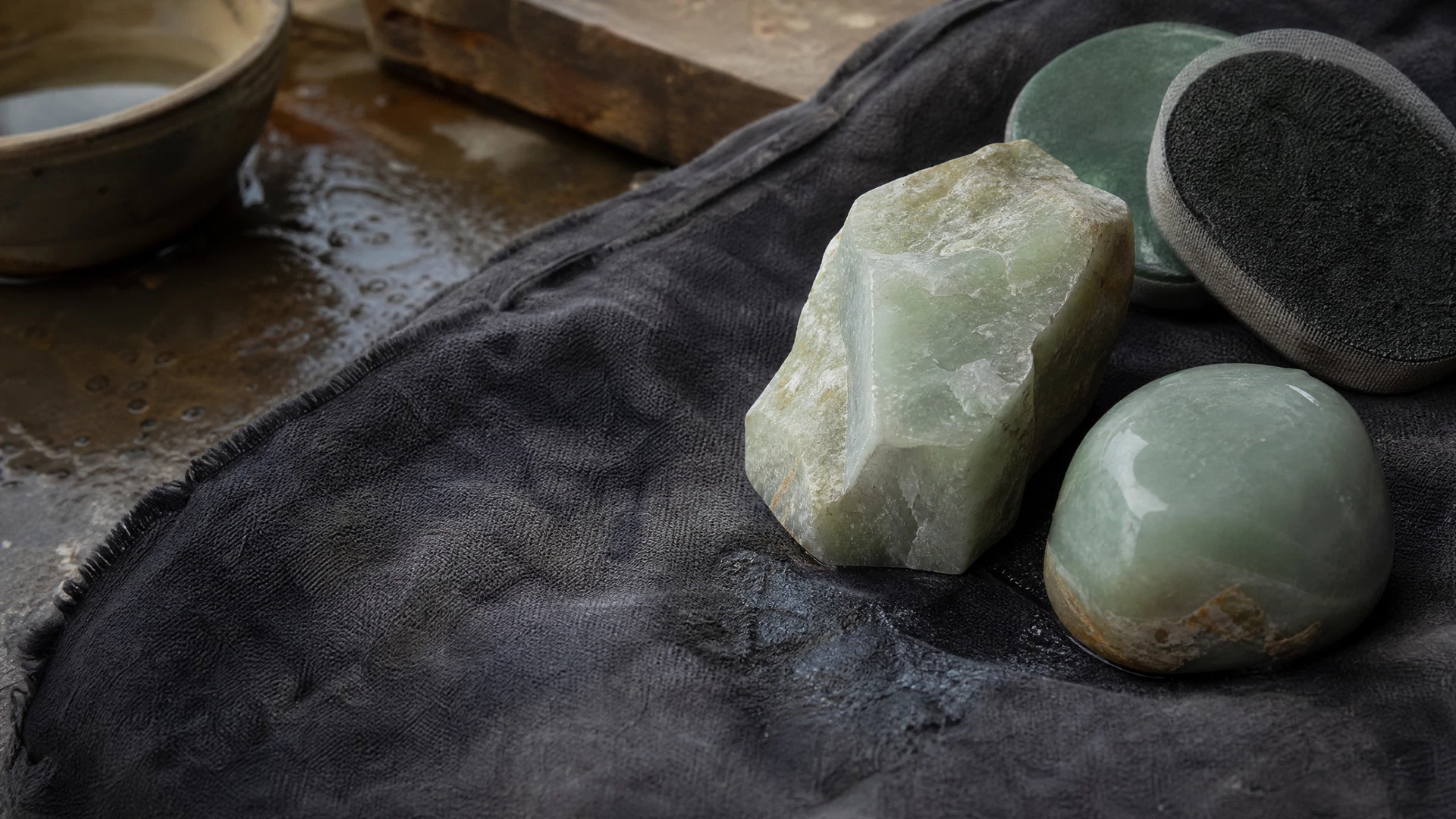
To hold raw jade is to grasp a fragment of deep time, a material that survived the slow, crushing weight of tectonic shifts to emerge with a stubborn dignity. Unlike brittle diamonds or soft soapstone, jade possesses an internal resilience called toughness. It does not yield to the chisel; instead, it demands a process of attrition, a slow wearing away that mirrors the geological forces that forged it. The carver who approaches jade with haste finds only frustration, for this stone refuses to be hurried. It requires a specific temperament, a willingness to enter a long dialogue where the stone often has the final word. The resulting object is a record of patient friction, a testament to a human life briefly intersecting with the eternal.
"Jade" encompasses two distinct minerals: nephrite and jadeite. Nephrite, the stone of ancient China and the Maori, is a silicate of calcium and magnesium characterized by an interlocking, felt-like fibrous structure. This internal weave makes it incredibly difficult to fracture, a legendary toughness used for tools long before it became a medium for art. Jadeite is a silicate of sodium and aluminum with a granular, crystalline structure. Harder than nephrite, it is slightly more prone to chipping. A carver must understand these microscopic differences before the first tool is laid, for the stone’s response to abrasion depends entirely on whether one is working the dense, oily fibers of nephrite or the bright, glassy grains of jadeite.
The process begins with an act of intense observation known as "reading the stone." Rough jade often arrives encased in a weathered rind, a deceptive exterior hiding the treasures within. A carver might cut a "window" to peek at color and clarity, but the interior remains a mystery. One must look for the subtle flow of color, internal fractures, and the "water" or translucency of the material. It is a moment of profound possibility; the rough block holds a thousand potential forms, but the carver must find the one that the stone’s internal geography will permit. This stage is a humble mapping of the stone’s soul, identifying where light will live and shadows will gather.
Once read, the planning phase requires the carver to see through the opaque mass. Jade carving is a process of revelation; the artist paints the design directly onto the stone, adjusting lines to bypass a hidden flaw or to highlight a vibrant vein. There is a profound cultural specificity to these designs, from the fluid lines of a Chinese dragon to the organic curves of the Maori koru. Regardless of the tradition, the design must be structurally sound, for the toughness that makes jade beautiful also makes it unforgiving of errors that might lead to a catastrophic break. It is a conversation between the artist’s intent and the stone’s limits, where the material dictates the final form.
The transition to reality begins with the first cut, a moment both violent and reverent. Historically done with weighted saws and abrasive sand, the physics remain the same today: it is an act of grinding. The blade does not slice; instead, microscopic particles of the abrasive wear away the surface one layer at a time. The carver must feel the resistance of the stone through the tool, listening for the specific hum of a clean cut. There is no room for error; once the stone is removed, it cannot be replaced. The weight of the material and the spray of coolant create a sensory experience both physically demanding and deeply meditative, marking the start of a long journey.
Jade is too tough for steel; it is conquered only by something harder than itself. Historically, this meant using quartz sand or crushed garnets applied with bamboo or wooden tools. Modern carvers use diamond-impregnated tools, but the fundamental principle of "rubbing the stone" remains. It is a process of gradual refinement, moving from coarse abrasives that remove bulk to increasingly fine grits that begin to reveal the stone’s true character. This slow attrition gives jade its characteristic soft edges and flowing forms, a quality that cannot be achieved through rapid cutting. This stage is the heart of the craft, where the rough shape is coaxed into a refined form through millions of tiny, controlled scratches.
As the form emerges, the carver enters a state of rhythmic repetition. The work is loud and wet, yet within that chaos lies a profound stillness. A constant flow of water is essential to keep the stone cool and carry away the fine slurry of stone dust that would otherwise clog tools and obscure the artist’s vision. There is a physical toll; hands become calloused and eyes must remain focused through the constant spray. Yet, there is a deep satisfaction in seeing the light begin to penetrate the stone, turning a dull mass into something that glows from within. The carver must balance tool pressure against the stone’s resistance, a dance where too much force shatters and too little stalls progress.
Drilling and internal carving represent the most precarious stages. To create a hollow vessel or a delicate chain, the carver must bore into the heart of the stone with preternatural patience. The drill bit must be constantly lubricated, as the heat generated in a confined space can easily shatter a piece that has already seen hundreds of hours of labor. These internal spaces represent the "breath" or the "void" within the object, a concept central to many carving traditions. The carver must visualize the thickness of the walls from the inside out, often working by feel. It is a test of nerves, where a slight lapse in concentration results in the heartbreaking sound of stone cracking under internal stress.
The cultural context of jade carving is as varied as the stone, yet a thread of reverence runs through every tradition. In China, the "Stone of Heaven" embodied virtues like benevolence and integrity, serving as a moral compass for the soul. In the Mesoamerican world, jade was synonymous with life-giving water and the breath of life, often placed in the mouths of the dead to ensure safe passage. For the Maori, pounamu is a sacred material, each piece carrying the mana of ancestors and the history of the land. To carve jade is to step into this long lineage of meaning, contributing one’s own labor to a global history of veneration that spans millennia.
Safety is a silent partner, protecting the carver from the material they seek to master. The primary danger is the dust; grinding jade releases microscopic particles that can cause severe respiratory issues if inhaled over time. A responsible carver always works with a constant stream of water to suppress this dust, ensuring the workshop remains a place of creation. Eye protection is equally vital, as high-speed tools can send fragments of stone or stray abrasive grains flying. The physical environment must be managed with proper ventilation and ergonomic setups to mitigate the strain of long hours. These practices are the essential framework that allows the artist to continue their dialogue with the stone for a lifetime of work.
Polishing is the final refinement, a stage that can take as long as the carving itself. It is not merely about shine; it is about revealing the depth of color and the quality of luster. The carver moves through increasingly fine abrasives—ending with powders so fine they feel like flour—using leather, wood, or felt buffs to work the surface. Nephrite responds with a soft, waxy, or "greasy" luster that feels warm to the touch, while jadeite can be brought to a high, glassy shine with sharp brilliance. This is the moment when the stone truly wakes up. The scratches of the carving process disappear, replaced by a surface so smooth it seems to have been formed by water rather than human tools.
Ultimately, jade carving is a lesson in the virtue of patience. In a world that prizes speed, the stone demands the opposite. It forces the carver to slow down, to breathe with the rhythm of the wheel, and to accept that some things simply cannot be rushed. There is a specific "stone-time" where the hours disappear into the friction of the abrasive. The stone does not care about deadlines; it only cares about the quality of the attention paid to it. This patience is an active, focused engagement, a willingness to repeat a movement a thousand times until the desired curve is achieved. It is this quality of slow, deliberate labor that gives a finished jade object its peculiar weight and presence.
When the work is finally done, the resulting object possesses a sense of permanence that few other materials can match. A finished jade carving will outlast its creator, its owner, and perhaps the culture that produced it. It remains cool to the touch, a dense reminder of the earth’s deep history and the human hand’s ability to shape it. The wistfulness lies in the realization that the artist is a temporary steward, a brief visitor in the stone’s multi-million-year journey. Yet, in that intersection, something new is born—a fusion of geological endurance and human imagination. To work jade is to accept one’s own transience while creating something eternal, a silent legacy that outlasts the sound of the grinding wheel.