Arts
The Long Thread: How Silk Becomes Cloth
From the silent hunger of the silkworm to the clatter of the loom, the journey of silk is a testament to the labor and biology that transform a single thread into cloth.
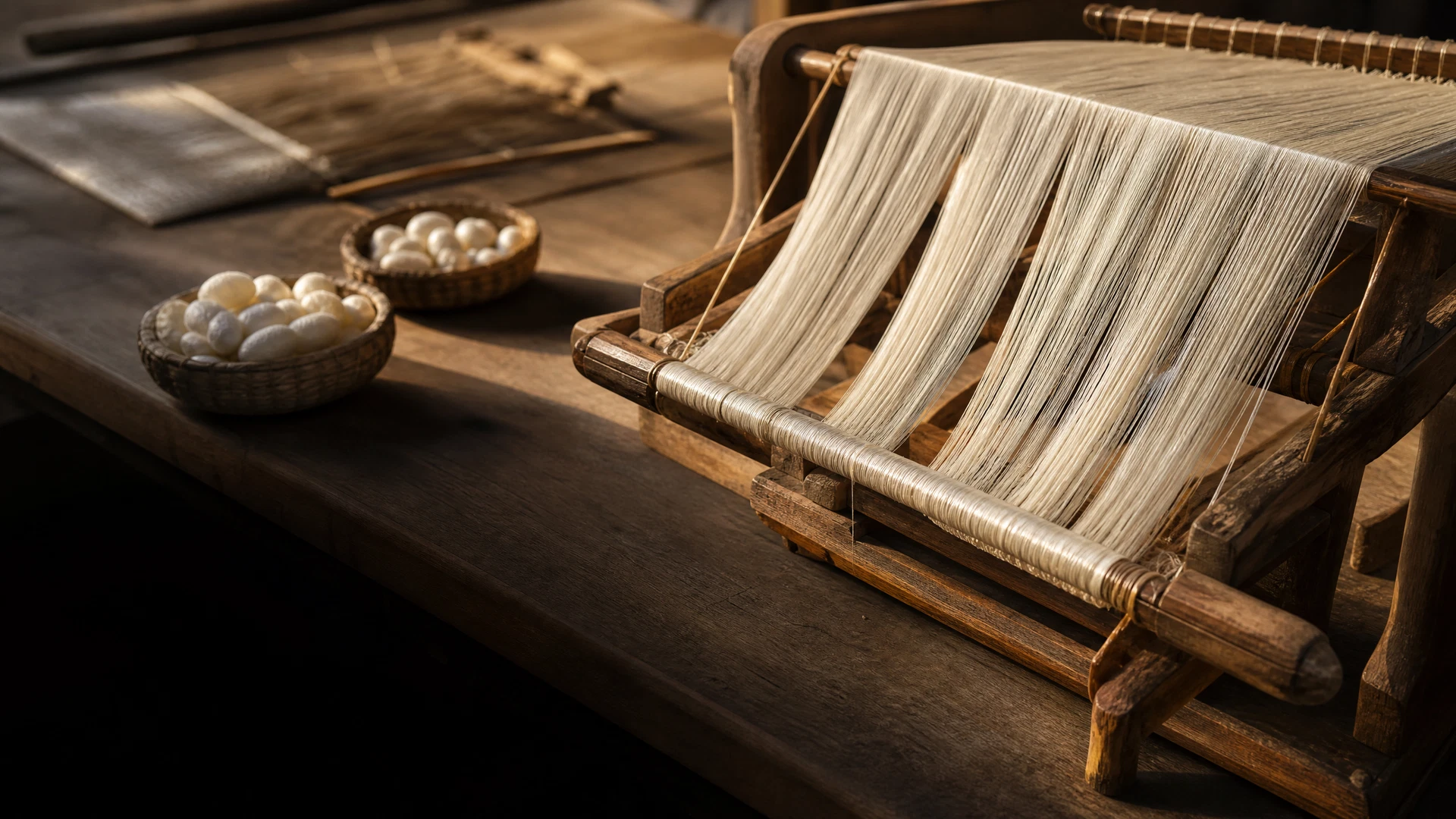
The journey of silk begins with a profound silence that masks one of nature’s most intensive transformations. It is a material defined by a paradox: the immense tensile strength of a protein filament produced by a creature so fragile that a sudden temperature shift or a contaminated leaf can end its contribution. To understand silk is to acknowledge the vast distance between the biological impulse of the silkworm and the shimmering complexity of a finished brocade. This long thread, often extending nearly a kilometer from a single cocoon, connects the practitioner to a lineage of labor. It is a craft of patience, where one must align their pace with the rhythmic life cycle of the Bombyx mori, recognizing that every yard of cloth is a ledger of labor and biological destiny.
At the heart of this process stands the White Mulberry, Morus alba, a tree whose leaves serve as the sole currency for the silk trade. The cultivation of these trees is the first act of care in a long chain of dependencies. In the high-density orchards of Zhejiang or the terraced groves of the Levant, the labor of harvesting is relentless; leaves must be picked at their nutritional peak, free from dew or dust, to satisfy the larvae. This is not merely agriculture but a form of stewardship, as the quality of the leaf directly dictates the luster and strength of the resulting fiber. The grower watches the weather, knowing that the tree’s resilience is the only thing standing between the silkworm and starvation.
Inside the rearing rooms, the atmosphere is thick with the sound of thousands of tiny jaws—a noise often compared to the falling of light rain on a thatched roof. The silkworm progresses through five distinct stages known as instars, shedding its skin each time it outgrows its current form. During these weeks, the labor shifts to a domestic scale, requiring constant feeding schedules. The worms are kept on large bamboo trays, which must be cleaned and refreshed with a regularity that borders on the ritualistic. There is a specific vulnerability to this stage; the creatures are sensitive to noise, strong odors, and smoke, demanding a level of environmental purity that reflects the high stakes of the harvest. It is a period of intense, quiet observation.
The transition from larva to architect occurs when the worm ceases to eat and begins to search for a place to anchor its final work. Within its body, large glands produce liquid fibroin, the structural protein of silk, while another secretes sericin, a gummy substance that acts as a natural adhesive. As the worm moves its head in a rhythmic figure-eight motion, it extrudes these proteins through a specialized organ called the spinneret. The liquid hardens instantly upon contact with the air, forming a twin-filament thread that is simultaneously flexible and remarkably strong. This biological engineering is a marvel of precision, as the worm manages the tension and flow of the silk to ensure the cocoon’s structural integrity. It is a solitary act of creation.
The resulting cocoon is a masterpiece of protective geometry. Over three to four days, the worm wraps itself in a single, continuous thread that can reach lengths of nine hundred meters. The architecture of the cocoon varies by breed and region; some are snowy white and oval, while others, particularly the wild varieties like India’s Tussar, possess a golden hue and a more textured surface. The density of the silk layers is not uniform, with the outermost "floss" being coarser than the fine, inner filaments. This stage represents the peak of the material’s biological potential, yet it is also the point where the human handler must make a decisive choice regarding the future of the thread.
To preserve the continuity of the silk, the natural cycle of the moth must be interrupted before it can emerge and break the filaments. This process, known as stifling, involves the application of heat—either through steaming or sun-drying—to ensure the pupa does not complete its transformation. It is a practical necessity that carries a heavy weight, highlighting the transactional nature of the craft where the life of the insect is traded for the integrity of the cloth. The cocoons are then sorted by size, color, and quality, with any damaged specimens set aside for lower-grade spinning. This sorting requires an experienced eye, as subtle differences in the cocoon’s weight or surface texture indicate the yield and quality of the silk.
Reeling, or filature, is the delicate act of unravelling the cocoon to recover the long, continuous thread. The cocoons are submerged in hot water to soften the sericin gum, a step that requires precise temperature control to avoid damaging the fibroin. The reeler uses a brush to find the elusive "eye" of the thread, the starting point of the nearly kilometer-long filament. Because a single silk strand is too fine to be used alone, several filaments—usually between three and ten—are drawn together and passed through a small guide. As they emerge, the cooling sericin causes the filaments to fuse into a single, cohesive yarn. This is a moment of intense focus, as the reeler must maintain a consistent thickness that will determine the final quality.
The methods of reeling reflect a wide spectrum of regional traditions, from the ancient hand-turned wheels of rural China to the high-speed automatic basins of modern factories. In India, the production of wild silks like Muga or Eri often involves a manual, decentralized approach, where natural variations in the fiber are celebrated rather than eliminated. Japanese techniques, by contrast, have historically emphasized extreme uniformity and specialized machinery to ensure a flawless finish. These variations are not merely technical choices but cultural expressions, reflecting different philosophies of labor and beauty. The distance between a hand-reeled thread and a machine-processed yarn is vast, representing two different ways of engaging with the material’s inherent limits and possibilities, a testament to the diversity of the silk tradition.
Once reeled, the silk yarn must be strengthened through throwing or twisting. Raw silk is naturally somewhat brittle, so the yarn is twisted to bind the filaments more tightly together. The direction and degree of the twist define the yarn’s character; "organzine" is a high-twist yarn used for the warp, providing the strength to withstand the tension of the loom, while "tram" is a lower-twist yarn used for the weft, offering a softer surface. This mechanical intervention is a crucial step in preparing the silk for the rigors of weaving, turning a delicate biological product into a durable material. The throwing mills of the past, with their clattering spindles and humid air, were the bridge between the quiet of the rearing room and the complexity of the weaving shed.
Dyeing is where the silk finds its voice, as the protein fibers possess a remarkable affinity for pigments. Unlike cotton or linen, silk absorbs color with a depth and luminosity that seems to emanate from within the fiber itself. The process involves submerging the yarn or the cloth in large vats of dye, where the temperature and pH must be managed to ensure an even take-up of color. Historically, this was a labor of local ecology, using madder for reds, indigo for blues, and weld for yellows, each requiring different chemical mordants to fix the hue. The dyer’s hands are often stained with the memory of their work, a physical testament to the chemical labor required to transform the pale silk into a vibrant palette.
Preparing the loom is the most intellectually demanding phase, requiring a complex architecture of threads known as the warp. Each individual silk yarn must be threaded through the heddles and the reed in a specific order to create the desired pattern. This warping process can take days for complex designs, representing a significant investment of time before weaving begins. The weaver must calculate the tension of hundreds of threads, ensuring that the loom is balanced and ready for the rhythmic dance of the shuttle. It is a stage of profound anticipation, where the abstract design in the weaver’s mind begins to take physical form in the grid of the warp, a silent structure waiting for the introduction of the weft.
The act of weaving is the final synthesis of all the labor that has come before, a rhythmic interlacing of warp and weft that transforms yarn into cloth. Whether performed on a traditional draw-loom or a modern power-loom, the process requires a physical and mental coordination that is both exhausting and meditative. The shuttle flies across the shed, carrying the weft thread through the open warp, while the weaver beats the cloth to ensure a tight, even structure. This is where regional variations in pattern become most visible, from the intricate ikat of Uzbekistan to the heavy satins of Lyon. The weaver’s body becomes an extension of the machine, a vital link in the chain of production that turns the raw potential of the silk thread into a tangible reality.
When the finished cloth is finally removed from the loom, the distance it has traveled from the mulberry grove is immense. The shimmering surface, the cool touch, and the elegant drape are all echoes of the silkworm’s brief life and the reeler’s steady hand. Silk remains a material that resists total mechanization, always requiring a degree of human judgment to manage its inherent variability. It is a testament to the persistence of craft in an age of disposable goods, a long thread that connects the modern wearer to a lineage of labor stretching back to the dawn of civilization. To wear silk is to carry the weight of this history, a reminder that the most luxurious of materials begins with the simplest of acts: the feeding of a worm on a bed of leaves.