Travel
The luminous stillness of Aitutaki: A journey through the South Pacific's premier almost atoll
In the heart of the Cook Islands, Aitutaki offers a rare geological transition where volcanic heights meet coral motus. This "almost atoll" invites travelers to explore a vast, turquoise lagoon while honoring traditional marine reserves that preserve the delicate balance of this island paradise.
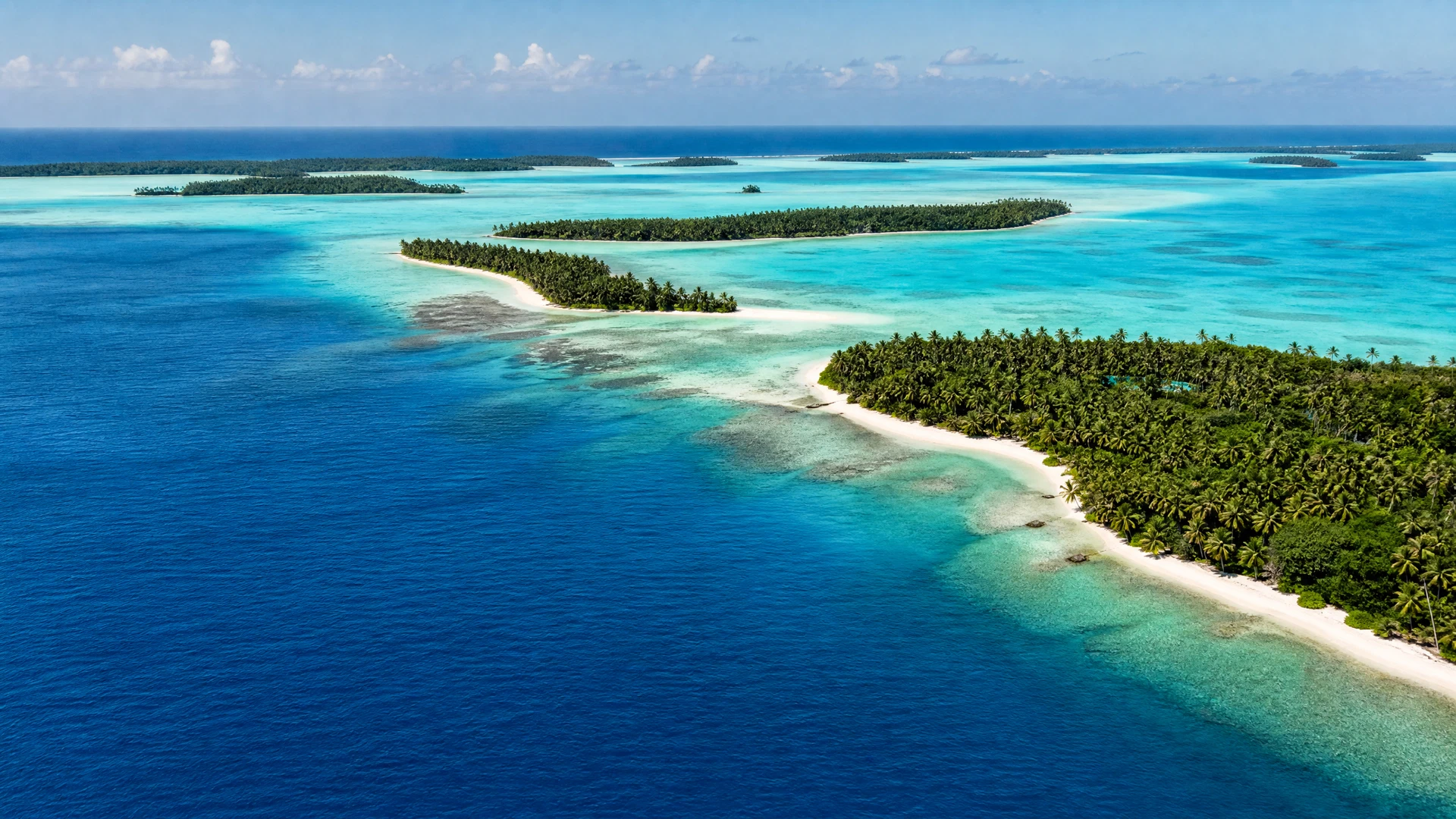
The descent into Aitutaki is a masterclass in the spectrum of blue. From the window of a small prop plane, the ocean transitions from a deep, bruised indigo to a translucent, neon turquoise that seems lit from beneath. This is the first glimpse of the "almost atoll," a rare geological formation where a volcanic peak still rises from the center of a developing coral ring. Unlike a true atoll, where the central island has completely submerged, Aitutaki retains its emerald heights, providing a dramatic contrast to the fifteen low-lying coral motus that necklace its fifty-square-kilometer lagoon. It is a place where the earth is still caught in a slow-motion transformation, suspended between the fire of its volcanic past and the quiet persistence of the reef.
To understand the scale of this landscape, one must first climb Maungapu. At 124 meters, it is the highest point on the main island, a modest height that nonetheless commands a staggering perspective. The trail winds through dense tropical foliage before opening onto a summit that offers a 360-degree panorama of the surrounding reef system. From here, the lagoon looks like a giant, spilled palette of watercolors, with the white sandbanks of the motus acting as dividers between the shallow flats and the deeper channels. The distant roar of the Pacific breaking against the outer reef serves as a constant, rhythmic reminder of the island’s isolation, a solitary emerald set in the vastness of the South Seas.
Descending from the heights, the life of the island shifts toward the water. The lagoon is not merely a scenic backdrop but the very heart of the community, a liquid playground that covers more area than the land itself. Navigating these waters requires a shift in tempo; the shallow depths and hidden coral heads demand a slow, observant pace. Local boatmen guide visitors through the labyrinth of turquoise, pointing out the subtle changes in water color that indicate depth or the presence of giant clams. There is a profound stillness here, interrupted only by the splash of a paddle or the occasional cry of a nesting seabird on a distant islet, creating an atmosphere of deep, meditative solitude.
One of the most iconic stops within this watery expanse is Tapuaetai, known more commonly as One Foot Island. This small motu is the quintessential South Pacific dream, a teardrop of white sand and coconut palms surrounded by gin-clear water. Yet, it holds a curious distinction: it is home to what is widely considered the world’s smallest post office. Travelers often bring their passports here to receive a unique stamp, a whimsical reminder of their journey to one of the most remote corners of the globe. Walking the perimeter of the island takes only minutes, but the sensation of being at the edge of the world lingers long after the boat departs.
However, the beauty of Aitutaki is not something to be taken for granted. The island’s ecological health is protected by the RAUI 2025 traditional marine reserves, a modern implementation of an ancient Polynesian custom. These designated no-take zones at Maina, Akaiami, and Ootu Beach are essential for the long-term regeneration of the reef’s biodiversity. Visitors are expected to strictly respect these boundaries, which allow fish populations to thrive and coral systems to recover from environmental pressures. This stewardship is a central part of the Aitutaki experience, a reminder that the privilege of visiting such a pristine environment comes with a collective responsibility to ensure its survival for future generations.
The motus themselves, such as Akaiami and Maina, offer distinct characters for those willing to explore. Akaiami was once a stopover for the legendary Coral Route flying boats in the 1950s, and a sense of that golden age of travel still clings to its shores. Today, it is a place of quiet reflection, where the only tracks in the sand belong to crabs or the occasional traveler seeking a moment of total disconnection. Maina, at the southwestern edge of the lagoon, provides a front-row seat to the power of the open ocean, where the reef protects the calm interior from the crashing waves of the Pacific. Each islet is a miniature ecosystem, a fragile outpost of life that demands a gentle footprint and an observant eye.
Practicality on Aitutaki is defined by the rhythm of the tides and the availability of local knowledge. While the main island offers small villages and a handful of cafes, the true essence of the trip is found in the logistics of the lagoon. Engaging with local guides who understand the nuances of the RAUI reserves and the seasonal migrations of marine life is not just a matter of convenience, but a way to support the local economy and gain a deeper understanding of the island’s heritage. Whether it is learning about the traditional methods of weaving or the specific types of coral that form the reef, the interactions here are grounded in a genuine pride for the land and sea.
As the sun begins to set, the lagoon undergoes one final transformation. The turquoise fades into a soft, glowing lavender, and the volcanic silhouette of the main island darkens against a sky of orange and pink. There is a wistful quality to this hour, a realization that Aitutaki is a place of fleeting moments and enduring cycles. It is not a destination for those seeking high-octane thrills or manicured luxury, but for those who find value in the slow observation of the natural world. In the quiet transition from day to night, the "almost atoll" remains a steadfast guardian of the South Pacific’s wild, luminous heart, a sanctuary where time is measured by the tide rather than the clock.