Travel
The Golden Sands and Tidal Rhythms of New Zealand’s Smallest National Park
Nestled at the northern tip of the South Island, Abel Tasman National Park offers a luminous intersection of native forest and turquoise sea. This coastal sanctuary, defined by its golden granite sands and ancient Māori heritage, invites travelers to move in harmony with the shifting tides of the Awaroa Inlet.
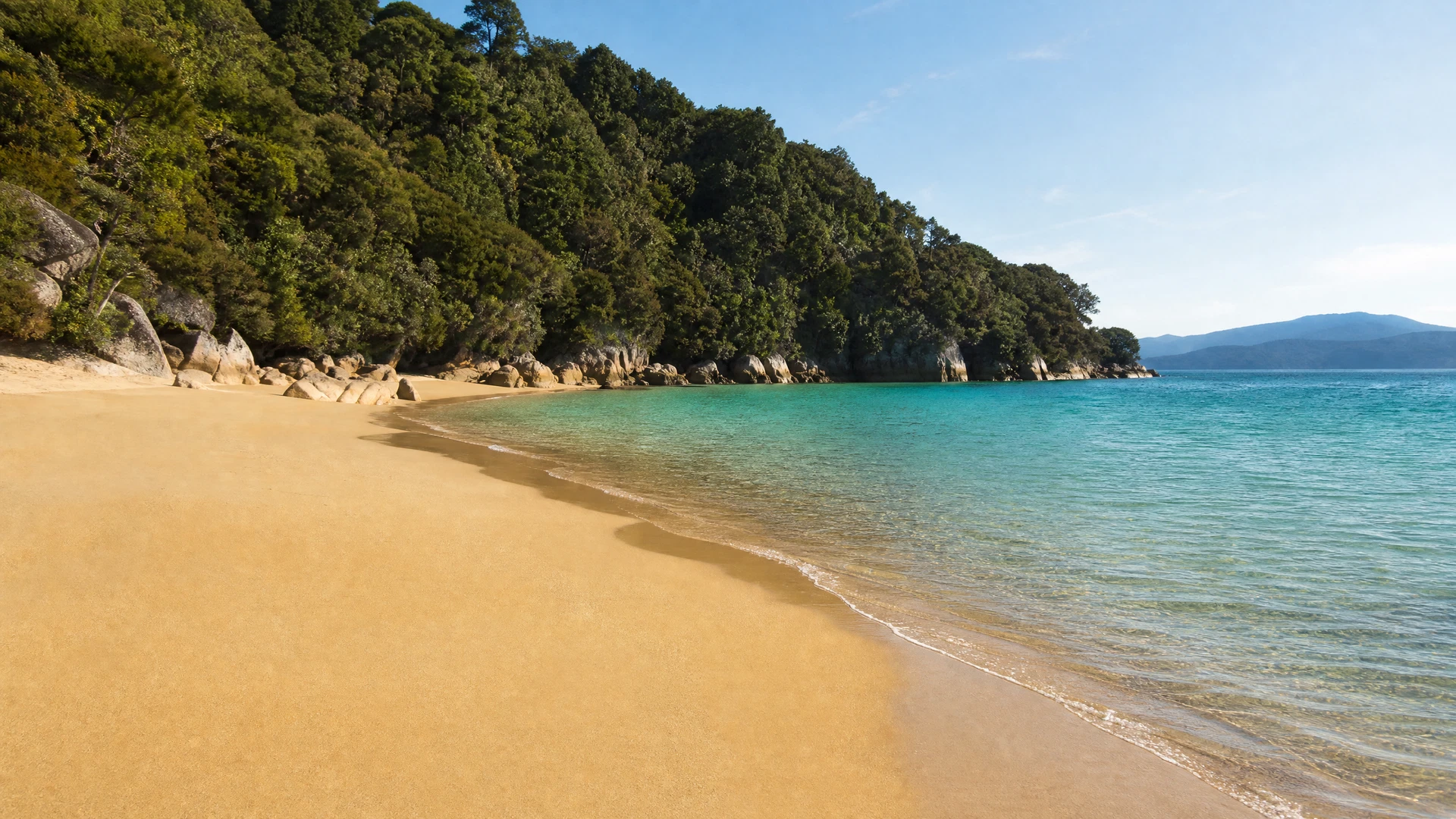
The first encounter with Abel Tasman National Park is less a visual discovery and more a tactile one. It begins with the fine, yielding texture of golden granite sand beneath the soles of your feet, a warmth that seems to radiate from the earth itself. Here, on the northern edge of New Zealand’s South Island, the Tasman Bay stretches out in a gradient of crystalline turquoise, its clarity revealing the undulating shadows of submerged reefs. The air carries the sharp, clean scent of salt spray mingled with the damp, earthy fragrance of the surrounding podocarp forest. It is a place where the boundary between the terrestrial and the maritime feels porous, a thin line of gold separating the deep green of the hills from the endless blue of the Pacific.
Though it is the smallest of New Zealand’s national parks, spanning just 22,530 hectares, the landscape possesses a deceptive vastness. Established in 1942 to mark the 300th anniversary of Dutch explorer Abel Tasman’s brief and fraught encounter with these shores in 1642, the park serves as a living monument to the passage of time. Tasman never actually set foot on the land, his ships lingering only long enough to record the jagged coastline before a violent misunderstanding with the local inhabitants forced a hasty departure. Today, the name remains a bridge between the European age of discovery and a land that had already been known and named for centuries by those who called it home.
Long before the Dutch masts appeared on the horizon, the coastal fringes were the domain of Māori who recognized the region’s bounty. For over five hundred years, the land supported seasonal camps and sophisticated kumara gardens, where the fertile soil and temperate climate allowed for the cultivation of sweet potatoes. Walking the trails today, one might pass over sites where archaeological remains—midden heaps and ancient terrace formations—lie silent beneath the leaf litter. These are not merely historical footnotes but reminders of a deep, continuous stewardship. The relationship between the Tangata Whenua and the granite cliffs is one of profound intimacy, rooted in a time when survival depended on the precise reading of the sea’s moods.
The geology of the park is dominated by its namesake granite, a resilient stone sculpted by millennia of wind and wave action. The cliffs rise abruptly from the water, their faces weathered into smooth, pale expanses or fractured into rugged outcrops where seabirds find purchase. This granite is the source of the park’s signature golden beaches; as the stone slowly erodes, it breaks down into coarse, glittering grains that reflect the Southern Hemisphere sun. Inland, the granite serves as the foundation for a lush canopy of beech and broadleaf trees, where the silver fern—the national emblem—unfurls its fronds in the dappled light of the understory.
Navigating the park is an exercise in choosing your own rhythm, whether by foot along the iconic Coast Track or by water in a sea kayak. The track winds through the forest, occasionally dipping down to sea level to cross a sun-drenched cove before climbing back into the hills for a panoramic view of the bay. From these heights, the water looks like a sheet of glass, occasionally broken by the playful arc of a fur seal or the wake of a passing boat. The experience is one of constant transition, shifting from the cool, shaded silence of the bush to the bright, exposed energy of the shoreline in a matter of minutes.
Perhaps the most distinctive feature of a journey through Abel Tasman is the necessity of consulting the tide charts. The Awaroa Inlet, a vast expanse of mudflats and shallow channels at high tide, becomes a passable land bridge only during a narrow window surrounding low tide. To cross is to participate in a mandatory pause, a temporal boundary set by the moon rather than the hiker. There is a quiet thrill in waiting for the water to recede, watching the ripples disappear to reveal a shimmering, wet floor of sand. It is a reminder that in this coastal wilderness, human schedules are secondary to the natural cycles of the earth.
The forest itself is a chorus of native birdlife, providing a soundtrack that is as much a part of the park as the scenery. The bellbird’s liquid notes and the tui’s complex, metallic calls echo through the canopy, while the inquisitive fantail often flits alongside hikers, hoping to catch insects stirred up by their footsteps. In the quieter corners of the park, the flightless weka can be seen foraging in the undergrowth, its bold demeanor a testament to the relative isolation of these protected lands. This biological diversity is a fragile inheritance, requiring constant vigilance to protect against invasive species and the pressures of modern travel.
As the journey concludes, usually at the southern gateway of Marahau or the northern end at Wainui, the transition back to the modern world feels abrupt. The silence of the forest is replaced by the hum of machinery, and the rhythm of the tides gives way to the ticking of the clock. But the memory of the golden sand remains, a physical sensation that lingers like a stowaway in your shoes. Abel Tasman National Park is more than just a destination; it is a reminder of the elegance of the natural world, a place where the smallest of spaces can hold the most profound of experiences, anchored by the steady, golden heartbeat of the New Zealand coast.