Travel
The Granite Cathedrals of Fiordland: Navigating the Primordial Silence of New Zealand’s Deep South
Amidst the ice-carved valleys and ancient temperate rainforests of Te Wahipounamu, Fiordland National Park offers a raw encounter with the Earth’s geological memory, where fourteen silent fiords and endangered flightless birds find sanctuary within a landscape defined by vertical peaks and torrential rain.
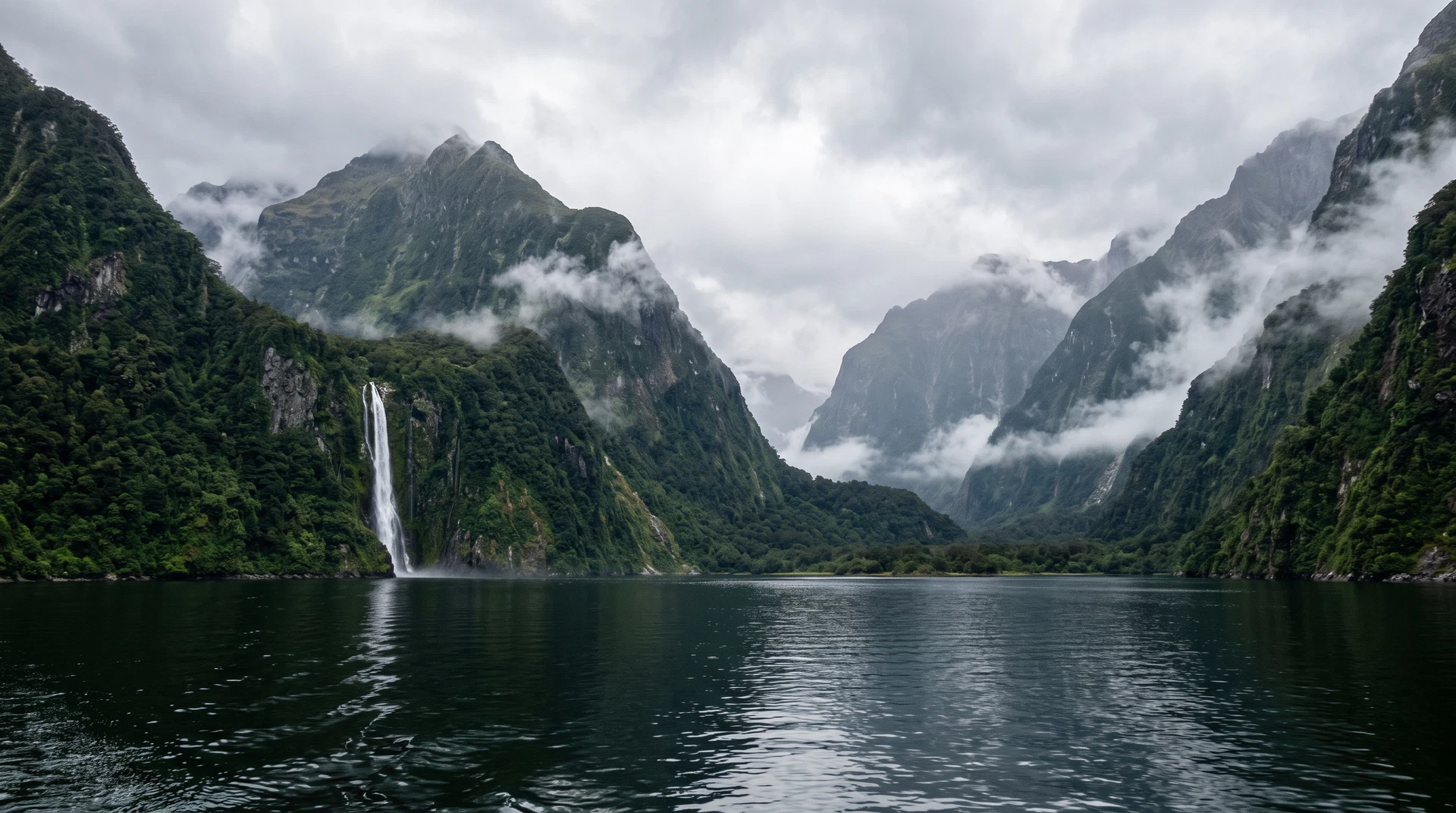
Fiordland National Park is a colossal, 1.26-million-hectare testament to the raw, unyielding power of geological time. Situated in the southwestern corner of New Zealand’s South Island, this vast wilderness forms the cornerstone of the Te Wahipounamu UNESCO World Heritage site. To enter Fiordland is to step into a realm where the modern world feels like a distant afterthought. The landscape is dominated by the sheer scale of its proportions, where mountains erupt toward the heavens in jagged, ice-scarred peaks of granite. It is a place where the air is heavy with the scent of damp earth and ancient wood, and where the silence is so profound it seems to have a weight of its own, broken only by the distant roar of a thousand waterfalls.
The park’s defining features are its fourteen fiords, carved by the slow movement of glaciers during successive ice ages. Among these, Piopiotahi, or Milford Sound, stands as the most iconic. Here, the granite walls of the mountains plunge vertically into the dark, tannin-stained waters of the sound, creating a dramatic corridor that leads toward the Tasman Sea. The scale is disorienting; what looks like a small trickle of water from a distance reveals itself to be a cascading torrent hundreds of feet high as you draw closer. The water itself is a phenomenon, with a permanent layer of fresh water floating atop the salt water, stained dark by the forest floor and creating a unique environment where deep-sea corals thrive in relatively shallow depths.
Further south lies Patea, or Doubtful Sound, a place of even greater solitude. Three times longer than Milford and with a surface area ten times larger, Doubtful Sound is often shrouded in a spectral mist that clings to the steep, forested slopes. The name "Doubtful" was bestowed by Captain Cook, who hesitated to enter the sound for fear that the prevailing winds would prevent his ship from ever leaving. Today, that sense of isolation remains palpable. Navigating its winding arms, one encounters the "Sound of Silence," a moment where engines are cut and the only noise is the rhythmic drip of water from the canopy and the occasional call of a distant bird.
The geological drama of Fiordland is not confined to its coastline. Deep within the interior lies Lake Hauroko, New Zealand’s deepest lake, which reaches down 462 metres into the earth’s crust. The lake is surrounded by dense forest and is steeped in Māori legend, serving as a reminder that this land has been revered for centuries. The water is cold and remarkably clear, reflecting the surrounding peaks with a clarity that is almost unsettling. To stand on its shores is to feel the immense pressure of the mountains that hem it in, a reminder that in Fiordland, the vertical dimension is just as significant as the horizontal. The lake is a remnant of the glacial forces that have sculpted this region over millions of years.
Fiordland’s ancient temperate rainforests are a living museum of Gondwanan flora, a lush ecosystem that has remained largely unchanged for millennia. These forests are dominated by silver beech and kamahi trees, their trunks draped in a thick carpet of mosses, liverworts, and ferns. It is a world of infinite greens, where every surface is a host for life. This dense canopy provides a vital sanctuary for some of New Zealand’s most endangered endemic species. The flightless takahē, once thought to be extinct, was rediscovered in the remote Murchison Mountains of Fiordland in 1948. The kākāpō, the world’s only flightless parrot, also finds refuge here, its nocturnal habits and moss-colored plumage making it a ghost of the forest.
Water is the lifeblood of Fiordland, arriving in quantities that are difficult for those from drier climates to comprehend. The region is one of the wettest on Earth, with some areas receiving over seven metres of rainfall annually. The rain here is a transformative force, turning the granite faces into a shimmering wall of temporary waterfalls that appear and disappear with the clouds. The rainfall fuels the lushness of the rainforest, but it also dictates the rhythm of life in the park. Sudden flooding is a constant possibility, and the tracks that wind through the valleys can become impassable torrents within hours. To travel here is to accept the dominance of the weather, to understand that the landscape you see today may be entirely hidden tomorrow.
The remoteness and environmental sensitivity of Fiordland necessitate a high degree of stewardship. Biosecurity protocols are strictly enforced to prevent the introduction of invasive species that could devastate the fragile ecosystem. Visitors are required to clean their gear and boots before entering, a small but vital act of protection for the native wildlife. The conditions are hazardous, and the park’s vastness means that help is often far away. Those who venture onto the Great Walks must be prepared for extreme weather changes and the physical demands of the terrain. It is a landscape that demands respect, offering its wonders only to those who are willing to approach it on its own terms.
Ultimately, the appeal of Fiordland lies in its ability to remind us of our own smallness. In a world that is increasingly mapped and managed, this corner of New Zealand remains stubbornly wild. It is a place where the geological past is present in every granite cliff and glacial valley, and where the silence of the fiords offers a rare opportunity for reflection. Whether viewed from the deck of a boat in the heart of Milford Sound or from a high mountain pass, the majesty of Fiordland is undeniable. It is a primordial wilderness that continues to endure, a profound expression of the rawest natural heritage our planet has to offer.